

The number of unique wallets engaging in peer-to-peer (P2P) stablecoin transactions in China experienced a staggering 43-fold expansion between the first quarter of 2024 and the second quarter of 2026, according to comprehensive new data from blockchain analytics firm Chainalysis. Despite Beijing maintaining stringent restrictions and outright bans on domestic cryptocurrency trading and mining, the digital asset economy within mainland China continues to find ways to adapt, pivot, and thrive through decentralized channels.
During the reporting period running from July 2025 to June 2026, Chainalysis recorded an impressive $104.1 billion distributed across 18.1 million separate transfers involving self-custodied stablecoin holdings in China. Furthermore, these stablecoin holdings turned over an average of 33.2 times per year. This velocity is more than three times the global average of 9.3 annual turnovers, highlighting a usage pattern that strongly indicates participants are utilizing stablecoins primarily as operational working capital rather than long-term speculative holdings.
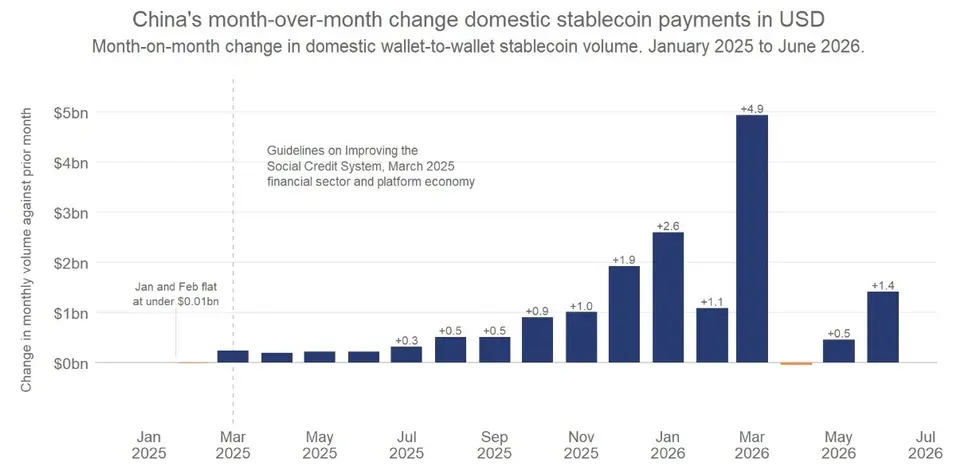
The latest findings from Chainalysis estimate that China’s total underground or resilient crypto economy is worth at least $176 billion. Within this ecosystem, domestic P2P activity accounted for 59.1% of the total volume, marking a dramatic 3.5-fold increase in its market share compared to the 2025 reporting period. Monthly metrics further underscore this resilience, with China’s domestic stablecoin transfer volume peaking with a $4.9 billion addition in March 2026 alone, representing the largest single-month increase captured in the data.
South Korea Leads East Asia’s Crypto Economy Despite Sharp Drop in Exchange Profits
While China displays remarkable P2P resilience, South Korea stands firmly as East Asia’s largest overall crypto economy, commanding a massive $449.1 billion valuation, according to the Chainalysis geographical breakdown. Total economic activity within the country grew by 12.3% during the year leading up to June 2026, driven largely by retail traders exhibiting a pronounced preference for emerging artificial intelligence-linked tokens.
However, the broader financial health of South Korea’s centralized digital asset infrastructure has faced severe headwinds. The first half of 2026 proved particularly challenging for local crypto exchanges, which saw their combined operating profits plummet by 78%. This contraction coincided with a broader cooling period characterized by reduced trading activity, deflated market valuations, and shrinking customer deposits across the board.
Data released by the Korea Financial Intelligence Unit (KoFIU) illustrates the depth of the downturn. Average daily trading volume across domestic virtual asset exchanges slumped by 44% compared to the preceding six months. Simultaneously, overall market capitalization dropped by 33%, while won-denominated customer deposits fell by 35%. Exchange revenues declined by 41% over the same timeframe, even as the total number of trade-eligible accounts managed a marginal increase of 0.4%.

Securitize Shares Rally Amid South Korea’s Tokenization Push
In contrast to the struggles faced by spot exchanges, digital asset infrastructure providers are finding fertile ground in South Korea as the nation prepares for major regulatory shifts. Shares of tokenization platform Securitize rallied by 8% following the company’s announcement of a strategic partnership with South Korean technology giant LG CNS.
Securitize and LG CNS formalized their collaboration by signing a memorandum of understanding aimed at developing tokenized assets and robust digital asset infrastructure tailored for South Korean financial institutions. This partnership grants Securitize a valuable early foothold in the country just as regulators prepare to roll out a comprehensive framework for tokenized securities. Last week, South Korea’s Financial Services Commission proposed new rules governing the issuance and circulation of tokenized stocks, bonds, funds, and alternative securities, with the legal framework officially scheduled to take effect in February 2027.
Standard Chartered Plans Institutional Custody in Singapore
Moving southward into Southeast Asia, London-headquartered multinational banking institution Standard Chartered has announced ambitious plans to launch digital asset custody services for institutional clients in Singapore. Under this new offering, the firm will securely store select cryptocurrencies, stablecoins, and tokenized real-world assets on behalf of institutional clients and corporate entities that qualify as accredited investors.
Standard Chartered executives emphasized that Singapore’s established position as a leading global financial and technological innovation hub forms a critical pillar of the bank’s broader international digital asset strategy.
Independent Reserve Expands Payment Tools and Launches Derivatives Trading
The institutional momentum in Singapore is echoed by local exchange operators. Independent Reserve, a crypto exchange holding a full license in Singapore, has rolled out new cross-border payment tools designed to enable businesses to execute both fiat and stablecoin payouts seamlessly. Corporate accounts can be funded using either Singapore dollars or US dollars to make direct payments to suppliers or employees across more than 20 different currencies, with USDC and USDT integrated as primary payment options.
In addition to its cross-border payment solutions, Independent Reserve has expanded its product suite by launching dedicated crypto derivatives trading for sophisticated investors through its newly established subsidiary, ReserveX.
Meanwhile, Payward—the parent company of major global exchange Kraken—has announced a strategic partnership with Singapore Gulf Bank. The collaboration is designed to facilitate round-the-clock, instantaneous institutional crypto settlement, further solidifying Singapore’s status as a premier hub for digital finance.
Hong Kong Officials Reaffirm End-2026 Deadline for Crypto Licensing Framework
In Hong Kong, government officials are pressing forward with their regulatory agenda without delay. The administration has reaffirmed its firm commitment to submitting an omnibus amendment bill before the end of 2026. This legislation is designed to establish formal, comprehensive licensing regimes covering digital asset trading, custody, advisory, and asset management services as part of a wider overhaul of the city’s crypto laws.
Christopher Hui, Hong Kong’s Secretary for Financial Services and the Treasury, stated during a policy briefing that the government remains on track to submit the amendment bill within the year to create a predictable and secure operational environment for virtual asset service providers.
Hong Kong’s regulatory clarity continues to attract heavy capital, standing out prominently in the Chainalysis Geography of Cryptocurrency report for its high concentration of institutional activity. Institutional platforms accounted for 16% of all service inflows into Hong Kong—nearly three times the proportion observed in any neighboring regional market. The city successfully attracted nearly $24 billion in inbound business-to-business transaction flows, bolstered by the historic issuance of its first stablecoin licenses in April.
Japanese DEX Usage Surges 200% Since 2022 as Country Tightens Market Rules
Across the East China Sea, Japan’s crypto ecosystem is experiencing a profound shift toward decentralized finance (DeFi). The Chainalysis report revealed that decentralized exchanges (DEXs) now account for nearly 35% of all digital asset service activity in Japan, representing the highest share among any mature market in East Asia. Chainalysis noted that 65.7% of all DEX swaps in the country fell within the $10 to $1,000 range, with overall DEX activity surging by more than 200% since 2022.
This grassroots shift toward decentralization comes on the heels of decisive legislative action. In July, Japanese lawmakers passed crucial revisions that formally integrate digital assets into the country’s overarching financial markets framework, bringing greater regulatory oversight to the sector.
At the same time, Tokyo continues to align its financial policies with international geopolitical measures. The Japanese government officially added Russian cryptocurrency exchange Garantex to its expanded sanctions list in response to the ongoing war in Ukraine. According to a joint statement released by the Ministry of Foreign Affairs, the Ministry of Finance, and the Ministry of Economy, Trade and Industry, Japan added 33 organizations and nine individuals linked to Russia to its asset-freeze list, severely restricting payments and capital transactions with the targeted entities. Garantex has previously faced stringent sanctions from the United States, the European Union, and other international allies for allegedly facilitating financial evasion by sanctioned Russian entities.
India-Based Scam Operation Targets US Seniors via Bitcoin ATMs
While institutional adoption and regulatory frameworks mature across major financial hubs, law enforcement agencies are grappling with increasingly sophisticated cross-border cybercrime syndicates. India’s Central Bureau of Investigation (CBI) recently executed a series of raids resulting in the arrest of four individuals allegedly operating an international tech-support fraud and extortion ring targeting elderly citizens in the United States.
The criminal operation utilized deceptive computer pop-up notifications displaying toll-free numbers falsely associated with Microsoft. Victims who dialed the numbers were manipulated into believing their personal computers had been severely compromised or linked to illegal activities, such as child exploitation, under a calculated scheme designed to coerce them into handing over substantial funds. Investigators noted that the syndicate successfully defrauded a single Florida resident of $440,000 using these tactics, often laundering proceeds through alternative financial channels, including physical Bitcoin ATMs.
Violent Robbery in Thailand Forces Victim to Surrender $820,000 in Crypto
Physical security concerns surrounding high-net-worth digital asset holders also came to the forefront in Southeast Asia following a violent home invasion in Thailand. Three armed assailants carried out a targeted robbery at a residence in Bang Lamung, forcibly compelling a foreign resident to transfer cryptocurrency valued at approximately $820,000 under duress.
In addition to the digital asset transfer, the perpetrators made off with physical cash and three luxury Rolex watches. Local law enforcement authorities have launched an intensive investigation into the incident, with preliminary police suspicions indicating that the armed robbers may be foreign nationals, potentially originating from China.



Leave a Reply