
The legal collision between French courts and international public DNS resolvers has entered a critical new phase, placing the Swiss non-profit foundation Quad9 at risk of crippling financial penalties. Since 2024, French courts have repeatedly issued multi-intermediary piracy blocking orders aimed at cutting off public access to illicit sports streaming websites. While some DNS providers chose to exit the French market entirely rather than comply, Quad9 opted to remain, setting the stage for a high-stakes courtroom showdown over the technical viability and jurisdictional overreach of DNS-level censorship.
In May, the Paris Judicial Court ordered major DNS infrastructure operators—including Google, Whalebone (the operator of DNS4EU), and Quad9—to block unauthorized streams of Women’s Tennis Association (WTA) matches for internet users physically located in France. Initiated by the prominent sports broadcaster beIN Sports, the initial legal filing targeted six specific domains. According to statements from Quad9, subsequent updates introduced another 52 domains to the blacklist, bringing the total number of targeted URLs to 58.
Despite the binding nature of the judicial mandate, Quad9 has revealed that it is not blocking any of the 58 domains in question. In fact, the foundation confirmed that it has never implemented the required blocks, marking a deliberate, conscious policy decision that could ultimately carry a devastating financial price tag.
beIN Returns for Penalties
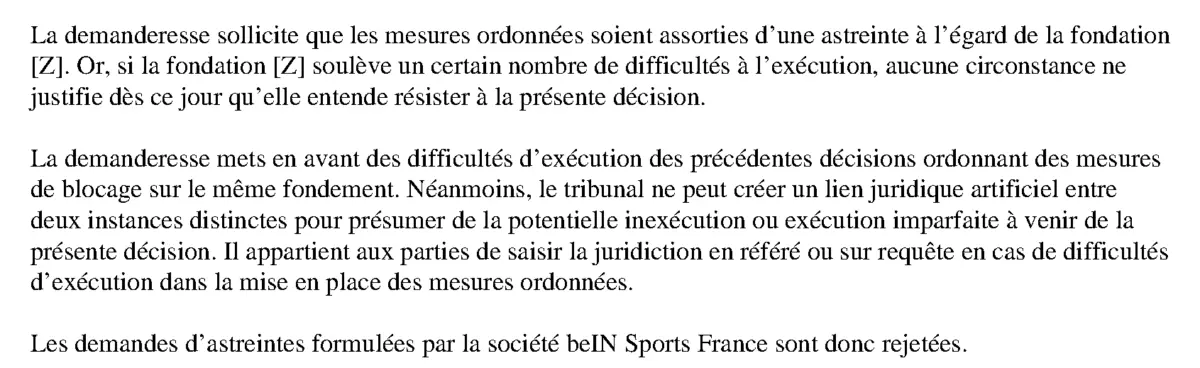
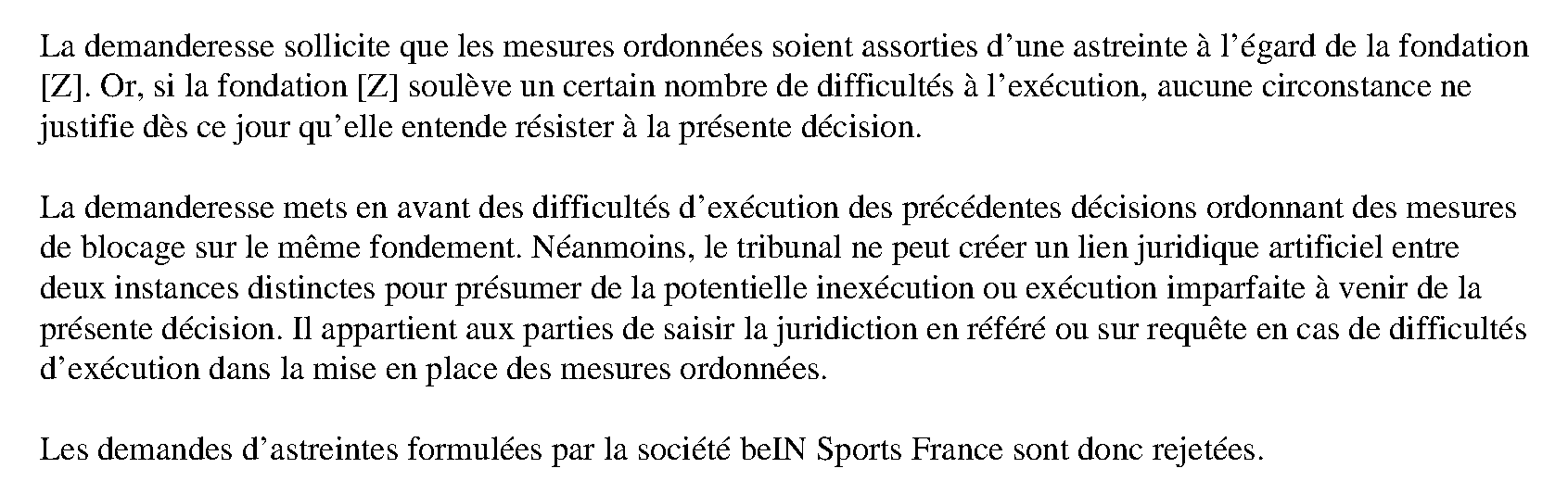
From the very beginning of the legal proceedings, beIN Sports sought to secure financial leverage to ensure strict compliance. When the broadcaster originally requested the blocking order, it petitioned the Paris court to impose a punitive fine of €2,000 per day for every single domain that Quad9 failed to block. Notably, Quad9 was singled out individually for this penalty request, while other major DNS resolvers involved in the case did not face the same immediate threat.
At the time, the court declined beIN’s request for financial penalties. The presiding judges explained that there was no definitive indication at that early stage that the foundation intended to actively resist the order, noting in the ruling that if operational problems arose later, the parties could return to court to seek enforcement.
That is precisely what beIN Sports chose to do. Quad9 reported that the broadcaster recently returned to the Paris Judicial Court to demand steep financial sanctions. According to the foundation, beIN is now asking the court to assess penalties of €10,000 per domain, per day of non-compliance. Across the 58 domains currently on the blocklist, this translates to a staggering €580,000 per day, accumulating into potential liabilities running into the millions of euros every week.
The case was heard before the Paris court, with a final judicial decision anticipated within three weeks. If the court rules in favor of the broadcaster, the retroactive and ongoing penalties would apply directly from the moment the original order was issued, presenting an existential financial threat to the non-profit infrastructure provider. While public records of the recent hearing remain scarce, Quad9 has detailed the technical and philosophical justifications behind its refusal to comply, even under the shadow of potentially bankrupting fines.

The DNS Blocking Problem
From a purely technical standpoint, Quad9 possesses the capability to block domain names and thereby avoid the mounting regulatory pressure. However, the foundation maintains that it cannot cleanly restrict the required pirate site blocks exclusively to users within France, which is the explicit geographic limitation demanded by the court order.
As a privacy-focused public recursive DNS resolver, Quad9 does not track, collect, or store personal user data or IP addresses longer than operationally necessary. Consequently, enforcing a region-specific block requires the foundation to rely on third-party geolocation databases that attempt to map IP addresses to physical countries. Quad9 argues that these third-party databases are inherently prone to inaccuracies, gaps, and frequent errors, making precise geographical filtering impossible at the DNS resolver level.
"There is no legally useful way for us to define a French user," Quad9 representatives noted, emphasizing the technical impossibility of complying with pinpoint geographic mandates without collateral damage to innocent internet users outside France.
The foundation is well-acquainted with the complexities of regional enforcement. In Germany, Sony Music previously took Quad9 to court over similar piracy concerns. According to Quad9, German judges initially found that the resolver’s technical attempts to limit blocks exclusively to German citizens were insufficient. Although Quad9 ultimately won that specific legal battle on appeal in late 2023, the underlying technical reality acknowledged by the initial scrutiny was never fundamentally overturned.
Convincing the Paris court of these technical limitations will likely prove difficult. In its May ruling, the court explicitly stated that the defendants had failed to demonstrate that limiting the mandated blocks exclusively to French territory would be financially prohibitive or technically impossible.
Alternatively, Quad9 retains the option to implement a global block on the targeted domains, a step it previously threatened to take in 2024 and temporarily executed in Germany in 2023 under the direct threat of €10,000 daily fines. When asked why it has chosen a different path in France, the foundation explained that the German blocking action was implemented merely as an interim, temporary measure while the broader litigation proceeded through the courts. Quad9 stresses that conditions in France differ significantly and that it evaluates every international jurisdiction on its own unique merits.
" campaña-style="plain" We remain entirely confident in our core argument: DNS recursive resolvers are the wrong place to counter the problem of online piracy, and will result in significantly worse outcomes for the citizens of France," Quad9 stated.

These concerns are shared by broader segments of the internet governance community. Earlier this year, a comprehensive report published by the Internet Society warned that aggressive jurisdiction-specific blocking mandates impose disproportionate burdens on smaller and non-profit infrastructure operators.
"Large, well-resourced operators may be able to absorb the compliance costs, but smaller and non-profit operators risk being excluded from the market if they cannot afford the staffing and compliance infrastructure demanded by jurisdiction-specific blocking orders," the Internet Society report cautioned.
Leaving France?
Should the Paris court rule in favor of beIN Sports and approve the multi-million euro daily penalties, Quad9 will be forced to take decisive action to protect its organizational survival. The foundation outlines three primary options under such a scenario, none of which are ideal.
First, Quad9 could attempt to implement a restricted block targeting only users it calculates to be in France, a method the foundation warns remains imprecise and legally hazardous due to unreliable geolocation data. Second, it could succumb to the pressure and apply the domain blocks globally, a move that would effectively allow French courts to project their domestic jurisdictional reach across the entire global internet.
The third and most drastic option is to follow the precedent set by OpenDNS, which completely suspended its DNS resolution services in France in June 2024 following the initial Canal+ piracy blocking order. Cutting off French users entirely would resolve the immediate legal conflict, though the practical accuracy of geo-blocking an entire national user base remains complicated.
Quad9 indicates that it has not yet formally discussed these alternative courses of action with its governing Foundation Council. Any eventual decision must balance the legal obligation to respect local laws with the necessity of safeguarding the organization from financial ruin.
"Additionally, we are required by Swiss law to abide by our founding principles of privacy, security, and stability of the internet and how those principles are applied to our user community in a consistent and predictable manner in all areas," Quad9 noted.
Recklessly Dangerous
The ongoing legal dispute is unfolding against a backdrop of expanding legislative powers in France designed to crack down on unauthorized sports broadcasts. In July, the French Parliament approved a controversial law establishing an automated, real-time blocking mechanism for pirate sports streams. Under this framework, new domain names can be added dynamically during live sporting events, with the national communications regulator ARCOM conducting compliance and review processes only after the blocking measures have already been enacted.
Quad9 views this legislative trajectory as a dangerous escalation of an already problematic regulatory environment.
"An unfettered, unencumbered and delegated power given to an unspecified list of commercial parties to block any content they desire seems to us recklessly dangerous, un-necessary, and counter-productive," the foundation stated.
According to Quad9, automated and real-time blocking frameworks will ultimately incentivize internet users to migrate toward less secure, unverified DNS systems operating in unknown foreign jurisdictions. Furthermore, the sheer velocity required to process dynamic, real-time updates rules out any meaningful human vetting or judicial oversight of the targeted domains.
"Dynamic injection of false answers weaponizes the DNS against end users," the foundation warned. "This blocking method will be proven to be ineffective, wasteful, and will not achieve the goal of removing the content which remains as reachable as ever."
The immediate future of the dispute now rests with the Paris Judicial Court. A formal ruling regarding beIN Sports’ penalty application is expected to be delivered later this month, after which Quad9 is anticipated to announce its definitive operational response. Representatives for beIN Sports declined to comment on the ongoing legal proceedings.


Leave a Reply