
U.S. Representative Darrell Issa has officially introduced a new legislative bill designed to crack down on foreign pirate websites operating outside American jurisdiction. While the final legal text of the proposal has not yet been published on congressional tracking portals, early drafts and previously circulated frameworks indicate that the legislation targets both traditional Internet Service Providers (ISPs) and major Domain Name System (DNS) resolvers. The introduction of this bill has already reignited fierce debates regarding online censorship and digital infrastructure safety, while simultaneously highlighting internal competition among lawmakers pursuing alternative site-blocking frameworks on Capitol Hill.
The prospect of blocking foreign pirate websites at the network level has remained a deeply contentious issue in the United States for over a decade. Such measures have effectively been off the table since the controversial Stop Online Piracy Act (SOPA) and Protecting Intellectual Property Act (PIPA) initiatives were shelved in 2012 following massive public pushback and industry-wide protests.
The political landscape surrounding digital copyright enforcement shifted in January of last year, however, when Representative Zoe Lofgren introduced the Foreign Anti-Digital Piracy Act (FADPA). That proposal successfully set the legislative site-blocking wheels back in motion. By the following summer, a group of U.S. Senators advanced a separate legislative draft known as the Block BEARD Site Blocking Act. Meanwhile, Representative Issa—who currently serves as the chairman of the House Intellectual Property subcommittee—continued quietly developing his own alternative site-blocking framework, initially titled the American Copyright Protection Act (ACPA).

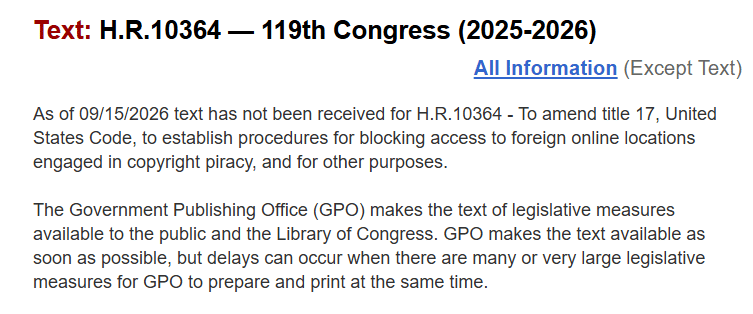
Although Issa’s bill had been heavily discussed among various industry stakeholders behind closed doors for months, it had not been formally introduced on the floor of the U.S. House of Representatives until now. According to official congressional records, Representative Issa has formally introduced H.R. 10364. The bill is officially described as a legislative measure "to establish procedures for blocking access to foreign online locations engaged in copyright piracy, and for other purposes." While the newly assigned bill number does not currently list a formal short title in congressional databases, Issa has previously referred to the legislative effort as the American Copyright Protection Act.
A Site Blocking Bill Without Text Available
At the time of congressional introduction, the complete text of H.R. 10364 was not yet publicly available online. Congressional tracking portals noted that the Government Publishing Office had not yet received the finalized document, and Issa’s congressional office had not issued an immediate press statement detailing the specific provisions of the newly dropped bill. Inquiries directed to Representative Issa’s office requesting a copy of the legislative text and formal comment did not yield an immediate response.
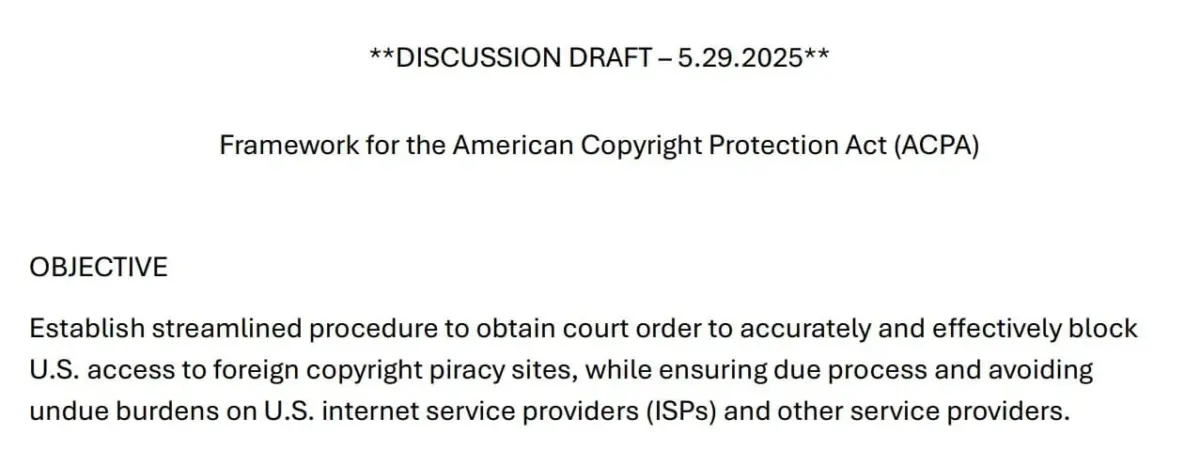
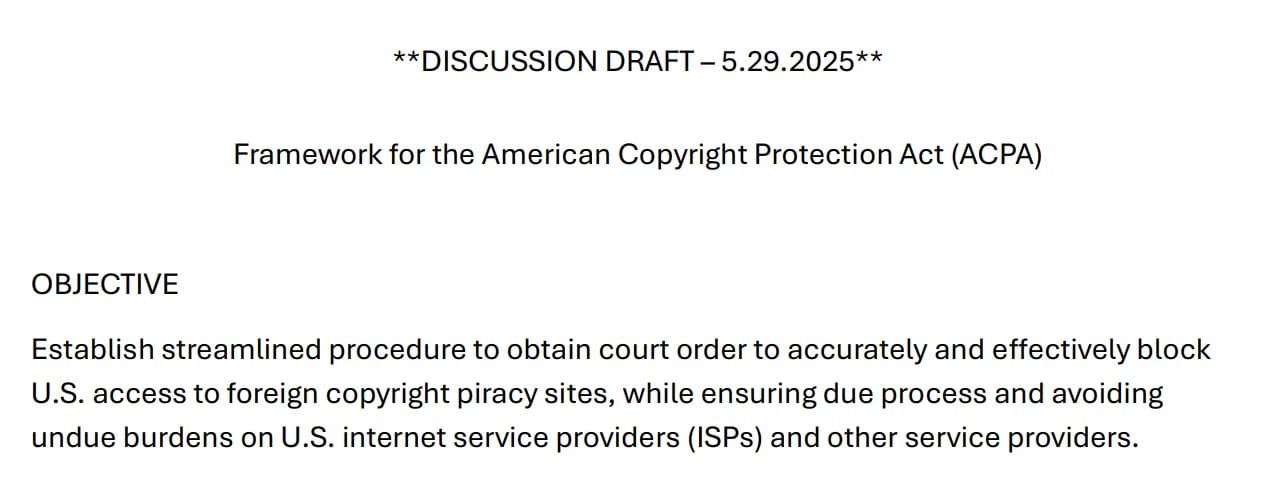
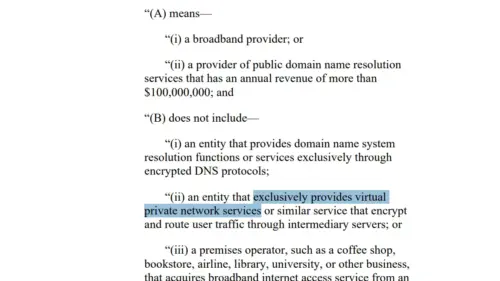
In the absence of the newly introduced legislative text, observers and policy experts have relied on the 2025 discussion draft of the ACPA to understand the contours of the proposal. A previous review of that draft framework revealed that it would empower copyright holders to obtain specialized court orders requiring both internet service providers and domain name resolvers to block access to designated foreign pirate sites within the United States.
Unlike other competing site-blocking proposals that have circulated through Congress, Issa’s earlier draft included distinct structural mechanisms. Notably, the framework stipulated that the Judicial Conference of the United States would maintain a specialized roster of designated federal judges to hear all site-blocking cases, while the U.S. Copyright Office would be responsible for publishing and maintaining a public directory of active blocking orders.
Furthermore, Issa’s early proposal uniquely targeted the risk of overblocking—a common criticism leveled against network-level internet filters. The draft reportedly included a specific protective provision allowing any innocent third party whose website was wrongly blocked as a result of a rightsholder’s error or administrative mistake to claim substantial financial compensation, potentially reaching up to $250,000. Whether these specific oversight and penalty provisions survived into the newly introduced version of H.R. 10364 remains unconfirmed, pending the release of the official legislative text.
Competing Site Blocking Bills and Legislative Hurdles
The formal introduction of the bill did not come as a complete surprise to political observers tracking intellectual property legislation. On June 30, Representative Issa stated during an interview with The Capitol Forum that his explicit intention was to introduce the anti-piracy legislation before Congress entered a scheduled district work period. Although that initial self-imposed deadline passed without a formal introduction, the measure has finally materialized.
Time is of the essence for the legislative push. Representative Issa is retiring at the end of his current congressional term, leaving lawmakers only a narrow window of a few months to advance any meaningful copyright enforcement legislation through the House of Representatives. Even if passing a bill within this timeframe is not entirely impossible, H.R. 10364 faces significant political competition from other site-blocking initiatives currently weaving through Capitol Hill.
There are currently three distinct site-blocking efforts running parallel tracks in the U.S. Congress. Earlier this year, reports indicated that Senator Thom Tillis and Representative Zoe Lofgren were actively working to merge FADPA and the Block BEARD proposal into a single, unified bicameral bill that would mandate site-blocking obligations for both ISPs and large DNS resolvers. Representative Lofgren later confirmed that she was engaged in high-level negotiations for a comprehensive "four corners agreement" involving Representative Issa alongside Senators Marsha Blackburn, Chris Coons, Adam Schiff, and Thom Tillis.
While legislative sources have previously described these various efforts as separate and uncoordinated tracks, it remains unclear whether a broader consensus has been reached. If H.R. 10364 represents the House component of a larger, unified bipartisan deal, the final text would likely feature shared cosponsorship from key lawmakers like Lofgren. If no such agreement exists, the House currently finds itself considering two competing site-blocking bills, with the Senate pursuing its own separate legislative vehicle.
Immediate Opposition and Industry Silence
Even before the official text of H.R. 10364 was published online, digital rights and civil liberties groups mobilized to voice sharp opposition to the measure. Public Knowledge, a prominent digital advocacy organization, issued a formal warning arguing that the legislation effectively transforms broadband internet providers into private copyright police forces.
Meredith Rose, Senior Policy Counsel at Public Knowledge, criticized the mechanism of utilizing domain name system resolvers for broader enforcement. She emphasized that applying blocking orders to global DNS resolvers can easily result in broad, unintended collateral damage. According to Rose, such a system means that a single federal court can effectively cut off access to an online destination on a global scale based on a single complainant’s expedited legal filing and streamlined judicial procedures.
Rose further warned that small businesses, independent creators, and nonprofit organizations face disproportionate risks under wide-reaching site-blocking frameworks while possessing the fewest legal resources to challenge erroneous blocks. Pointing to international precedents, she noted that similar site-blocking implementations in Europe have occasionally caused widespread disruptions to digital infrastructure, inadvertently taking down websites and services for hotels, retail shops, automotive repair businesses, telehealth programs, and even non-profit religious institutions.
Meanwhile, major entertainment industry associations and copyright holder coalitions have remained relatively quiet following the formal introduction. The Motion Picture Association (MPA)—an organization that notably awarded Representative Issa its prestigious Industry Champion Award earlier this year for his ongoing legislative efforts—did not immediately issue a public statement regarding the introduction of H.R. 10364. Requests for comment sent to major rightsholder advocacy groups did not receive an immediate response as the story continued to develop.
Leave a Reply