
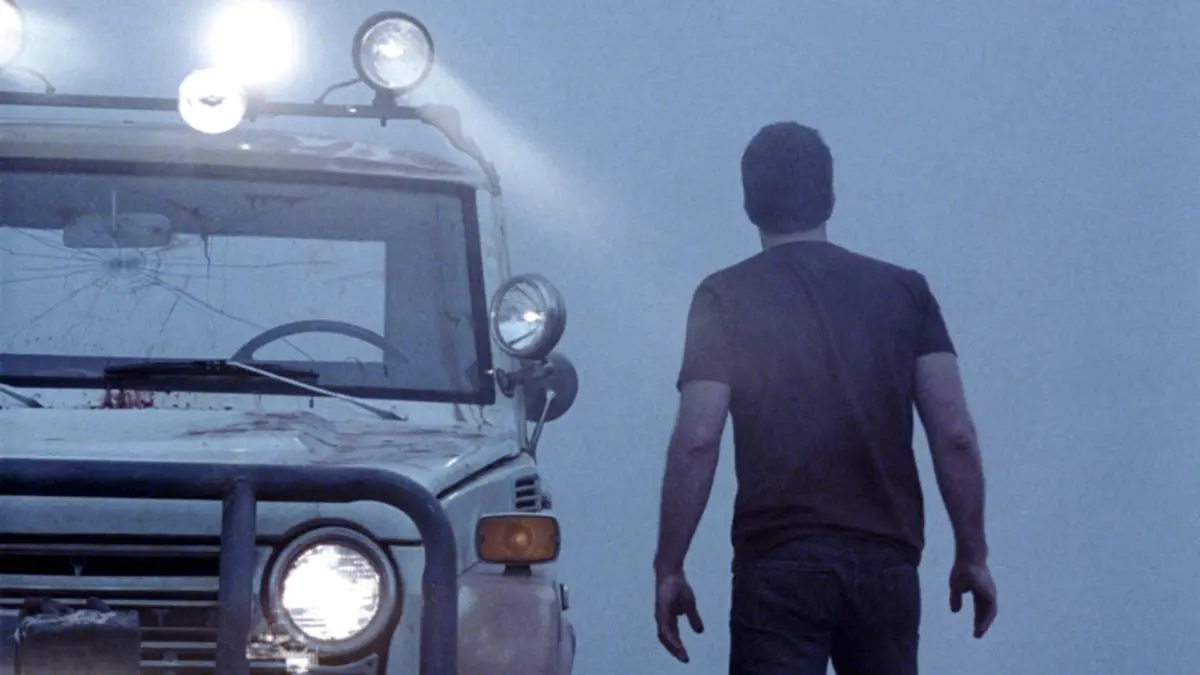
Stephen King movie adaptations have long occupied a strange and powerful space in popular culture, frequently possessing a habit of becoming larger and more enduring than the literary works that originally inspired them. While Frank Darabont’s cinematic translations of King’s stories have yielded some of the most celebrated films in history—with The Shawshank Redemption and The Green Mile standing as towering achievements in drama—his ventures into horror territory proved equally formidable. Films based on King’s writing, such as Stanley Kubrick’s The Shining, Rob Reiner’s Misery, and modern iterations of Carrie, have undeniably become foundational pillars of horror cinema.
Naturally, cinematic adaptations of King’s vast bibliography are notorious for taking massive liberties with their source material. The most famous example remains Stanley Kubrick’s The Shining, a film that Stephen King has spent nearly fifty years publicly criticizing for its departure from his vision. Yet, despite the creative friction generated by Kubrick’s psychological masterwork, no cinematic departure in the history of King adaptations has ever proven quite as devastating, controversial, or emotionally shattering as the final few moments of Frank Darabont’s 2007 adaptation of The Mist.
Based on King’s 1980 novella of the same name, Darabont’s film initially presents itself as a conventional, atmospheric monster movie with subtle stylistic overlaps resembling psychological survival horror games like Silent Hill. However, as the narrative unfolds, it steadily devolves into a profound and harrowing psychological downward spiral that separates it from almost every other project born from King’s library.
The story begins in the wake of a violent, midnight thunderstorm that severely damages the lakeside home of commercial artist David Drayton, played by Thomas Jane. Seeking to assess the damage and acquire essential supplies, David decides to drive into town the following morning, bringing along his young son, Billy, played by Nathan Gamble, and enlisting their neighbor, Brent Norton, played by Andre Braugher.

Upon arriving at the local supermarket, the trio finds the establishment already packed to capacity with dozens of local residents attempting to stock up on groceries and household goods in the aftermath of the storm. Almost immediately after they step inside the bustling store, an eerie, unnatural mist rolls in from the nearby lake, completely blanketing the outside world in a dense, dark white smog that cuts off visibility and isolates the town from the outside world.
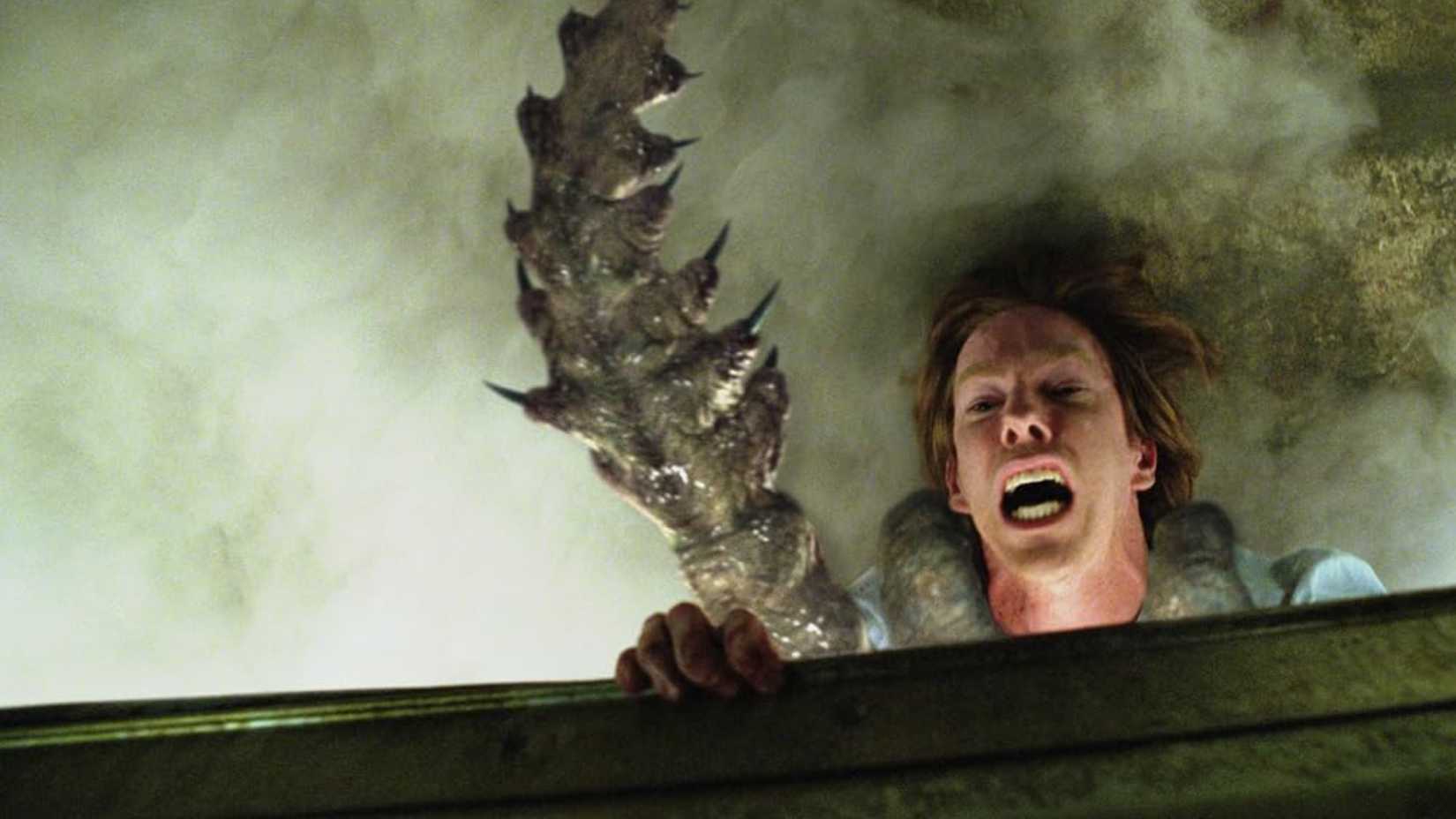
The Mist wastes virtually no time establishing that its central atmospheric shroud is concealing grotesque, lethal monsters within its white embrace. One of the film’s most visceral and effective sequences occurs relatively early in the runtime, when David and a small group of concerned men investigate the supermarket’s loading dock at the back of the store. They discover several enormous, otherworldly tentacles aggressively probing through the loading bay doors.
Norm, a young stock clerk played by Chris Owen, is among the first to encounter the horror, and his demise is depicted with unyielding brutality. The unseen creature wraps its thick, rubbery appendages around the young man. The tentacles protrude sharp, blade-like barbs that slice through flesh effortlessly. David, alongside Ollie Weeks, played by Toby Jones, and several other men, desperately tries to anchor Norm and pull him back into the safety of the warehouse. Despite their frantic efforts, the sheer strength of the tentacles quickly overpowers them. The young store clerk is dragged screaming into the thick fog, swallowed by a bloody mess as the remaining men watch in absolute, paralyzed horror.
This sequence serves as a nail-biting, immediate introduction to the film’s broader menagerie of Lovecraftian horrors. Darabont expertly utilizes concealment, ensuring that the true designs of the larger monsters lurking within the mist are only partially revealed. By relying on frantic camera pans, echoing screams, spurting blood, and those looming, colossal tentacles, the director lets the audience’s imagination do the heavy lifting.
Within the span of just a few scenes, the supermarket transitions from a place of refuge into an inescapable cage. David and the surviving townspeople realize they have no definitive understanding of what else might be waiting for them in the fog. Even the fragile comfort provided by the large glass storefront windows at the front of the shop begins to rapidly wane as the scale of the threat becomes apparent.

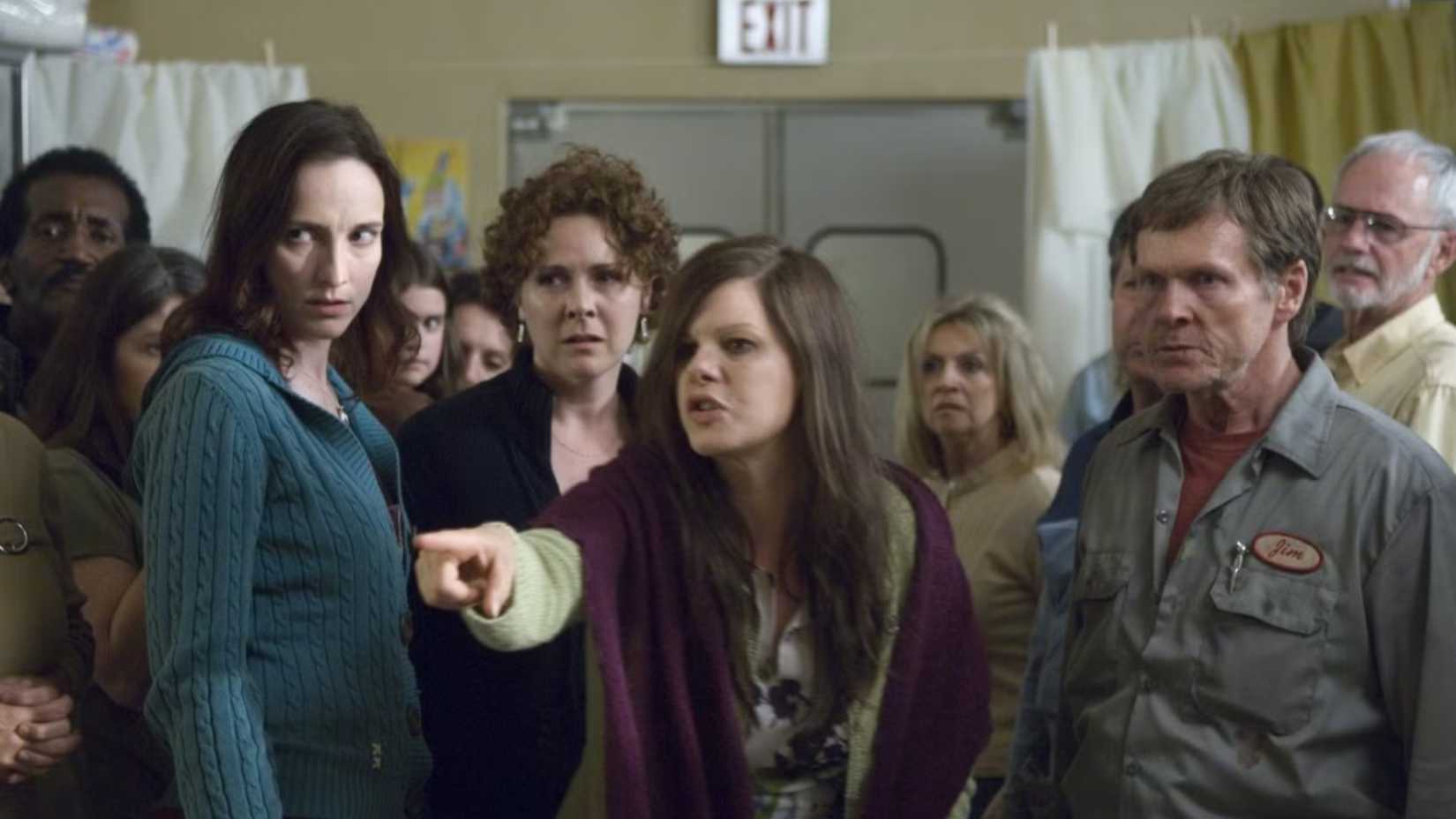
What makes the narrative truly fascinating, however, is how the monsters hiding outside eventually become far less terrifying than the humans trapped inside. As time slowly ticks away within the confines of the supermarket, the overwhelming weight of fear begins to systematically fracture every vestige of community, empathy, and rational thought among the survivors.
Mrs. Carmody, brilliantly portrayed by Marcia Gay Harden, emerges as the most dangerous figure within the store. As the psychological pressure mounts, she becomes increasingly unhinged, leaning heavily into religious fanaticism and hunting for an apocalyptic explanation for the unfolding atrocities. While David and a pragmatic faction of survivors struggle to comprehend the scientific or extradimensional nature of their situation, Carmody’s fervent interpretations gradually spill out into the open. She weaponizes the terror of the frightened survivors, convincing them that the mist is a manifestation of divine wrath and that blood sacrifices are required to appease whatever forces have unleashed the catastrophe.
The marketing campaign for the film famously encapsulated this descent with the tagline: "Fear changes everything." Although this line is never explicitly spoken by any character in the script—nor does it appear anywhere in Stephen King’s original novella, having been concocted entirely for the cinematic marketing—it serves as the undeniable central thesis of The Mist. Watching frightened people argue over the existence of monsters is deeply unsettling, but watching Mrs. Carmody successfully orchestrate a fanatical cult movement within a grocery store is far more devastating. Darabont taps directly into humanity’s desperate psychological need to extract meaning from senseless catastrophe, demonstrating that mob mentality can be far more horrifying than any building-sized Lovecraftian entity lurking in the white nothingness outside.
Despite the brilliance of the narrative and the strength of the direction, neither King’s original writing nor Darabont’s cinematic framing could entirely hide the limitations of the film’s visual effects. Produced on a relatively modest budget ranging between $13 million and $18 million, The Mist frequently exhibits rough edges in its computer-generated imagery.
The loading dock scene featuring the Lovecraftian tentacles provides a clear example of these budgetary constraints. The digital appendages frequently appear flat and lacking the necessary textural depth and shadow integration required to anchor them convincingly within a physical, lit environment. The lighting on the tentacles often fails to match the harsh, industrial glare of the garage. Much of the film’s CGI appears dated by modern standards, and those digital elements were regarded as somewhat jarring even upon the film’s initial theatrical release in 2007.
Yet, an oddly enduring appeal has emerged around these rough visual edges. Darabont has spoken in past interviews about the grueling reality of shooting the film on a dramatically reduced budget and an unforgiving production schedule, which required constant compromises regarding where to allocate limited financial resources. While the remainder of the digital creatures fare little better than the tentacles, these imperfect effects inadvertently grant the film a distinct, gritty B-movie energy. Furthermore, these dated visuals are easily overlooked because the emotional and psychological core of the story is anchored by powerhouse performances from its principal cast, including Thomas Jane, Marcia Gay Harden, and Toby Jones.
One of Horror Cinema’s Bleakest Endings
The most striking and consequential difference between Darabont’s cinematic adaptation and King’s original novella lies entirely in the conclusion. The filmmaker remains surprisingly faithful to the source material for the vast majority of the runtime, preserving the supermarket setting, the grotesque creature encounters, the spiraling religious fanaticism of Mrs. Carmody, and David’s desperate efforts to protect his young son. However, Darabont made the bold decision to provide the story with a definitive, closed-off conclusion, replacing King’s deliberately ambiguous and open-ended finale with a punch of emotional devastation that has since become legendary in horror history.
Darabont had spent years contemplating this alternative ending and fought fiercely to preserve it during the financing stages of production. Stephen King ultimately came to praise the radical departure, with Darabont later recalling that the author remarked he wished he had thought of the ending himself.
In the film’s final sequence, David Drayton and a small group of remaining survivors—including Amanda Dunfry, Dan Miller, and an elderly couple—finally manage to escape the confines of the supermarket. They board a car and drive continuously until the vehicle completely runs out of fuel, leaving them stranded in the middle of a desolate landscape completely consumed by the endless mist. With nowhere else left to run, no rescue in sight, and no indication of where the mist might end, David makes what he believes to be the only merciful decision left to him.
Realizing they are cornered and facing a horrific fate at the claws of the massive creatures stalking the fog, David discovers he has only four bullets left in his revolver. In an agonizing sequence of events, he chooses to shoot the remaining adult survivors in the car one by one, ultimately saving his own young son, Billy, for the very last bullet. The boy’s death carries an unbearable weight because David has spent the entirety of the narrative fighting tooth and nail to protect him from the external horrors, only to become the person forced to take his life.
In the immediate, grief-stricken aftermath, a sobbing David climbs out of the vehicle, desperate to surrender himself to the monsters and face his own end. He screams into the thick fog in absolute, unbridled agony. However, what finally emerges from the unknown white haze is not a towering Lovecraftian beast, but a heavily armored military convoy comprised of soldiers, tanks, and flatbed trucks filled with surviving civilians.
David watches in stunned, catatonic horror as the mist slowly begins to dissipate around the passing convoy. In the span of just a few seconds, the crushing realization sets in that military aid and rescue were merely moments away, rendering his unthinkable actions entirely unnecessary.
Those devastating closing moments are the primary reason The Mist has continued to haunt audiences and dominate cinematic discussions for nearly two decades. While the computer-generated creatures may occasionally betray the limitations of their era, and the supermarket setting may feel claustrophobic and repetitive, none of those technical hurdles detract from the overwhelming emotional impact left in the wake of the credits. Frank Darabont successfully transformed a monster story born from an inexplicable fog into a timeless, haunting meditation on the terrible things ordinary people are capable of convincing themselves to do when they believe all hope is entirely gone.
The Mist is currently available for streaming on Roku.

Leave a Reply