
The geopolitical landscape of software and technology infrastructure has shifted dramatically, compelling governments worldwide to reassess their reliance on foreign-controlled commercial tech stacks. For the Netherlands, a stark wake-up call arrived in early 2025 when the United States government imposed sweeping sanctions on the International Criminal Court (ICC). The swift and far-reaching consequences of these measures immediately cut off the ICC chief prosecutor’s access to essential Microsoft services, including corporate email accounts. Shortly thereafter, personal and institutional bank accounts linked to the prosecutor were frozen within affected jurisdictions, grinding vital international legal proceedings to a halt.
While watching these events unfold from The Hague, Dutch government officials experienced a sobering realization. They recognized that access to fundamental communication and operational services—tools upon which entire government functions rely—was entirely dependent on policy decisions, legal frameworks, and corporate entities residing outside of European jurisdiction. This profound vulnerability exposed the inherent risks of deep vendor lock-in with foreign technology giants.
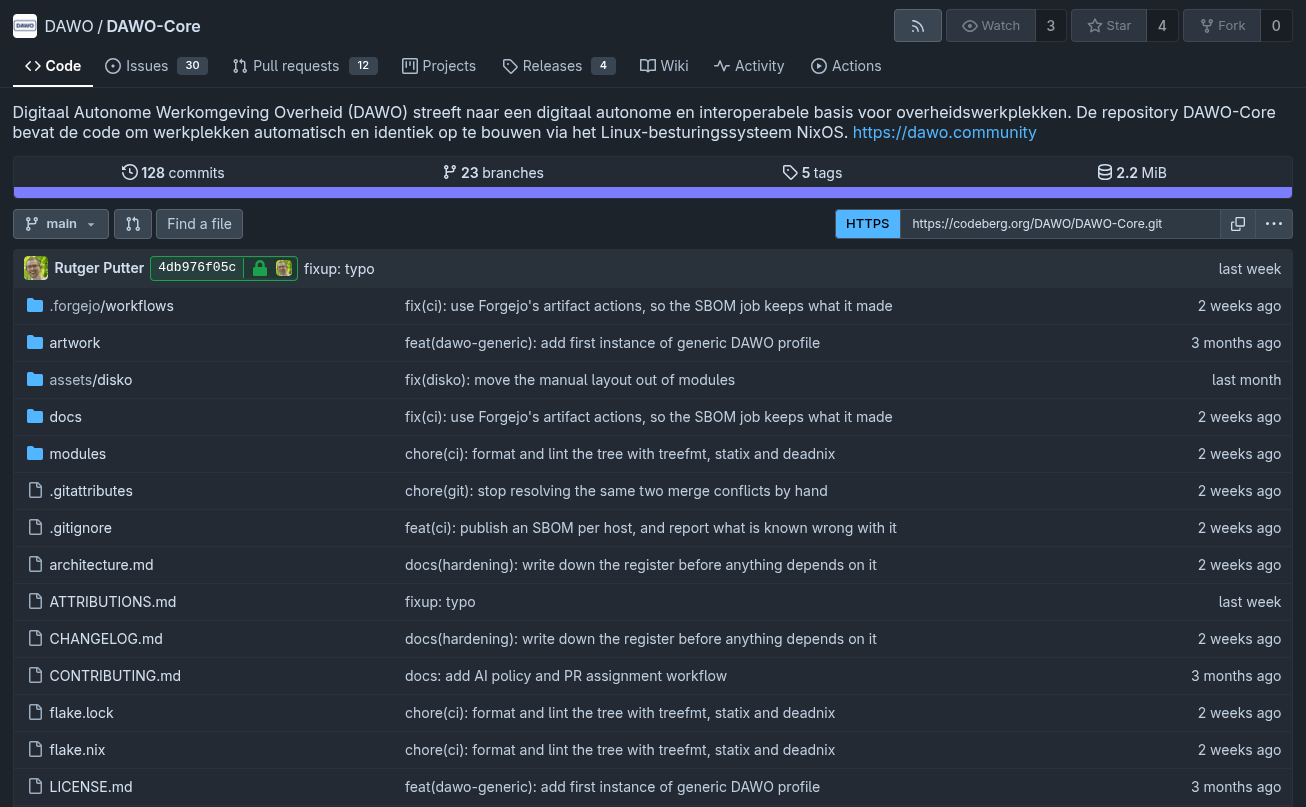
In response to this administrative and security awakening, the Dutch central government initiated DAWO, an acronym for Digitaal Autonome Werkomgeving Overheid, or Digital Autonomous Work Environment for Government in English. DAWO is a comprehensive framework designed to overhaul and secure the government’s entire digital technology stack. The initiative encompasses everything from the foundational operating system and office productivity suites to collaboration applications, cloud services, IT management tools, and artificial intelligence integration. Crucially, the entire architecture is built around a NixOS foundation, signaling a radical departure from traditional commercial operating systems.
How it Came to Be
The DAWO initiative transitioned from a conceptual security discussion into an official government mandate in July of last year. At that time, the Interdepartmental Commission for Government Business Operations (ICBR) issued a formal directive calling for the creation of a standardized, digitally sovereign work environment that could protect Dutch public institutions from external geopolitical disruptions and unilateral service shutdowns.
To execute this massive undertaking, the government assigned the project to its three major central IT service providers: SSC-ICT, DICTU, and DUO-ICT. Day-to-day development and architectural oversight have been handed over to a dedicated team associated with the Ministry of the Interior and Kingdom Relations (BZK). Prominent figures driving the development effort include notable technologists such as Victor Gevers, Rutger Putter, and Bram Buijs, who are leveraging their extensive expertise in open-source infrastructure to build a resilient administrative platform.
Why Go with NixOS?
Selecting the right foundational technology for a nationwide, sovereign government IT stack requires rigorous criteria, particularly regarding security, reproducibility, and independence from commercial pressures. The DAWO team ultimately selected NixOS, an operating system built around the Nix package manager, which manages system configuration through its own specialized functional programming language.
Under this architecture, each software package installs into an isolated directory containing immutable, cryptographically signed contents. This design feature ensures that a working system configuration is entirely reproducible across countless different machines. For a public sector rollout that must eventually span dozens of distinct government agencies and municipalities, this reproducibility eliminates the massive amounts of repeated configuration work that typically drains time, financial resources, and technical manpower.
According to technical estimates from the development team, roughly 80 to 90 percent of a system configuration carries over seamlessly between deployments, streamlining maintenance and deployment cycles. Furthermore, NixOS possesses a distinct hardware advantage: it can run efficiently on older computer hardware that Windows 11 cannot support. Because of this capability, current pilot testing programs for DAWO are being executed on decommissioned government laptops that would otherwise have been retired and sent out of service, saving taxpayers significant expenditure on hardware renewals.

Security and supply-chain integrity also influenced the choice of hosting platforms and development tools. Following a strategic approach similar to the Netherlands’ earlier migration to Forgejo, the DAWO initiative has completely moved its code hosting infrastructure away from corporate platforms like GitHub and GitLab. All of DAWO’s source code is hosted securely on a dedicated official Forgejo instance operated by the government, while a separate Codeberg instance serves as the primary entry point for external open-source contributors and community collaboration.
Crucially, NixOS was also chosen because it is an independent open-source project with no single corporation owning or controlling its ongoing development. Before arriving at this decision, the DAWO project leads evaluated other popular enterprise Linux distributions, such as openSUSE and Fedora. However, both were ultimately disqualified due to their direct commercial ties—openSUSE is closely linked to SUSE, while Fedora is owned by Red Hat, which is itself a subsidiary of the US-based technology giant IBM. By opting for NixOS, the Dutch government successfully sidestepped the risk of inherited corporate jurisdiction or foreign commercial interference.
Things Are Looking Up
The transition from theory to practice is already underway. Eight Dutch municipalities are currently running active trial programs to evaluate the DAWO environment in everyday administrative scenarios, coordinated via the Association of Dutch Municipalities (VNG). These pilot projects represent the crucial testing ground needed to gather feedback from end-users before the platform is scaled up for wider government adoption.
What distinguishes the Dutch DAWO initiative from past government-level open-source pushes is the catalyst behind it. The disruption caused by the ICC sanctions provided a direct, unmistakable illustration of the hidden costs and strategic dangers inherent in heavy vendor dependency. Government officials witnessed firsthand how quickly administrative capabilities can be compromised when critical digital infrastructure is controlled by foreign entities subject to external political pressures.
The Netherlands is far from alone in charting a course toward digital sovereignty. Across Europe, public sector organizations are increasingly seeking alternatives to dominant American tech monopolies. In Germany, the state of Schleswig-Holstein embarked on a parallel journey, systematically replacing Microsoft software with open-source alternatives and redirecting substantial portions of its former licensing budgets toward supporting the broader open-source ecosystem.
Similar transformations are taking root in Denmark and France. The Danish road traffic authority has actively moved away from Microsoft services, while French ministries are pushing forward with a broad Linux adoption strategy. Notably, approximately 80,000 healthcare insurance employees in France have already successfully transitioned to domestic, open tools, proving that large-scale administrative migration away from proprietary software is entirely feasible.
Looking ahead, the DAWO development team intends to gather ongoing feedback from the participating municipalities and relevant administrative stakeholders. With these insights, the project aims to release its first stable version next year, marking a major milestone in Europe’s broader movement toward technological independence and digital self-reliance.
Leave a Reply