
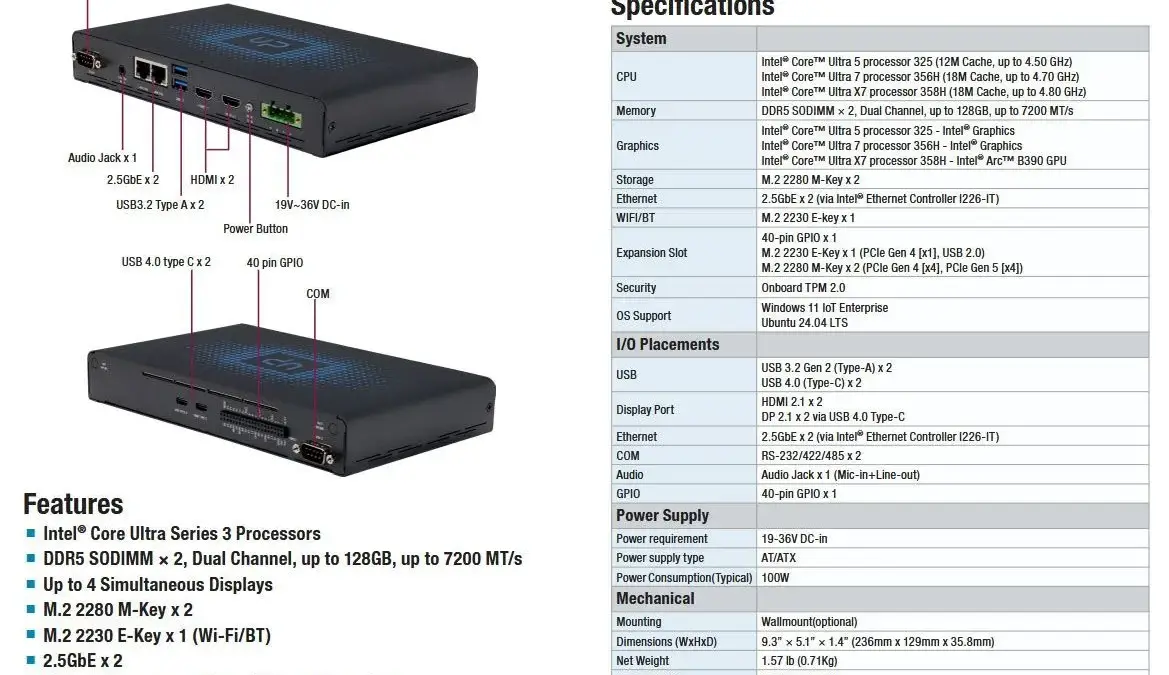
What truly sets the Up Xtreme PTL Edge Air apart from traditional desktop and embedded form factors is its thermal architecture. Rather than relying on a conventional mechanical cooling fan and bulky aluminum or copper heatsinks—which often introduce noise, collect dust, and consume valuable internal volume—Aaeon has opted to utilize Frore Systems’ cutting-edge AirJet ultrasonic membrane technology. This active cooling solution relies on the principles of ultrasonic vibration to generate high-velocity jets of air that efficiently move heat away from critical internal components. Despite being classified as an active cooling system because it moves air mechanically rather than relying purely on passive dissipation, the AirJet technology operates in an entirely different manner than standard axial or blower fans.
The implementation of Frore’s ultrasonic membrane technology yields substantial practical benefits for end-users operating in quiet environments or space-constrained deployments. According to Aaeon, the Up Xtreme PTL Edge Air is virtually silent during operation, registering at less than 21 dBA, which is well below the threshold of human hearing in a standard room environment. This near-silent operation makes the mini PC exceptionally well-suited for noise-sensitive deployments such as medical facilities, quiet office spaces, recording studios, digital signage installations, and automated retail kiosks where humming cooling fans would otherwise be an unwelcome distraction.
Beyond acoustic performance, the integration of solid-state active cooling has dramatic implications for the physical dimensions and weight of the hardware. Aaeon boasts that the unique thermal properties and slim profile of the AirJet modules have allowed its hardware designers to make the Up Xtreme PTL Edge Air significantly more compact than its predecessors and market competitors. Specifically, the manufacturer highlights that this new mini PC design is an impressive 35 percent thinner and 43 percent lighter than a comparable model relying on traditional heatsink and fan-cooled architectures. This dramatic reduction in physical bulk opens up new deployment possibilities, enabling the device to be tucked tightly behind displays, mounted inside cramped industrial control panels, or integrated into portable diagnostic equipment where every millimeter and gram counts.
The choice of the Intel Core Ultra X7 358H processor further anchors the Up Xtreme PTL Edge Air as a serious contender in the high-performance embedded market. Intel’s architecture in this tier brings substantial processing power, enhanced integrated graphics capabilities, and dedicated artificial intelligence acceleration through advanced neural processing units. For industrial applications, edge AI, computer vision, and complex data processing at the network periphery, having access to such robust silicon in a fanless or near-silent, ultra-compact chassis addresses a long-standing engineering compromise. Historically, developers and system integrators needing high-end x86 processing power were forced to accept large, heavy chassis with active fans that required regular maintenance, or they had to throttle performance significantly to rely on passive, fin-cooled enclosures.
Aaeon’s long-standing reputation in the embedded and industrial computing sectors heavily informs the design philosophy behind the Up Xtreme series. Known for engineering durable, reliable systems that can withstand harsh operating conditions, the company frequently pushes the envelope by experimenting with novel components and cooling methods. The Up Xtreme PTL Edge Air builds upon previous iterations in the lineup—which have historically explored unique integrations like blending Intel processor architectures with versatile auxiliary controllers—by focusing heavily on solving the perennial thermal challenges of modern high-density computing. By successfully incorporating Frore Systems’ AirJet technology into a production-ready commercial mini PC, Aaeon is demonstrating that solid-state active cooling has matured to a point where it can support enterprise-grade and high-performance mobile processors in ultra-slim enclosures.
As industries ranging from smart manufacturing and transportation to healthcare and retail continue to demand higher computational throughput at the edge, the physical constraints of deployment locations remain a primary bottleneck. Traditional cooling solutions often dictate the minimum size of a computer chassis, limiting where powerful hardware can be installed. By shrinking the chassis thickness by over a third and reducing total weight by nearly half while maintaining sub-21 dBA acoustic levels, the Up Xtreme PTL Edge Air provides a compelling blueprint for future compact computing solutions. Aaeon’s latest offering highlights an ongoing shift in hardware engineering, where thermal innovation is just as critical as raw processing power in defining the next generation of industrial and commercial PCs.

Leave a Reply