

Anyone who has ever sent a bank transfer overseas is intimately familiar with the painful, drawn-out process of waiting for things like working hours, correspondent banks, and rigid settlement times. In many modern contexts, it would arguably be faster, cheaper, and vastly more efficient to strap physical cash to a homing pigeon, or toss it into an envelope and send it via an express courier service.
Yet, a quiet and accelerating revolution is unfolding across global finance. Stablecoins are now capable of moving money across international borders around the clock, operating entirely independently of the legacy financial system’s sluggish steam engines. These digital assets can settle transactions 24/7, cut out convoluted layers of intermediaries, and provide individuals with direct access to digital dollars without even requiring them to open a traditional bank account.
This technological leap naturally forces a fundamental question: Do we even need traditional banks anymore? And what are the broader economic and systemic ramifications of stablecoins offering a fundamentally faster, cheaper, and easier way to move money across the globe?
The Two Clocks of Financial Disruption
To understand the tension between traditional banking and decentralized digital assets, industry experts look at how competition plays out across different time horizons. Anthony Vassallo, the director of crypto at Silicon Valley Bank—which famously failed in March 2023 and now operates as a division of First Citizens Bank—notes that competition from stablecoins manifests across two distinct time frames.
"Two clocks matter," Vassallo explains. "One is slow: currency substitution, deposit erosion, and weakening policy transmission building over months or years. One is fast: a depeg, issuer shock, or banking event that can move capital at software speed within hours."
Financial authorities are increasingly paying attention to both clocks. The European Central Bank has raised significant concerns about the potential macroeconomic impacts of stablecoins, arguing that large amounts of stablecoin reserves held in commercial bank deposits could trigger cascading withdrawals if there were ever a sudden surge in digital token redemptions. The central bank points to a fundamental "liquidity mismatch" between digital money and the traditional banking system that supports it. Reserve assets backing stablecoins are often subject to traditional, sluggish settlement timelines, while stablecoins themselves settle continuously around the clock.
The world saw this high-stakes dynamic play out in dramatic fashion in March 2023. USD Coin temporarily lost its vital one-to-one dollar peg after issuer Circle disclosed that a staggering $3.3 billion of its reserves were trapped inside the failed Silicon Valley Bank. The incident transformed an ordinary commercial banking failure into an overnight stablecoin crisis, forcing regulatory authorities to step in rapidly to guarantee deposits and prevent a wider contagion.

While bank runs represent extreme, high-velocity crises, the slower clock Vassallo describes carries a more insidious, drip-drip effect. This steady erosion happens quietly, often without an immediate crisis, making it far harder for regulators to track as it unfolds across the global economy.
Dollarization at a Slower Pace
The subtle, long-term impact of digital assets on sovereign currencies was highlighted in a July study by the Bank for International Settlements. The BIS examined stablecoin flows and conventional foreign currency deposits across 130 different economies. The research revealed that both forms of alternative currency tend to surge during periods of localized currency pressure, as well as during banking or sovereign debt crises. Crucially, stablecoin flows appeared significantly less affected by traditional government capital controls.
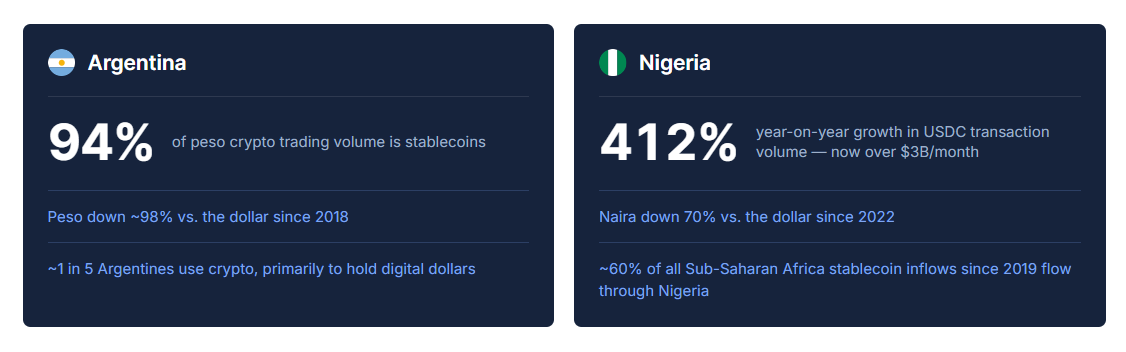
When ordinary citizens are desperate to escape a deteriorating local fiat currency, stablecoins provide a seamless, dollar-based alternative that local governments find exceptionally difficult to contain. A September report published jointly by Sphere Labs and Silicon Valley Bank explicitly points to emerging and volatile markets like Argentina, Nigeria, and Turkey as prime examples where stablecoin demand is tightly tethered to an insatiable local appetite for dollar exposure.
In Argentina, for instance, the report highlights that 94% of all cryptocurrency purchases made using the local peso were directed into stablecoins. Meanwhile, in Turkey, an estimated $38 billion worth of local lira was systematically swapped for stablecoins over the course of a single year.
Arnold Lee, the chief executive officer of Sphere Labs, argues that widespread stablecoin adoption is fundamentally a dollarization story driven by intense demand from populations facing severe structural barriers to accessing the traditional banking system.
"Most of these economies are going to keep moving toward dollars," Lee says. "What I spend my time on is the manner of it, because a country that manages the shift and one that gets overtaken by it end up in very different places."
When the Clock Speeds Up and Regulatory Friction Mounts
A separate BIS study published earlier in the year found that a sudden spike in demand for dollar-pegged stablecoins can easily spill over into traditional foreign exchange markets. Researchers analyzed four major USD-pegged stablecoins across 27 different fiat currencies between 2021 and 2025. The findings indicated that increased stablecoin demand places immediate downward pressure on local currencies and drives up the cost of obtaining physical dollars through FX swaps—an effect that intensifies when traditional financial intermediaries are already experiencing distress.
"When citizens in high-inflation economies move from local currency into digital dollars, monetary transmission weakens, deposit bases erode, and pressure builds faster than central banks can respond," Lee explains.
The real-world friction of this fast-moving capital was vividly demonstrated during a geopolitical and economic dispute between the United States and Colombia. While traditional banks and physical currency exchanges were closed for the weekend, local citizens seamlessly plowed their funds into digital dollars, operating on blockchain rails that never close.
This constant vulnerability is precisely why central banking warnings carry so much weight. Under the European Union’s landmark Markets in Crypto Assets regulations, stablecoin issuers are legally required to hold at least 30% of their total reserves in commercial bank deposits, with that requirement climbing as high as 60% for significant asset-referenced tokens.
However, the European System of Central Banks proposed moving away from these rigid, fixed percentage requirements in favor of a more flexible framework based on how quickly underlying reserve assets can actually be liquidated. Such a shift could theoretically avert a doomsday scenario where massive, sudden redemption waves bleed commercial lenders dry overnight—a systemic danger that Tether CEO Paolo Ardoino warned about when criticizing MiCA’s strict banking integration rules.
Ultimately, the underlying technology does not dictate the direction of the capital flow; it merely dictates the velocity. Money can exit a commercial bank and transform into a stablecoin when users demand digital dollars, and it can just as easily flow back into the banking system when those tokens are redeemed.
What Part of the Financial System is Actually Being Displaced?
Despite the rapid growth of decentralized financial rails, stablecoins are not entirely replacing the traditional financial architecture just yet. In many commercial contexts, they serve as a high-speed intermediate currency that accelerates cross-border transfers, only to end up converted right back into traditional fiat currency sitting inside a conventional bank account.
Pankaj Bengani, a former executive at Block and the co-founder of stablecoin payments firm MELD, notes that close to half of his company’s business-to-business stablecoin offramp volume originates in North America. The corporations utilizing these rails include international importers, exporters, major technology firms, e-commerce marketplaces, traditional payment companies, and modern fintechs.
"The vast majority of corporates in our data convert back to fiat immediately after the transaction settles. They are not taking a crypto position. They are using MELD as a settlement rail instead of SWIFT," Bengani explains.
According to Bengani, the largest volume of these flows consists of cross-border commercial payments—particularly scenarios where businesses earn or hold capital in U.S. dollars, but their overseas suppliers and employees require compensation in local fiat currency. Direct supplier payments make up nearly a third of all business use cases, while general invoice settlement accounts for roughly a quarter.
This commercial reality paints a very different picture than the common narrative of everyday citizens rushing into digital dollars purely to protect personal savings from rampant inflation or pulling lump sums out of the banking system during localized financial panics.
It also forces a deeper examination of what elements of legacy finance are truly being displaced. If corporate capital is not lingering within the crypto ecosystem, what traditional infrastructure is actually fading away?
"Stablecoins won’t replace SWIFT overnight," Bengani says. "The realistic change is a thinner correspondent layer, with a common settlement rail replacing intermediary steps that exist only because banks historically needed each other to cross borders."
In an economic landscape where capital moves at unprecedented speeds, this structural shift does not mean traditional banks are destined to disappear entirely. Bank deposits and government treasuries remain vital resting places for reserves, businesses still rely heavily on localized fiat currencies, and regulated financial institutions continue to play an indispensable role in providing custody, regulatory compliance, liquidity, and local settlement.
Instead of completely eradicating banks from the financial ecosystem, stablecoins are reshaping the underlying plumbing—shifting the traditional points of friction and redefining how global money moves from one corner of the world to another.



Leave a Reply