
By Solstice
09.30.2026
As the global focus on advanced thermal management continues to expand rapidly across a diverse range of high-tech and heavy industries—including aerospace, defense, semiconductor manufacturing, wind energy, and electric vehicles—manufacturers are increasingly facing a complex landscape defined by both unprecedented engineering challenges and new market opportunities. Among these sectors, the electric vehicle industry is undergoing a particularly profound and accelerated structural transformation.
With EV adoption rates accelerating across global markets and consumer demand continuously rising for more sophisticated, highly efficient, and lightweight cooling systems, automotive and industrial manufacturers are actively rethinking their traditional manufacturing approaches, particularly when it comes to brazing processes. While aluminum is rapidly becoming the material of choice for next-generation EV heat exchangers due to its favorable weight and thermal properties, conventional flux application methods are increasingly showing their limitations. Traditional techniques can frequently create manufacturing inefficiencies, persistent residue challenges, and mounting environmental and regulatory concerns that modern production lines can no longer afford to ignore.
Industry stakeholders and engineering professionals are now being invited to explore how advanced material science and modern application technologies are coming together to solve these systemic manufacturing hurdles. Through an exclusive on-demand event, manufacturers can examine how Praziflux® is actively transforming brazing processes across the electric vehicle industry and a wide variety of other high-performance thermal management applications. The comprehensive session delves into how this innovative fluxing material, when paired with a state-of-the-art non-contact dispensing method, delivers significant operational, financial, and environmental advantages over legacy manufacturing processes.
The ongoing evolution in thermal management is largely driven by the extreme demands placed on modern engineering systems. In the aerospace and defense sectors, equipment must operate reliably under extreme thermal loads and harsh environmental conditions, requiring cooling systems that are both exceptionally robust and meticulously manufactured. Similarly, in the semiconductor industry, the rapid densification of computing power necessitates advanced liquid cooling and thermal dissipation architectures to maintain optimal operating temperatures and prevent hardware degradation. Wind energy installations, which rely on massive electrical generators and power converters, face similar pressures to maximize thermal efficiency and reliability in remote, hard-to-access locations.
However, it is arguably within the electric vehicle market that the pressure to innovate has reached its peak. As automotive manufacturers strive to extend vehicle driving ranges, reduce overall vehicle weight, and accelerate charging speeds, the underlying thermal management systems have grown exponentially more complex. Modern EVs require intricate networks of heat exchangers, battery cooling plates, and power electronics thermal systems designed to keep critical components within strict temperature windows. To meet these stringent requirements, the industry has widely embraced aluminum as a primary material for heat exchangers because of its lightweight nature and excellent thermal conductivity.
Despite its performance benefits, joining aluminum components through traditional brazing methods has long presented persistent engineering challenges. Conventional flux application processes often involve dipping, spraying, or brushing corrosive chemical fluxes onto the metal surfaces prior to the furnace brazing cycle. These traditional methods frequently suffer from a lack of precision, leading to excessive flux usage, undesirable residue accumulation, and the potential for blocked fluid channels or compromised joint integrity. Furthermore, cleaning up residual flux post-brazing requires complex washing processes that generate hazardous wastewater, presenting significant environmental liabilities and disposal costs for manufacturing facilities.

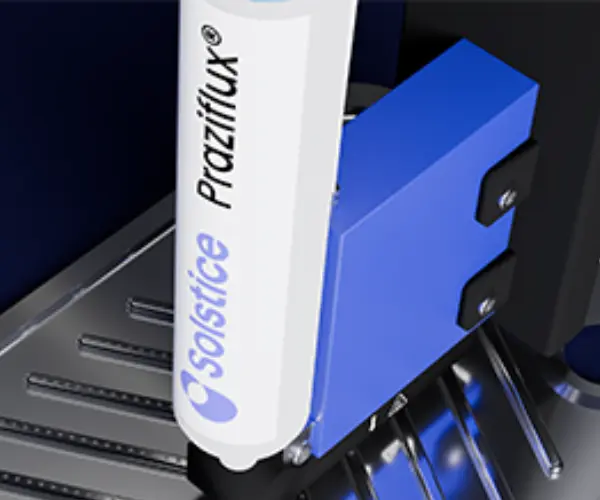
To address these longstanding limitations, industry innovators have turned their attention to advanced flux materials and precision delivery systems. Praziflux® has emerged as a compelling solution within this space, engineered specifically to address the intricate demands of modern aluminum brazing. When combined with innovative non-contact dispensing methods, such as advanced jetting technology, the material allows manufacturers to apply precise amounts of flux exactly where it is needed, eliminating the guesswork and waste associated with older application techniques.
The ongoing on-demand industry event highlights how these technological advancements translate into tangible shop-floor benefits. Whether organizations are manufacturing mass-market EV components or supporting other critical thermal management applications across demanding industrial sectors, the collaborative use of advanced jetting technology and innovative brazing flux solutions offers a clear pathway toward improved product quality. By achieving greater precision in flux deposition, manufacturers can significantly reduce defect rates, enhance structural reliability, and ensure consistent thermal performance across millions of produced units.
Beyond immediate quality improvements, the adoption of these advanced manufacturing techniques directly supports broader corporate sustainability goals. Minimizing chemical waste, reducing water consumption associated with post-brazing cleaning, and lowering energy consumption through optimized furnace cycles all contribute to a more environmentally responsible production lifecycle. In an automotive and industrial landscape where environmental compliance and carbon footprint reduction are becoming mandatory metrics for success, these sustainable manufacturing practices provide a distinct competitive edge.
Furthermore, as global supply chains and manufacturing facilities face ongoing pressures to increase overall production throughput, efficiency on the factory floor is more critical than ever. Traditional brazing workflows often act as bottlenecks due to the time-consuming nature of manual or semi-automated flux application and subsequent cleaning stages. By integrating high-speed, non-contact dispensing systems with advanced flux formulations, facilities can streamline their production lines, reduce cycle times, and achieve higher yields without compromising on stringent quality standards.
The comprehensive industry presentation provides engineering leaders, manufacturing executives, and technical specialists with a detailed look at how these technologies are being successfully deployed in real-world production environments. Participants can examine the technical mechanisms behind non-contact jetting, understand the material characteristics of advanced flux solutions, and evaluate the long-term economic and operational impacts of upgrading their thermal management manufacturing lines.
As the demand for high-performance cooling systems continues to grow alongside the expansion of electric vehicles and advanced industrial technologies, the methods used to manufacture these critical components must evolve in tandem. By moving away from inefficient legacy processes and embracing modern material science and precision application technologies, manufacturers are well-positioned to meet the rigorous demands of tomorrow’s thermal management landscape.

Leave a Reply