
"I get so overwhelmed that I do nothing" is a sentence that most people reserve for internal monologues, whispered in the quiet frustration of a day that slipped away. The scene is a familiar one across modern workplaces: you open your laptop at 9:15 in the morning with a crystal-clear understanding of what matters most for the day ahead. By 9:50, however, you have read the same three emails twice, opened a spreadsheet only to close it a moment later, checked the news to see if anything major happened, and moved absolutely nothing forward. Not a single thing.
The work itself is rarely hard. You could easily explain to a colleague exactly what needs to happen and why it matters. Yet, you remain sitting perfectly still.
That stillness tends to compound as the pile of obligations grows heavier. During a light week, everything runs smoothly. But introduce a week featuring a complex contract to review, a doctor’s appointment to schedule, a presentation deck to build, and a friend waiting for a reply since Tuesday, and suddenly none of the four tasks get done. Not even the one that takes two minutes. When the evening finally arrives, you are left feeling like someone who completely wasted a day, which in turn makes the psychological weight of tomorrow even heavier.
According to behavioral insights, this phenomenon is not a discipline problem. Instead, it is a definition problem, and definition problems possess practical fixes.
Why the Freeze Is Not Laziness
The core issue behind this paralysis is a load problem rather than a character flaw. Working memory research, including reviews by cognitive scientist Nelson Cowan, places the central limit of human working memory at roughly three to five chunks of information in young adults when rehearsal is blocked, with no single number holding universally across every situation. Human attention remains a remarkably small container. When an individual is suddenly confronted with eleven open loops arriving all at once, the sheer volume overwhelms the system, and the incoming pile does not care how disciplined you believe you are.
Most people who experience this have already cycled through the usual assortment of productivity repairs. They have downloaded new task management applications only to import their lives and abandon the software a week later. They have experimented with 5 a.m. wake-up routines that lasted for nine days before collapsing. They have attempted time-blocking, a strategy that works beautifully right up until the scheduled block arrives and they still find themselves entirely unable to make themselves open the file.
These tools frequently fail not because individuals lack discipline, but because those systems assume the hard part of the equation is deciding when to work. For people who experience chronic overwhelm, the obstacle sits somewhere entirely different. When someone confesses that they get so overwhelmed they do nothing, they are accurately describing that precise moment of friction when they look at an item on their list and their brain returns no obvious first move. This knowing-doing gap worsens significantly when the workday already feels overloaded from the start. Avoidance naturally provides immediate comfort in the short term while proving extraordinarily expensive by the time evening rolls around.
The Problem Is Not Motivation: Your Next Step Is Still a Decision
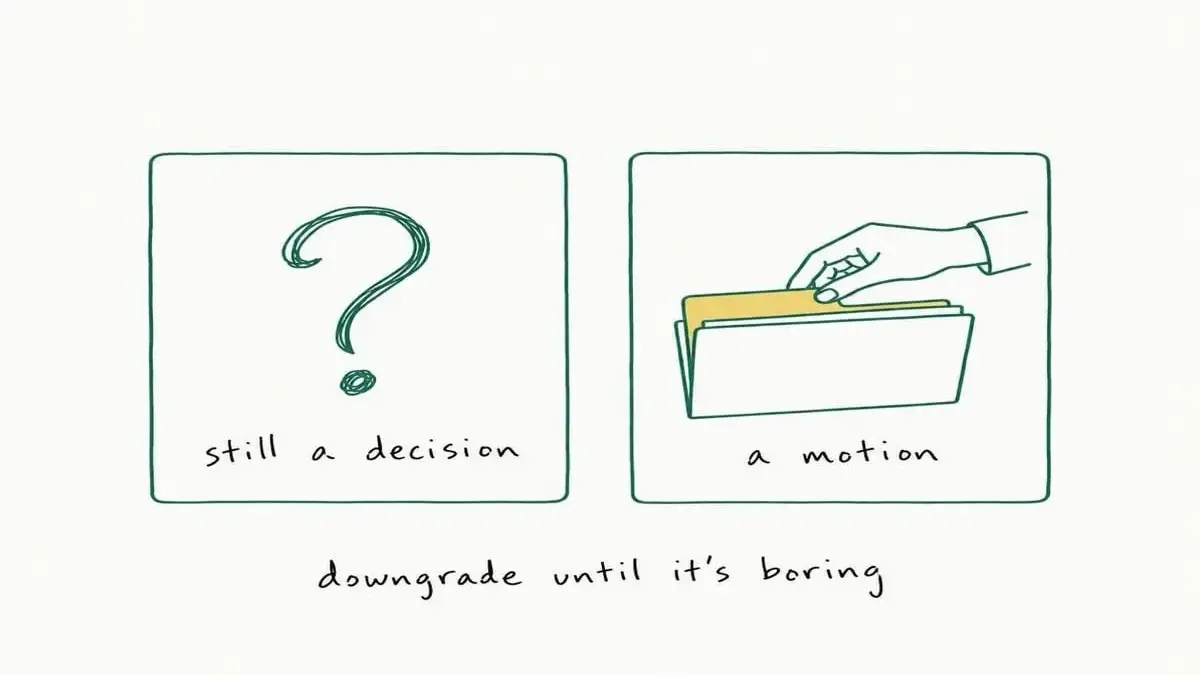
A close examination of a typical daily to-do list reveals a striking pattern: the vast majority of listed items are not actual physical actions. Entries like "sort out the insurance," "deal with the vendor thing," or "start the report" are not tasks at all. They are complex questions wearing the costume of tasks. Each one demands a preliminary decision before a single muscle can move, and when every available option opens with heavy cognitive lifting, doing nothing wins by default.
Research into decision deferral points toward the same conclusion. People become significantly more likely to postpone a choice entirely when the alternatives are difficult to navigate and the underlying conflict remains unresolved. While popular discussions of choice overload have sometimes oversaturated the concept, recent reviews indicate that choice overload is conditional rather than inevitable, with effects depending heavily on complexity, difficulty, and personal stakes. Simply having more options does not automatically paralyze everyone. However, encountering a choice that cannot be initiated without first settling an ambiguous prerequisite is an entirely different animal, and that is precisely what sits waiting on most overloaded lists.
This realization challenges some of the most repeated productivity advice. Breaking a big task into smaller tasks frequently fails to help because "write the report" simply becomes "outline the report," which then degrades into "think about the structure." Each of those iterations remains a decision. The work has not actually been made easier; it has merely been transformed into a shorter question.
The proper target is not making tasks smaller. The target is making them boring.
Downgrade the Task Until It Is Boring
A task has been downgraded sufficiently when a reasonably competent stranger could execute it without needing to ask a single clarifying question. That serves as the ultimate test. "Do my taxes" fails the test instantly. Conversely, "open the folder marked 2025 and put every paper document in one pile" passes seamlessly because there is nothing left to figure out. Boring is not a lowered standard of performance; rather, boring is the reliable signal that all the heavy thinking has already been completed.

When running personal tasks through this filter, the dread rarely vanishes entirely, but it stops functioning as an impenetrable wall and transforms into a minor, manageable errand. If a step still feels mentally heavy, it has not been downgraded enough, meaning a hidden decision is still lurking inside it.
There is an important warning to keep in mind: this approach is not a psychological trick designed to smuggle yourself into two hours of uninterrupted labor. That version inevitably backfires because your brain quickly learns that the instruction to "just open the file" was deceptive. The physical motion itself must be the entire commitment.
Writing the Three-Line Card
To implement this method, individuals write three simple lines on an index card or a sticky note: when and where the physical motion starts, the specific single motion itself, and the exact point where it ends. Specific implementation intentions of this shape possess a solid foundation in psychological research. A comprehensive meta-analysis encompassing dozens of independent studies and thousands of participants has demonstrated a clear average goal-attainment advantage for specific implementation intentions compared to simply holding a goal in mind.
A genuinely effective card looks remarkably dull: "When my coffee is made, at my desk, I open the vendor contract and read only section 4. Done when section 4 is read."
The act of writing this out matters more than it might initially appear. Experimental research indicates that making a specific, concrete plan for an unfinished goal actively reduces the intrusive thoughts that the unfinished goal otherwise produces, freeing up cognitive attention until the planned moment arrives. This is also why the initial step involves emptying the contents of your head onto paper. Ten items written out on a physical page are simply ten items. Ten items cycling endlessly in your head are ten items plus the exhausting psychological effort of holding them simultaneously.
Naming the Unmade Decision
A frozen task almost always conceals one unmade decision, and that decision is frequently small enough to feel slightly embarrassing in retrospect. An individual might be stuck because they do not know whether to use an old template or start fresh, or because they need a specific data point that only a colleague possesses, or because they secretly suspect that all available options are fundamentally flawed. Until that specific decision is explicitly named, every attempt to start running into the obstacle will quietly bounce off it, which explains how the exact same item manages to survive on a to-do list for five weeks.
Naming the block requires writing a direct sentence: "What I have not decided is __."
Once that answer is articulated, the required motion changes entirely. If the missing piece requires input from someone else, the motion is no longer the task itself, but rather sending a single message. If the decision belongs entirely to you but you continue to circle it endlessly, the motion becomes blocking out twenty minutes on the calendar specifically to make the choice. If neither option feels appealing, the solution is often to pick the one that proves easiest to undo.
In practice, managing this state on an ordinary day involves a brief exercise rather than an exhaustive planning session, resulting in one small, unimpressive output. Everything accumulated in the head is transferred to a single page, the item generating the most dread is identified, the hidden decision within it is exposed, and a single message is sent or a single file is opened. The day may not transform into a pinnacle of high productivity, but it stops being entirely lost—a different and far more reachable target.
When the Freeze Extends Beyond a Bad Week
An ordinary overwhelm freeze typically lifts the moment the next physical motion is clearly defined. However, a state of paralysis that persists over a prolonged period warrants a different category of attention. Mental health organizations consistently advise consulting with a qualified healthcare professional regarding severe symptoms that last for two weeks or more, including persistent trouble concentrating, difficulty making simple decisions, and ongoing challenges in completing everyday tasks and activities.
While online terminology frequently circulates terms like task paralysis or the impossible task to describe these experiences, they remain community shorthand rather than formal clinical diagnoses. Nevertheless, clinical literature and behavioral activation frameworks consistently support the foundational strategy of breaking inertia by scheduling concrete, manageable physical activities, even though such steps are designed to complement professional care rather than replace it.
Ultimately, overcoming the freeze does not require transforming a dreaded day into a triumph of output. It only requires moving one small thing forward.
Leave a Reply