
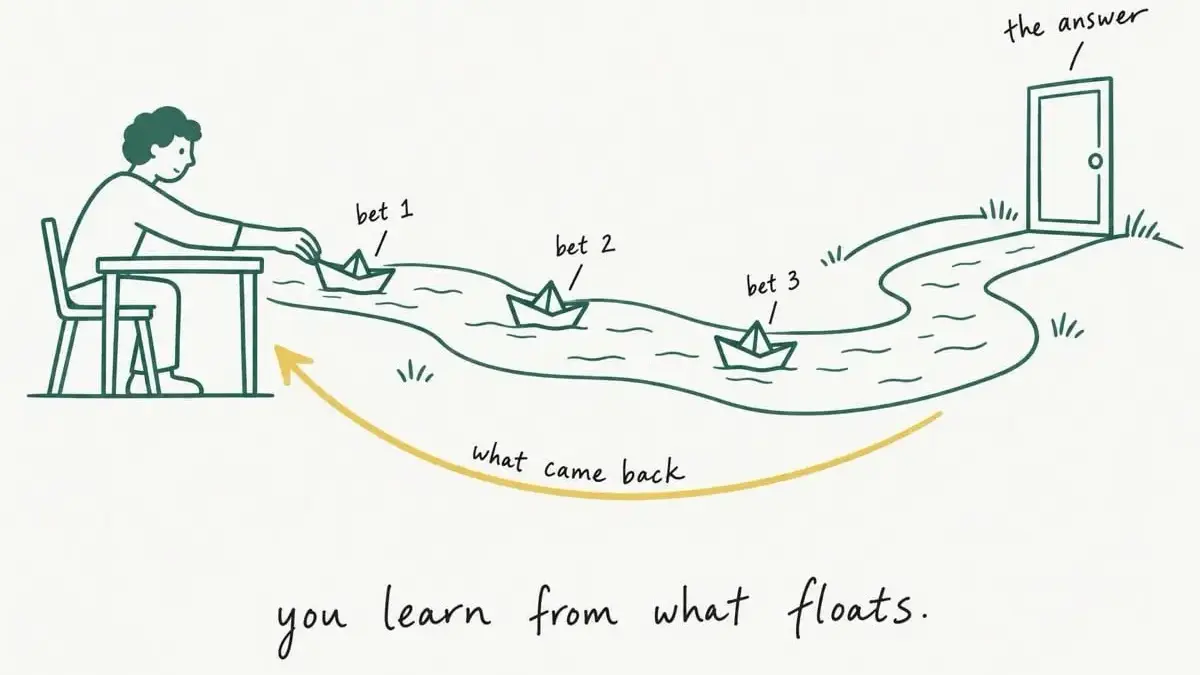
You know you want out, yet you still cannot name what you want instead. For three consecutive years, you have told yourself that next year will be the time you finally make a move. The job is fine, which is the ultimate trap. It is neither bad enough to walk out of nor good enough to stay awake for. Every guide you open advises you to first figure out what you want and then go get it. According to workplace researchers, that exact sequence is precisely why you are still sitting at the same desk. People who change careers successfully do not decide first and act second. Instead, they act first in small, inexpensive ways, letting real-world evidence gradually narrow down the answer.
So the weekends fill with endless research instead. You look up salary data for fields you will never enter and take personality assessments that return a four-letter code accurate enough to be entirely useless.
The primary reason you stay is that you are actually good at your job. That competence keeps the door from closing on its own. If you were failing miserably, the decision would be made for you by management. Instead, you keep choosing not to choose, every single Monday. Traditional advice focuses entirely on the stall itself, but for professionals ready to move past the paralysis, the core challenge lies in understanding how the transition actually begins.
Why Standard Career-Change Advice Leaves You Stuck
Most conventional career-change advice is written under the assumption that the person already knows their destination. It tells you to audit your transferable skills, rewrite your resume for the new field, and build out your network. Every one of those steps sits downstream of a fundamental decision you simply have not made yet. The advice that does attempt to address the decision sends you inward, instructing you to reflect until clarity magically arrives. While that method works for a select few, for plenty of others it returns nothing at all.
A quick look at institutional resources highlights the gap. University guides and federal employment sites offer a competent picture of what to do after you have chosen a path, but they remain entirely silent on how anyone actually chooses in the first place. The question of how to change careers successfully gets treated as a logistical problem when it is not yet one.
You have likely tried the inward version of this exercise: listing what you are good at, listing what you enjoy, and looking for an overlap that turns out to be either empty or too vague to translate into an actual job. That is not a failure of discipline. You were simply asked to produce an answer out of material you have not yet collected.
Changing Careers Is an Evidence Problem, Not a Decision Problem
A career transition is not a singular decision you make and then execute. Rather, it is a question you answer by gathering evidence, mostly about yourself, and mostly by doing things. You cannot possibly know how a field feels from the outside, and you cannot introspect your way to information you have never collected before. The move that actually works is small, cheap, and entirely reversible: do a tiny piece of the work, talk to someone who does it daily, and see what that direct experience tells you.
That approach runs counter to the usual sequence. The strongest academic case for it comes from Herminia Ibarra, a researcher who studies career transitions. Her findings rest on an in-depth study of 39 managers and professionals who changed or were attempting to change careers. Her work highlights a distinct order of operations: identity work comes first, the career change comes second, and both are achieved through active engagement.
This realization brings two uncomfortable truths to light. First, your current confusion is not a personal fault that must be repaired before you are allowed to take action. It is simply the ordinary condition of someone who has not yet run any real tests. Second, the timeline is sobering. Ibarra’s research estimates that most career transitions take about three years. They do not take three months. If you measure your progress against an unrealistic plan that has you fully re-employed in a new field by spring, you will inevitably decide you are failing around week six and quit the only process that was ever going to work.
How to Change Careers Successfully Through Action
Navigating this transition effectively involves a specific sequence of moves: naming the constraints you cannot break, turning one vague destination into several specific bets, buying evidence through real conversations and actual work, and putting credentials dead last. The order carries far more weight than the content itself, because the expensive move—such as paying for a degree—is the one you cannot take back, meaning it belongs at the very end of the process.

Before asking what you want, you must write down what has to stay true. This includes the lowest monthly income you can accept without wrecking your household, the actual hours you have available each week, whether you can relocate, and whether a temporary pay cut is survivable. A destination that violates a real constraint is not a viable option; it is merely a daydream attached to a tight runway. Keeping every option open at once is the primary habit that prevents people from making decisions quickly.
Instead of hunting for a single correct answer, look for three plausible bets. A bet must be specific enough to test—not a vague aspiration like "something in healthcare," but a concrete role like a clinical data analyst at a hospital system. Three options strike the right balance because a single option turns into something you defensively cling to, while five options simply drag you back into endless research.
Each bet then requires two types of tests: conversations with people working in the field and a small piece of real work. The most useful conversations happen at the edge of your network rather than with close friends who already know what you know. Sociological research and large-scale data analyses demonstrate that weaker ties—former colleagues, acquaintances, or people two steps removed—frequently drive job transitions more effectively than close contacts, up to a certain point of diminishing returns. In practice, this means reaching out to people to ask what an ordinary Tuesday looks like in their role and who else you might speak with.
Above conversations, however, stands the value of actual work. Doing a small, real version of the job—such as a volunteer analysis, a weekend build, or a freelance project—gives you an honest read on whether you want to perform those tasks every day. Enthusiasm is never evidence, but a finished project is.
Putting Credentials Last and Understanding the 90-Day Window
One of the most critical aspects of this strategy is buying qualifications last. Traditional career advice often puts credentials first, yet employers’ actual hiring practices frequently lag behind public announcements regarding skills-based hiring. Comprehensive analyses of millions of corporate hires show that the promised expansion of alternative hiring methods accounts for only a tiny fraction of total annual placements. While credentials still carry weight in regulated fields, tuition cannot be spent on employer press releases.
To manage this without stalling, professionals can establish a 90-day window to run their bets through clear checkpoints. Weeks one and two involve defining constraints and outlining bets on paper. Weeks three through ten are dedicated to running conversations and small projects in parallel. Weeks eleven and twelve focus on review: determining what came back viable, what proved unfeasible, and what deserves further pursuit.
Take Joyce, a hospital operations manager who tested three bets over her 90-day window. Through a contact found via an acquaintance, she discovered that one analyst path required evening certifications she did not possess, prompting her to build her own dashboard project on her own time. By the end of her review period, she had not changed careers, but she had successfully eliminated unviable options and laid the groundwork for a future resume rewrite.
Conversely, Tom, an agency account director, found that all three of his alternative bets came back cold. Rather than signaling failure, this outcome revealed that his core frustration stemmed from his specific role rather than his entire industry, making the problem far easier and cheaper to fix.
Ultimately, navigating a career change successfully from the inside is unglamorous and inexpensive. It is primarily a matter of discovering which of your ideas can survive a real Tuesday on the job, one careful test at a time.



Leave a Reply