
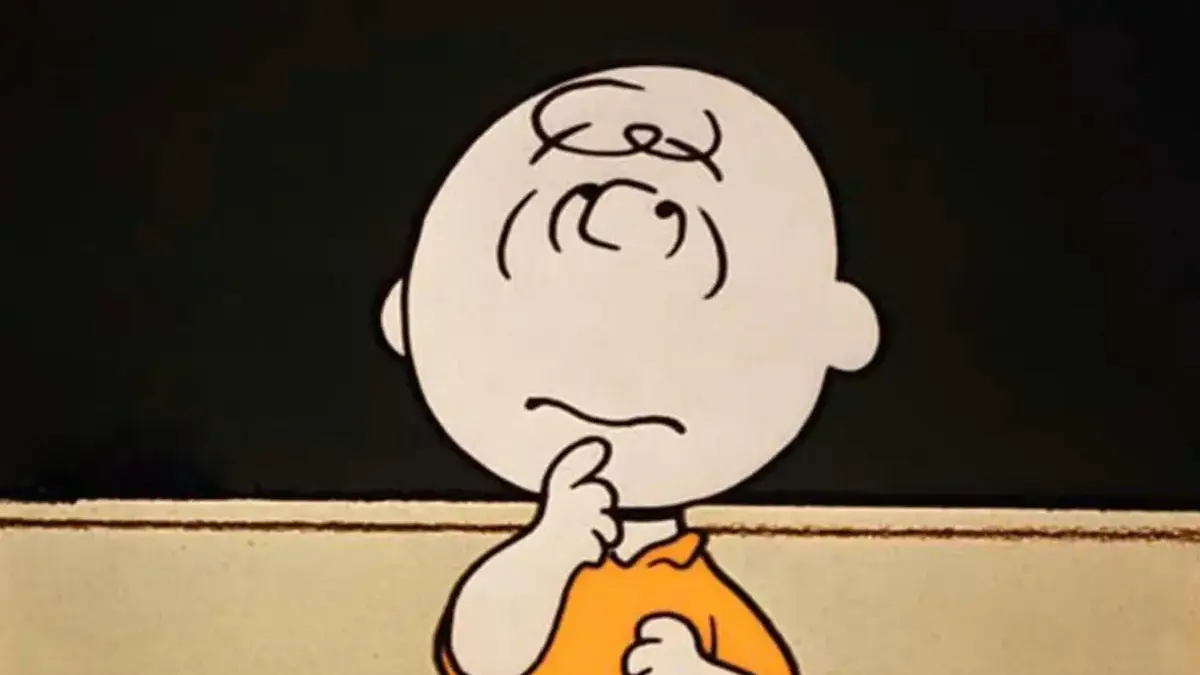
Unless Woodstock is saying something even more brilliant—though it is notoriously difficult to tell—American cartoonist Charles Schulz may have penned his single most profound philosophical statement decades before his passing, without ever truly realizing its weight.
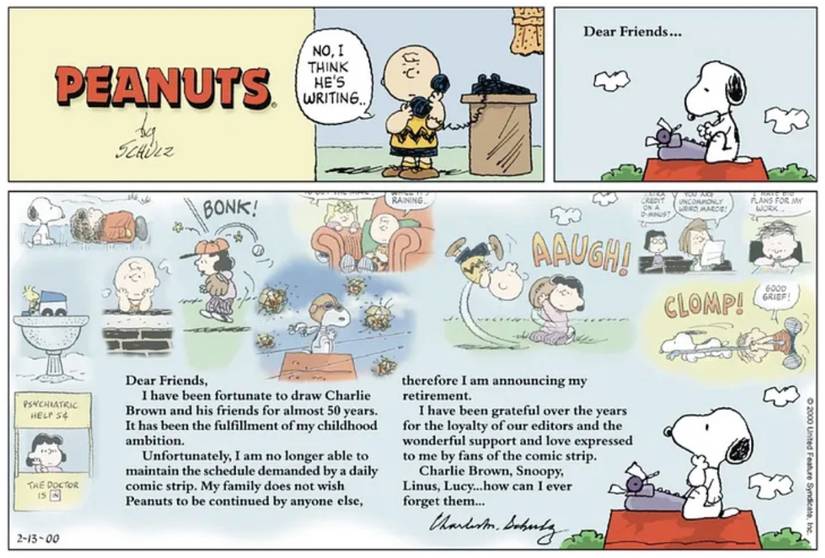
American cartoonist Charles Schulz died on February 12, 2000, at the age of 77. The very next day, the final Peanuts comic strip ran in newspapers across the world, bringing a definitive close to a remarkable 50-year run featuring Charlie Brown, Snoopy, and the rest of the beloved neighborhood gang. That timing might initially seem entirely logical to the casual observer—an assumption that the comic strip was written and submitted shortly before its publication date. However, Peanuts strips, particularly elaborate Sunday editions like this final one, were routinely produced weeks and sometimes months ahead of publication. This made the timing of the final strip’s release a striking, if somewhat bittersweet, coincidence.
Schulz had publicly announced his retirement two months earlier, in December 1999, following several strokes and a private battle with advancing colorectal cancer. He had created his final strip shortly after making that retirement announcement to his syndicate and fans. While Schulz was acutely aware that he was terminally ill, he could not have known with absolute precision two months in advance the exact day he would pass away. Consequently, by sheer coincidence, he penned what amounted to his own cultural and artistic obituary, with his final published comic strip appearing on newsstands just one day after his death.

The timing was auspicious and deeply profound, which felt entirely fitting for a man who left such an enduring imprint on American culture and the medium of comic strips. Over the course of his legendary 50-year career, Schulz produced nearly 18,000 individual Peanuts comics. While some strips were designed to be sweet, whimsical, or lighthearted comedy, others possessed an incredible depth of character and philosophical weight. Among these stands a specific sequence from February 3, 1966, which arguably contains Schulz’s finest and most insightful quote—a remarkably high bar for an artist of such immense and prolific talent.
Charlie Brown and the Spelling Bee
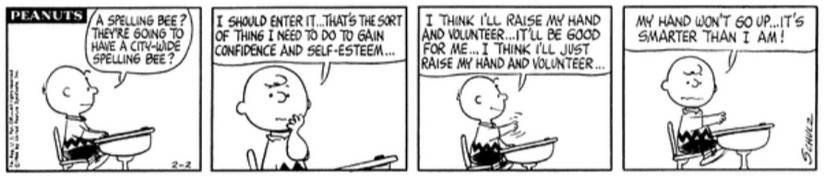
The iconic quote originated as a memorable moment within an extensive, multi-week storyline centered around Charlie Brown participating in a school spelling bee. The narrative arc began on February 2, 1966, and stretched across newspapers all the way until February 20. The story ran for 16 consecutive daily strips, excluding Sundays. Sunday editions were typically handled differently because they required significantly longer lead times for color separation and printing, and because many casual readers only picked up the comics section on weekends, necessitating more self-contained gags.
In the unfolding plotline, an enthusiastic Charlie Brown bravely volunteers to represent his class in the school-wide spelling bee. While he enters the competition with high hopes and genuine excitement, he characteristically botches his very first turn at the microphone. When given the relatively simple word "maze," a nervous and flustered Charlie Brown spells it as "m-a-y-s." Mortified by his immediate failure, a stressed-out Charlie Brown retreats to his desk and lays his head down in utter despair. When his teacher notices and sternly instructs him to pick his head up, he snaps under the pressure and talks back, resulting in an immediate trip to the principal’s office. He is later sent back to the classroom, where he eventually humbles himself to apologize to his teacher for his outburst.

However, the true emotional and intellectual highlight of the entire multi-week storyline did not occur at the spelling bee podium or in the principal’s office. Instead, it arrived in only the second strip of the sequence, immediately after Charlie Brown had first announced his decision to volunteer.
The comic strip opens with an incredulous Lucy van Pelt, who simply cannot fathom why Charlie Brown would willingly subject himself to public humiliation by volunteering for a spelling bee when everyone already expects him to fail. In direct response to Lucy’s characteristic skepticism and mockery, Charlie Brown shouts back in frustration: "Well, what’s wrong? What’s wrong with trying?! I can try, can’t I?"
Immediately following this defensive outburst, Charlie Brown delivers a line of dialogue that transcends the Sunday comics page entirely. He looks at Lucy and says: "What’s the good of living if you don’t try a few things?"
Good grief, it is a brilliant sentiment. It represents a remarkably thoughtful yet deceptively simple statement about the fundamental human condition—the kind of wisdom that would benefit anyone to keep in mind, regardless of age or circumstance.
Naturally, the profound nature of the statement is entirely lost on both Lucy and Charlie Brown himself within the context of the scene. They are depicted simply as ordinary children, and they are certainly not supposed to possess profound self-awareness when they utter philosophical truths, a dynamic that occurred quite frequently throughout the history of Peanuts. Yet, historical evidence suggests that even Charles Schulz himself failed to recognize the true brilliance of the words he had written into the mouth of his most famous, self-doubting creation.
Charlie Brown on the Big Screen
This extensive 20-part newspaper story detailing Charlie Brown’s ill-fated spelling bee adventure later served as the primary narrative foundation for the very first theatrical Peanuts feature film, titled A Boy Named Charlie Brown, which premiered in theaters on December 4, 1969. That motion picture, which was personally written by Schulz himself, remains a major yet somewhat overlooked piece of animation and comic strip history.
The film closely follows the narrative trajectory of the spelling bee newspaper arc, albeit with substantial new material added to stretch the plot across an 85-minute feature runtime. Yet, despite the expansion of certain scenes and musical numbers, several elements from the original newspaper comic strips were left out of the cinematic adaptation, most notably Charlie Brown’s poignant rhetorical question about the purpose of living.
Perhaps Schulz felt there was no organic narrative place for the line within the bustling structure of the animated feature, or perhaps he simply viewed it as standard throwaway dialogue, failing to recognize that it was anything out of the ordinary. Regardless of its omission from the silver screen, the quote stands on its own merits. That simple statement carries just as much profound weight as any adage handed down by a president, a classical philosopher, or any other historical figure society traditionally looks to for deep wisdom. Because, when stripped of all complexity, what is the ultimate point of living if we do not dare to try a few things while we are here? Charles Schulz certainly tried, and the world has been living with the remarkable results ever since.



Leave a Reply