
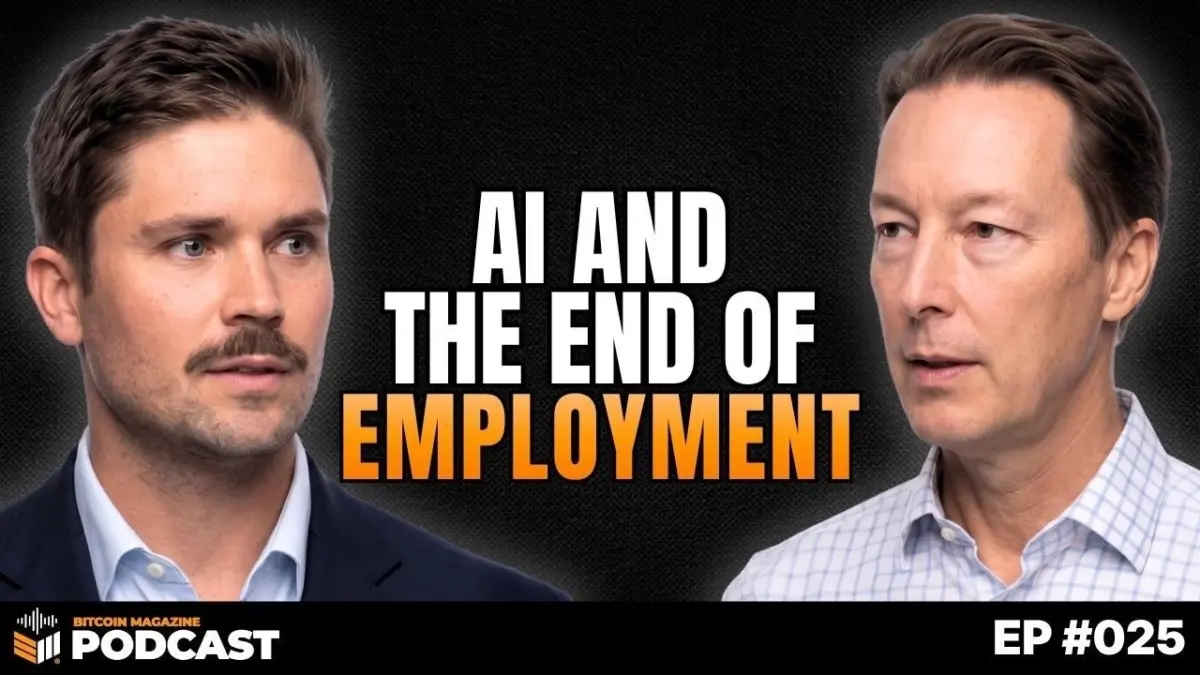
Artificial intelligence is fundamentally altering the modern workplace, increasing productivity, and streamlining operations across nearly every major industry. However, a central question remains: can machines ever truly replace the human entrepreneur?
To explore this pressing issue, prominent Austrian economist and Mises Institute Senior Fellow Per Bylund recently joined Spencer Nichols on a special broadcast to break down the economic realities of automation, human action, and market innovation. Bylund argues that while machine learning algorithms are powerful statistical engines capable of driving unprecedented operational efficiency, they fundamentally lack the capacity to imagine the future.
As society navigates this technological shift, Bylund suggests that humanity is undergoing a massive structural transformation, moving away from a traditional employment economy and into an entrepreneurship economy. This evolution carries profound implications for the future of employment, systemic innovation, and the generation of economic value.
Austrian Economics on AI, Innovation, and Entrepreneurship
To understand the limitations of artificial intelligence in a market economy, Bylund applies the principles of Austrian economics, which emphasizes human action, subjective value, and the critical role of uncertainty in commerce. Unlike neoclassical economic models that often treat markets as static equations, Austrian economics views the market as a dynamic, ever-changing process driven by alertness to profit opportunities.
AI systems operate entirely on historical data, recognizing patterns and executing programmed tasks with astonishing speed. Yet, this reliance on past information highlights a permanent limitation. Because the future is inherently uncertain and unwritten, a statistical engine cannot anticipate or create novel conditions that have never occurred before. True economic progress relies on judgment, imagination, and the willingness to bear risk—qualities exclusive to human beings.
Invention vs. Innovation: What Bitcoin Teaches About AI
A core theme of the discussion centers on the vital distinction between invention and innovation, utilizing Bitcoin as a prime case study. An invention is the creation of a new technological tool or method, whereas innovation involves the successful implementation of that tool to solve human problems and satisfy consumer demands within a market framework.
Just as the creation of cryptographic technologies laid the groundwork for decentralized digital currency, the development of artificial intelligence represents a monumental technical invention. However, possessing the technology is entirely different from knowing how to harness it effectively to create sustainable economic value. The conversation draws parallels to show that while AI provides powerful raw capabilities, it takes human entrepreneurial vision to transform those capabilities into meaningful market innovations.
From an Employment Economy to an Entrepreneurship Economy
For generations, the prevailing economic model has centered on the employment economy, where the vast majority of the workforce trades labor for a predictable paycheck within established hierarchical corporations. Bylund posits that this paradigm is breaking down.
As automation and artificial intelligence absorb routine cognitive and physical tasks, traditional bureaucratic employment structures are becoming less viable. Instead, society is rapidly transitioning toward an entrepreneurship economy. In this emerging landscape, individuals will increasingly operate as independent economic agents, project creators, and specialized problem-solvers rather than cogs in a traditional corporate machine. This shift redefines job security, transforming it from stable corporate tenure to personal adaptability, continuous learning, and direct value creation.
Can Regulators Keep Up with the Speed of AI?
As artificial intelligence advances at an exponential pace, governments and regulatory bodies worldwide are scrambling to establish frameworks to govern its use. However, Bylund and Nichols discuss the inherent difficulties of state intervention in rapidly evolving technological sectors.
Regulatory processes are notoriously slow, bureaucratic, and bound by political incentives. By the time policymakers draft, debate, and enact legislation to control a specific AI capability, the technology has often evolved past the regulations, rendering them obsolete or counterproductive. Furthermore, heavy-handed oversight risks creating barriers to entry, stifling smaller innovators while inadvertently shielding massive technology conglomerates from agile competition.
Remote Work, Capital Controls, and the Future of Money
The conversation also broadens to encompass the interconnected shifts in global labor, monetary policy, and financial sovereignty. The rise of remote work has decoupled productivity from geographic location, allowing knowledge workers to operate across international borders with unprecedented ease.
This global mobility intersects directly with discussions on capital controls and the future of money. As governments attempt to monitor and restrict the flow of capital, decentralized financial technologies and sound money principles offer alternative pathways for individuals to protect their wealth and engage in voluntary, borderless trade free from arbitrary monetary interference.
The Dynamics of Trade, Geopolitics, and Protectionism
Examining broader economic philosophies, Bylund reinforces a fundamental tenet of classical economics: every voluntary trade has two winners. When two parties engage in commerce without coercion, both do so because they expect to improve their condition, resulting in a net creation of wealth and mutual benefit.
Despite this foundational economic reality, geopolitical competition—particularly between the United States and China—frequently relies on protectionist policies, state subsidies, and market interventions. The discussion highlights tangible examples of government distortion, ranging from steel stockpiles and sugar subsidies to the complex network of corporate lobbying that props up protectionist measures. These interventions often enrich politically connected special interests at the expense of everyday consumers and general economic efficiency.
Regulatory Capture in the Artificial Intelligence Sector
Concluding the broadcast, the conversation turns to the current landscape of artificial intelligence development, focusing on major industry players such as OpenAI and Anthropic. Bylund analyzes how prominent technology firms frequently advocate for stringent government regulations under the guise of safety and ethical oversight.
According to economic theory, this dynamic is a classic example of regulatory capture. By supporting complex compliance standards and licensing requirements, established tech giants can effectively pull up the ladder behind them, raising the cost of entry so high that upstart competitors and open-source developers cannot survive. Ultimately, this dynamic threatens to centralize control over artificial intelligence within a handful of heavily regulated corporate monoliths, running counter to open market competition and genuine innovation.
Disclaimer: The views and opinions expressed in this show are those of the participants and do not necessarily reflect the official policy or position of BTC Inc., Bitcoin Magazine, or any affiliated entities. This content is provided for informational and educational purposes only and should not be construed as investment, legal, tax, or accounting advice. Nothing contained in this show constitutes a solicitation, recommendation, endorsement, or offer to buy or sell any securities or financial instruments. Viewers should consult their own advisors before making financial or business decisions.



Leave a Reply