
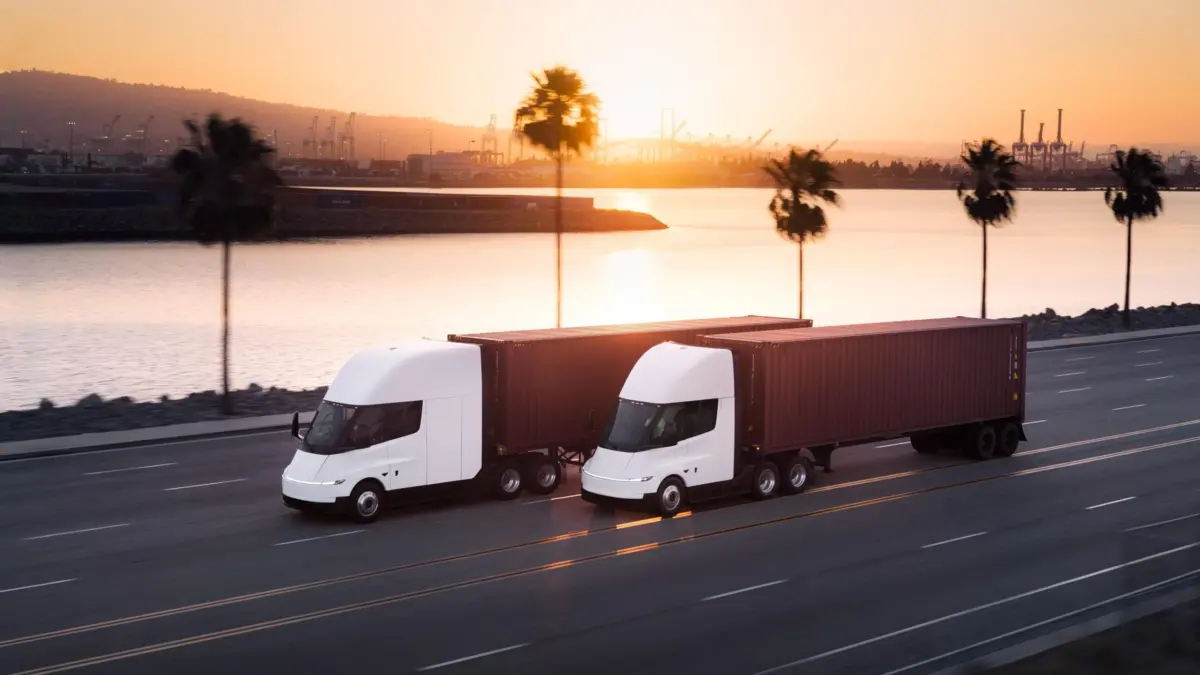
Remember the Tesla Semi? The long-gestating, heavy-duty truck first introduced in concept form all the way back in November 2017 is finally rolling into volume production as of April 2026—marking nearly a decade of anticipation, engineering redesigns, and repeated delays since its initial unveiling. On Thursday evening, the company hosted a high-profile launch event for the Semi at its brand-new production facility in Sparks, Nevada, aimed squarely at demonstrating to customers, partners, and investors that the exceptionally long wait has finally drawn to a close.
The showcase took place at Tesla’s dedicated Semi factory, situated directly next to the established Gigafactory Nevada. According to company executives, the new production plant is designed with an ambitious annual capacity of up to 50,000 heavy-duty trucks, translating to roughly 1,000 vehicles per week. The primary objective of the evening was to formally roll out an impressive roster of new and returning commercial fleet customers for the Class 8 electric truck. The confirmed list features major industry players such as PepsiCo, US Foods, DHL, WattEV, ABF Freight, Einride, IMC Logistics, and OK Produce—though a significant portion of this lineup had already leaked online ahead of the official proceedings thanks to a curious YouTuber flying a drone over the Sparks facility. Tesla confirmed that the first wave of customer deliveries from the new production line officially began this week.
Despite the celebratory atmosphere, the event left several key questions unanswered, particularly regarding the details that might have explained why the development cycle was so protracted and what the exact commercial roadmap looks like moving forward. Notably, Tesla declined to reveal cumulative order numbers or update the official retail pricing for the Semi. Industry trackers and prior reports have pegged the price of the long-range variant at roughly $290,000. In short, much like many of Tesla’s corporate events in recent years, this presentation left industry analysts wanting for more granular financial and operational updates.
The road to volume production has been fraught with challenges. The heavy-duty truck was originally slated to enter commercial production back in 2019, but those timelines were repeatedly pushed back due to a combination of unprecedented external factors, including the global COVID-19 pandemic and severe supply chain constraints affecting parts availability across the automotive sector. While Tesla did deliver a small batch of Semis to PepsiCo in late 2022, those initial units were largely manufactured by hand on a temporary pilot line rather than a fully automated production system.
When the vehicle was first announced in 2017, Tesla advertised an aggressive starting price of $150,000 for a version with a 300-mile estimated range, and $180,000 for a variant capable of traveling 500 miles on a single charge. The manufacturer never officially updated those figures in public channels until recently, though industry publication Electrek reported earlier this year that Tesla sales representatives were actively quoting enterprise customers approximately $290,000 for the 500-mile configuration.
Over the past three years, Tesla’s engineering teams have quietly refined the Semi’s architecture, managing to shave nearly 1,000 pounds off the vehicle’s overall weight while constructing the dedicated manufacturing hub in Nevada. The company finalized its production-ready design specifications in February 2026, confirming two distinct trims: a Standard Range variant rated for 325 miles of travel at a full gross combination weight of 82,000 pounds, and a Long Range variant targeting 500 miles. By April, the very first production-line Semi rolled off the assembly equipment at the Sparks facility, officially initiating volume output.
Tesla Chief Executive Officer Elon Musk was notably absent from the gathering in Nevada, as he was in Washington, D.C., attending a state dinner alongside U.S. President Donald Trump and Chinese President Xi Jinping. However, Musk addressed the audience via a pre-recorded video message, enthusiastically praising the vehicle as "the funnest truck to drive."
"This is really going to be a revolutionary truck," Musk stated in his video address, emphasizing its capability to handle heavy industrial logistics. "That is capable of carrying the heaviest loads over very long distances. With ease of recharge, Megacharger that’s capable of a megawatt of power. This is really going to be a phenomenal truck."
Battery and Engineering
A significant portion of the Thursday evening event was dedicated to detailing the advanced hardware, chemistry, and engineering choices integrated into the final production truck. Dan Priestley, Tesla’s Director of Semi Truck Engineering, emphasized that the advertised 500-mile operating range is calculated based on tests conducted with a fully loaded vehicle rather than diminished payloads under ideal conditions. Furthermore, Tesla Vice President of Engineering Lars Moravy noted that a Semi hauling a lighter cargo weight of approximately 60,000 pounds could potentially extend its range to around 600 miles. By offering configurations tailored to different operational masses, Tesla aims to address diverse commercial use cases rather than forcing fleet operators to rely solely on the heaviest, longest-range battery pack.
Tesla maintains that the Semi offers a significantly lower total cost of ownership compared to traditional internal combustion engines, driven by lower energy costs and a drastically reduced number of moving parts requiring routine maintenance. That economic argument gains substantial weight in an economic landscape where diesel fuel prices have experienced historic volatility, soaring past $6.50 per gallon across parts of the United States—nearly double the cost seen in prior periods. Tesla reports that a fully loaded Semi now consumes approximately 1,700 watt-hours per mile, representing an improvement over the original design target of 2,000 watt-hours per mile. These efficiency gains have allowed the manufacturer to incorporate a smaller, lighter, and more cost-effective battery pack while preserving the targeted driving range.
Underneath the exterior, the Semi utilizes Tesla’s proprietary in-house 4680 battery cells, replacing the 2170 cells sourced from external suppliers that were used in earlier prototype test vehicles. Company engineers explained that this cell transition, paired with comprehensive vehicle-efficiency updates, yields a lower-mass energy storage system without sacrificing operational distance.
Tesla has also substantially redesigned the vehicle’s powertrain and drive axle architecture since the initial 2017 unveiling. The updated truck features a newly engineered steel-caged rotor replacing the earlier carbon-fiber-sleeved design, a bar-wound stator shared with the Cybertruck, and a redesigned drive axle that is roughly 80 kilograms lighter than previous iterations. Additionally, engineering teams eliminated the three separate oil reservoirs used in the original drive axle design, removing oil from the wheel hubs entirely and consolidating into a single shared lubricant for both the motor and gearbox. Moravy stated that this unified fluid system is engineered to last for upwards of 250,000 miles before requiring service.
Traditional hydraulic steering systems have similarly been replaced by a redundant electric power steering setup, which Tesla claims delivers superior precision and driver feedback. At the same time, the truck’s increased wheel cut grants it a turning radius comparable to that of a passenger-sized Model Y. Priestley noted that this maneuverability was intentionally engineered to ease navigation through congested urban environments and tight warehouse loading docks.
Additionally, the Semi shares key thermal management components with the newly road-worthy Cybercab robotaxi. Utilizing an indirect thermal system that integrates shared pumps, compressors, and heat exchangers, the vehicle eliminates long refrigerant lines running to the vehicle’s exterior front end while enabling thermal energy to be transferred dynamically between the cabin, the battery pack, and the drive units to maximize overall operational efficiency.
Charging and Uptime
Over the past year, Tesla has steadily built out its enterprise customer pipeline for the heavy-duty electric truck. Autonomous trucking technology startup Einride announced a major commitment for 500 trucks this past August, while IMC Logistics confirmed earlier this week that it is purchasing 50 Semis to support sustainable drayage operations in California. Furthermore, Tesla was recently selected by a coalition of major global cargo-owning shippers to supply 2,500 zero-emission freight trucks for operations across California.
The immediate operational challenge for Tesla will be scaling production fast enough to meet this accumulated demand and fulfilling deliveries to commercial partners. Several freight operators have waited years for the promised electric fleet vehicles, meaning that maintaining delivery schedules will be critical for the company’s long-term reputation in the commercial logistics sector.
Rapid charging infrastructure represents another critical frontier, given that the Semi requires immense electrical throughput to replenish its massive 822 kWh battery pack. To address this, Tesla has continued expanding its proprietary Megacharger network, designed to deliver up to 1.2 megawatts of power per charging stall. Company representatives stated that Tesla expects to operate more than 30 dedicated Semi charging stations encompassing over 200 megawatt-capable charging posts by the end of the year, alongside supporting customer-installed overnight depot charging infrastructure. During the live event, engineering leads monitored a Semi connected to one of the new Megawatt chargers, demonstrating a state-of-charge increase from 3 percent to 60 percent in approximately 30 minutes.
Tesla is positioning the Semi not merely as a standalone electric vehicle, but as an integrated fleet management product. Executives highlighted that the company’s existing pilot fleets have demonstrated an operational uptime exceeding 98 percent, comfortably outpacing the industry average of 90 to 95 percent typically seen with diesel-powered Class 8 commercial trucks. To maintain these metrics, Tesla is building out a specialized Semi service infrastructure encompassing mobile repair units, remote diagnostic capabilities, and over-the-air software updates.
During demonstrations, engineering staff showcased software features designed to enhance the day-to-day driving experience, including portable driver profiles that automatically transfer preferences between different trucks in a fleet, and dynamic range estimation tools that continuously adjust calculations based on changing payload weights.
While executive leadership declined to disclose precise order backlog numbers or official retail starting prices during the presentation, Musk maintained that the commercial waiting list remains significant and urged prospective buyers to place reservations. Throughout the evening, corporate representatives continually emphasized that the primary economic driver for the Semi lies in its long-term total cost of ownership advantages over conventional diesel trucks—offering predictable operating expenses, reduced upkeep requirements, and insulation from fossil fuel market volatility.
"You know, volatility in the oil market and the diesel market goes up and down," Moravy noted during the presentation. "लेकिन typically, we’ve seen in the history of the last 20 years, electricity is pretty flat. And wouldn’t it be great to have a flat cost in your shipping rates?"



Leave a Reply