
As the quarterly goal-setting deadline approaches across corporate offices, professionals everywhere are facing a familiar ritual. Employees are drafting four bullet points that sound thoroughly responsible, submitting them to a manager who will skim them once, and watching as the quarter buries those objectives by week three.
The underlying problem is rarely a lack of ambition. Most professional goals are simply never built to survive an ordinary Tuesday—the kind of day when a customer escalates an issue, a key team member resigns, and a project promised back in January suddenly requires an unapproved budget. Traditional SMART goals for work routinely fail at the same critical juncture: they are grammatically correct yet operationally empty, lacking a starting number, a named owner, or any attachment to a specific day of the week.
To address this widespread corporate frustration, organizational experts are advocating for a structural redesign of workplace objectives. By integrating precise baselines, verifiable metrics, realistic dates, and dedicated check-in days, professionals can transition from passive corporate theater to actionable execution.
What a SMART Goal for Work Actually Is
At its core, a legitimate SMART goal for work is an objective written with such precision that a colleague could independently verify its completion without asking for clarification. It clearly states a measurable change from a known starting point, establishes a target that remains realistic given actual available resources, outlines a clear business rationale, and sets a firm deadline.
The famous acronym, however, has drifted significantly from its origins, and that evolution matters. George Doran originally introduced the SMART framework in Management Review in November 1981. Designed specifically for managers assigning objectives within a company, Doran’s original formulation stood for Specific, Measurable, Assignable, Realistic, and Time-related.
Over time, corporate culture substituted terms like Achievable and Relevant. Practitioners note that this shift reflects a fundamental change in ownership: Doran was assigning work to other professionals, whereas modern employees typically write their own objectives. On a shared team goal, this distinction is critical. A vague declaration that a department will "improve onboarding" creates a sentence that four people can nod at and nobody actually owns. Reclaiming the assignable element is essential for true accountability.
The Anatomy of Operational Work Goals
Effective professional goals share a distinct architecture: a verifiable starting number, a metric that can be checked by an external party, a specific completion date, and a standing time for review. Rather than relying on passive verbs like "improve," "increase," or "streamline"—which render a goal impossible to miss and therefore meaningless—successful professionals anchor their targets in hard data.
For individual contributors, moving from vague aspirations to operational targets transforms daily execution. For example, instead of aiming to "improve the quality of monthly reporting," a professional might target cutting client report revisions from an average of four rounds down to two or fewer by the end of the quarter, tracked via shared file history and reviewed every Friday afternoon.

Managerial goals similarly benefit from structural precision. Rather than resolving to "be a more available manager," leadership objectives can be structured around holding a strict 30-minute one-on-one session with each direct report every two weeks throughout the quarter, tracked directly via calendar verification.
Team delivery, customer service, and sales objectives follow the same rigorous pattern. A customer service initiative moves from a vague desire to "respond to customers faster" to explicitly raising first-reply resolution rates on tier-one tickets from a known baseline to a defined percentage by year-end, verified weekly through helpdesk reports. Similarly, sales professionals replace the nebulous goal of building a stronger pipeline with a commitment to booking a specific number of qualified discovery calls each month, supported by dedicated outreach blocks on their calendars.
Professional development, process improvements, and workload management also thrive under this methodology. Completing specific educational modules to ship a workflow-replacing query by a hard deadline, cutting month-end close times by systematically automating reconciliations, or reducing recurring meeting hours by strategically declining decisions-free gatherings all share the same structural integrity.
The Five Essential Components of Execution
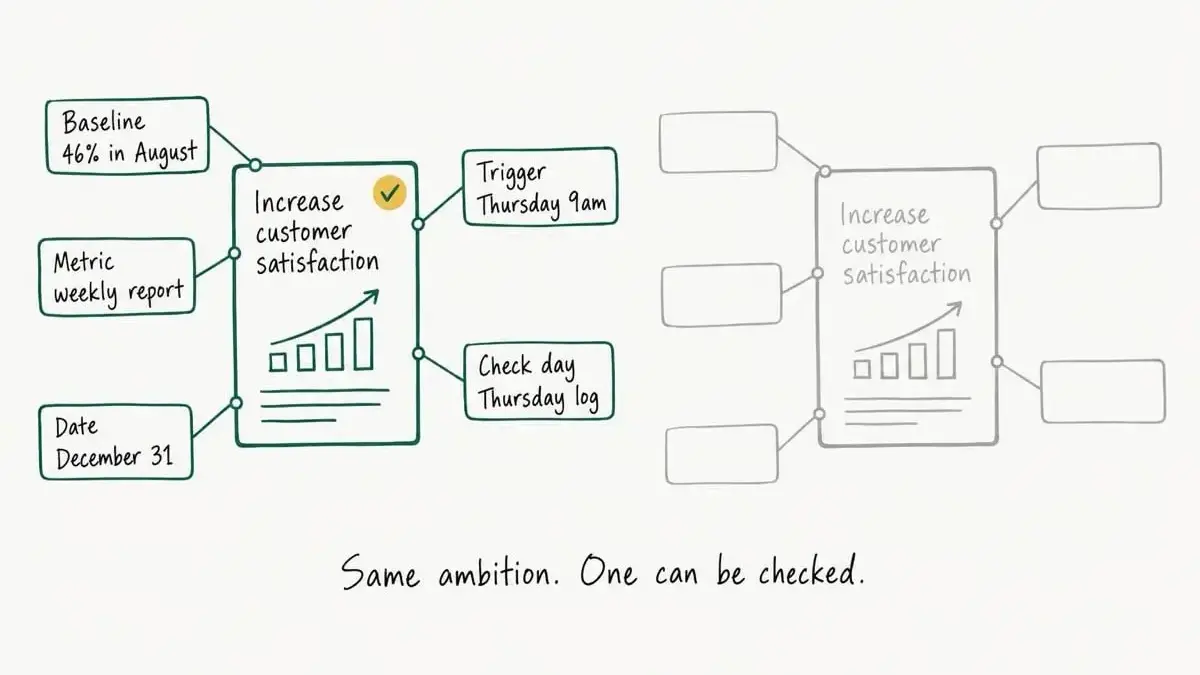
Five distinct elements separate an active work goal from a passive statement on a performance form: a verifiable baseline, an objective metric, a date that avoids the generic quarter-end cluster, a behavioral trigger, and a dedicated check-in day.
A baseline gives meaning to progress. Without a starting number, any subsequent figure is mere decoration, turning performance reviews into subjective arguments. Establishing a metric that an external party can verify aligns with decades of goal-setting research demonstrating that specific, difficult objectives consistently outperform generalized encouragement. Furthermore, establishing a behavioral trigger—an if-then plan specifying when, where, and how an action will be initiated—significantly increases the likelihood of attainment by removing the friction of decision-making. Finally, establishing a consistent check-in day ensures that progress is actively monitored rather than selectively remembered.
Managing the Review Version Versus the Running Version
To navigate corporate systems successfully while maintaining personal productivity, professionals often maintain two versions of every goal. The review version belongs on the official corporate form: it is assignable, dated, tied to established business metrics, and tailored for a manager who will spend less than two minutes reviewing it.
The running version, conversely, lives where the actual work happens. It carries the behavioral trigger, the check-in schedule, and the weekly log tracking the numbers. Maintaining both versions prevents goal-setting season from feeling like corporate theater while ensuring that performance records remain robust when promotions or organizational restructurings are decided.
When unexpected disruptions inevitably occur—such as team resignations or shifting company priorities—workplace goals require a built-in floor version: the minimum acceptable result that still counts, paired with a clear rule for resuming progress after a missed week. By focusing on consistent monitoring rather than rigid, unyielding targets, professionals can maintain operational momentum even when the business landscape shifts beneath them.



Leave a Reply