
After a decade of serving as a cornerstone for open-source container management, Portainer’s Community Edition (CE) has officially hit a major developmental turning point. The upcoming release of Portainer 3.0, representing a complete ground-up architectural rebuild of the platform centered entirely around Kubernetes, will not serve as the codebase for the traditional open-source Community Edition.
This significant shift was formally announced by Neil Cresswell, the Chief Executive Officer of Portainer, who detailed how the open-source community line will diverge from the commercial and enterprise-focused trajectory of the platform. According to Cresswell, the current Community Edition will continue to be based upon Portainer 2.45 LTS, which stands as the final release within the broader 2.x software lineage. Subsequent architectural advancements, including completely redesigned user consoles, a modernized back-end architecture, and native cloud-native primitives, will not be ported over to the open-source CE branch.
Instead, the legacy-based Community Edition will transition into a maintenance-only phase. Users relying on the open-source branch can still expect essential security patches, routine bug fixes, and backported features from the 3.x series, but these updates will be strictly limited to scenarios where a matching Docker API exists to interface with them. True feature parity is no longer guaranteed, as a significant portion of the capabilities landing in Portainer 3.0 rely heavily on Kubernetes primitives that simply do not exist within standard Docker environments.
Why the Change?
Addressing the rationale behind this monumental architectural pivot, Cresswell explained that the decision stems fundamentally from mounting maintenance challenges rather than an arbitrary strategic shift. Maintaining a unified product codebase had become increasingly burdensome for the development team. Historically, every time the engineering staff wanted to introduce a new security policy or expand API capabilities, they were forced to build that specific feature three separate times: once for Kubernetes, once for Docker Swarm, and once for standalone Docker and Podman deployments.
Portainer 3.0 abandons this fragmented model entirely. The new platform replaces the monolithic interface approach with five distinct consoles, each meticulously engineered around a specific operational job rather than relying on a single, all-encompassing interface to handle every conceivable workload.
Cresswell noted that the Community Edition quite simply does not fit into this new operational paradigm. The policy models, advanced operations APIs, and enterprise-focused consoles arriving in Portainer 3.x are designed with enterprise-grade users in mind from the very beginning. Releasing that type of specialized framework as a community edition, the company argues, would fundamentally misrepresent what the software is and who it is ultimately intended to serve.

What This Means for You
For administrators and developers currently running standard Docker environments, the immediate impact is minimal. Existing deployments utilizing the 2.x release line will continue to function precisely as they always have, and the platform will continue to receive necessary security patches. Staying put on the 2.x branch is a fully supported and viable choice for users who have no immediate desire to transition to enterprise-grade or Kubernetes-heavy infrastructures.
For those who choose to migrate to the 3.0 architecture, native connections for Docker, Swarm, and Podman environments will remain operational. For users who prefer to maintain traditional Docker-style workflows while leveraging a Kubernetes cluster underneath, Portainer has provided a dedicated compatibility layer known as Portainer-D2K. This tool allows familiar utilities like Docker Compose to deploy and manage applications directly on top of a Kubernetes infrastructure.
However, the broader trajectory of the platform’s innovation has shifted decisively. Any future developments in observability, GitOps tooling, or advanced policy management will be engineered for Kubernetes environments first. Native Docker setups will occupy a secondary tier within the interface hierarchy and will not receive these advanced modern capabilities.
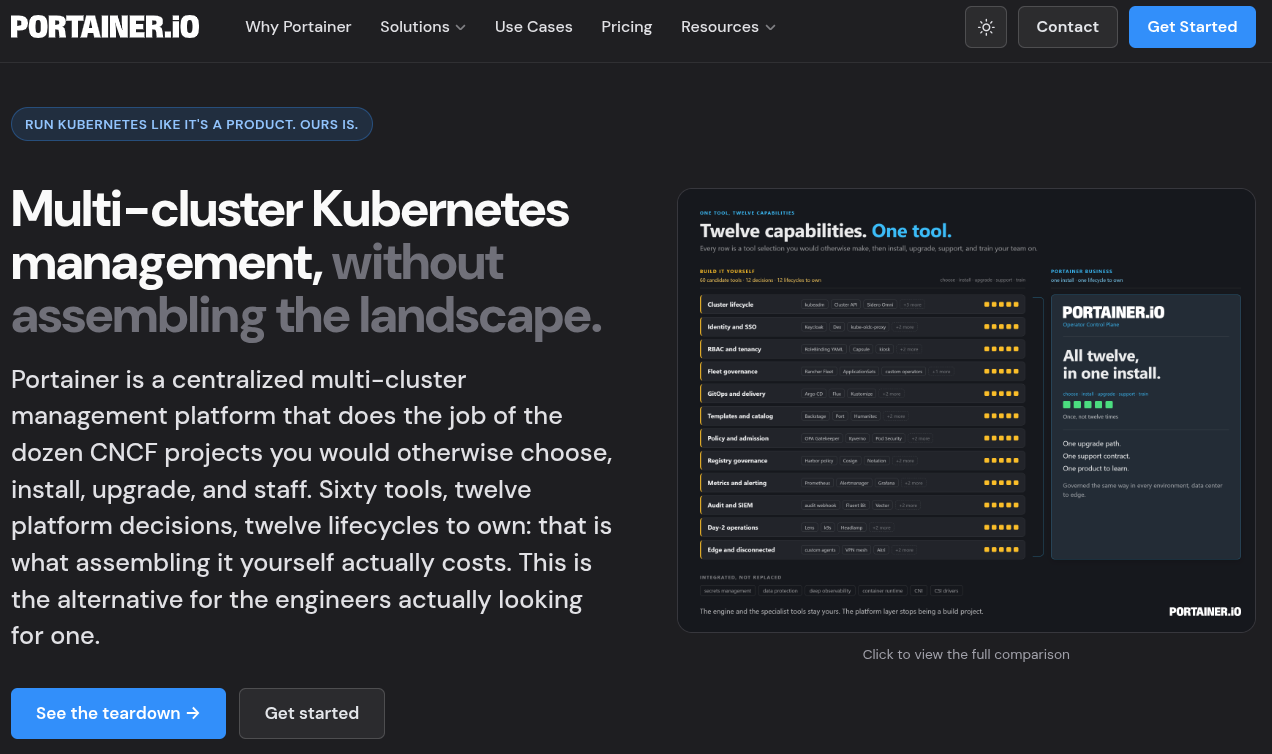
Users seeking access to these new features without migrating to a Kubernetes infrastructure will find that a traditional, free, open-source path no longer exists within the 3.x ecosystem. The sole no-cost route to utilizing Portainer 3.x is through the "3 Nodes Free" program, which is Portainer’s pre-existing node-capped tier for the closed-source Business Edition rather than an open-source CE build.
For homelab enthusiasts, small businesses, and independent administrators who find remaining on version 2.x indefinitely unappealing, the landscape of available tools continues to evolve. While alternative self-hosted container management interfaces are actively developed across the open-source ecosystem, none serve as a direct, drop-in replacement for every legacy Portainer workflow, particularly for those who heavily rely on advanced multi-node orchestration and management capabilities. Nevertheless, for small Docker and Swarm environments seeking a capable self-hosted administrative interface without entering a paid tier, exploring alternative projects remains a practical consideration as the container management landscape moves into its next chapter.


Leave a Reply