

A high-stakes federal lawsuit targeting several of the world’s most prominent private torrent trackers has taken an astonishing procedural twist. What began as a routine copyright infringement case has devolved into a bizarre legal mystery involving allegations of identity theft, ghostly digital footprints, impossible cinematic coincidences, and a last-minute motion for voluntary dismissal that has left both defense counsel and the presiding judge searching for answers.
Last month, legal observers were stunned when defense attorneys representing major private torrent trackers informed a federal judge that the plaintiff who initiated the litigation may actually be an impostor. Following those explosive revelations, U.S. District Judge Andrea R. Wood quickly escalated the matter, placing the case on a formal sanctions track and scheduling a crucial in-person hearing.
Since that initial warning, the litigation has careened through a series of increasingly surreal developments. Defense attorneys Erin Russell and Haley Finch formally asked the court to hold the plaintiff in contempt of court. Their petition accused the individual of systematically misrepresenting his identity, falsely claiming copyright ownership over works he did not create, and executing court filings using an unverified mail-drop address.
The "Real" Matthew Schneider Appears
To substantiate their claims, the defense team representing the anonymous ("John Doe") tracker operators submitted a sworn declaration from Matthew A. Schneider of Ottawa, Ontario. This individual is explicitly listed in IMDb credits as the filmmaker behind the three motion pictures cited prominently in the original federal complaint: "Split: A Film Anthology," "Do Us Part," and "Orlando Gloom, Always the Same."
Under the penalty of perjury, the Canadian creator clarified that while he indeed produced these independent films alongside high-school friends years ago, he has no connection whatsoever to the lawsuit bearing his name.

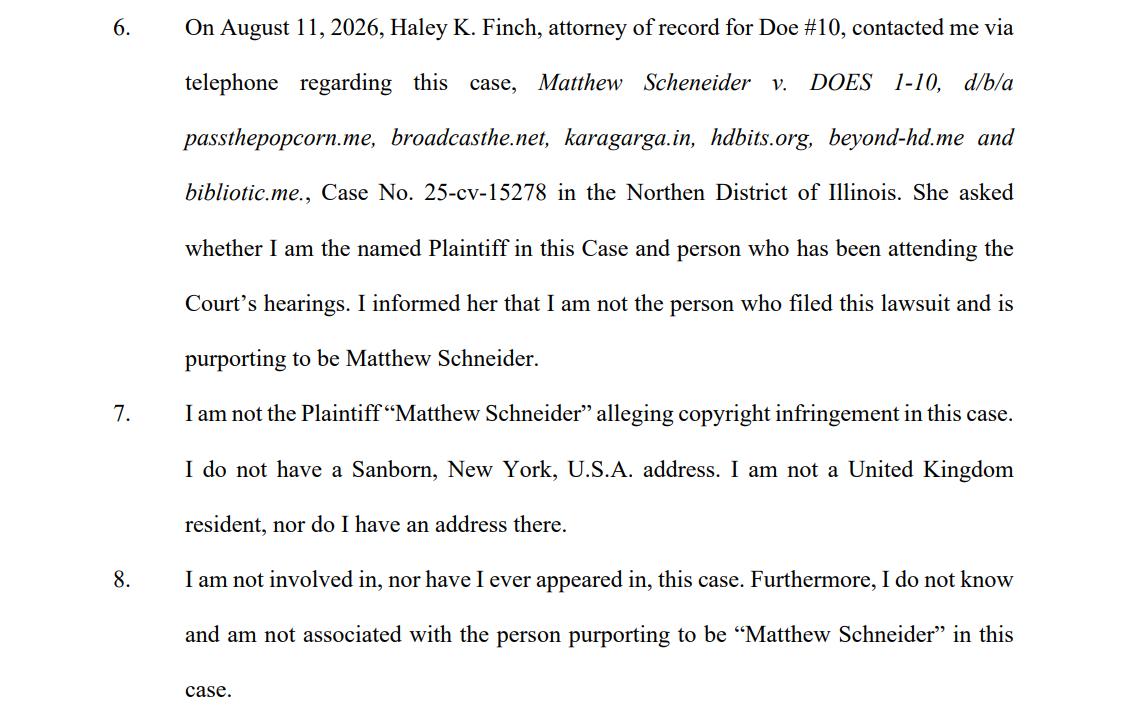
"I am not involved in, nor have I ever appeared in, this case," Schneider stated in his declaration. "Furthermore, I do not know and am not associated with the person purporting to be ‘Matthew Schneider’ in this case."
The films in question were brought to life under the banner of a high-school filmmaking collective known as "Dirtbag Films." Solmund MacPherson, a key collaborator in the group, also submitted a sworn statement confirming that the collective never sold or transferred the intellectual property rights to the films. Furthermore, MacPherson testified that he did not recognize the "matthew.schneider94" email address that appeared on every single filing submitted throughout the federal lawsuit.
In a bid to provide concrete physical evidence for the court, MacPherson successfully tracked down an archival copy of "Do Us Part." The authentic Canadian filmmaker makes a direct on-screen appearance with a speaking role in the film, providing Judge Wood with an authoritative reference point to compare his voice and likeness against the individual driving the litigation. Additionally, an archived Instagram post featuring a photograph of the Canadian Schneider offered further visual verification, though he has since transitioned away from independent filmmaking entirely.
A Different Matthew Schneider
Faced with this mounting wall of contradictory evidence and sworn testimony, the plaintiff refused to back down. Instead, in a legal response filed late last week, he introduced an extraordinary defense: he argued that the case simply involves two entirely different people who happen to share the same name.
The plaintiff asserted in court documents that he has "consistently identified himself in this action as Matthew Schneider, an independent filmmaker and creative professional from the United Kingdom." He insisted that he never explicitly claimed to be the Canadian citizen and never made any reference to Dirtbag Films in his initial pleadings.
"The existence of another person with the same or similar name is not evidence of impersonation," the plaintiff argued in his opposition filing.
However, the remarkable similarities do not end with a shared moniker. The self-described UK filmmaker claims to have independently produced his own catalog of motion pictures bearing the exact same titles as the Canadian Dirtbag Films productions.
Identical Film Titles and Missing Metadata
To back up this assertion, the plaintiff submitted a digital exhibit containing metadata files for his alleged UK versions of the three disputed movies. The timestamps provided in the metadata indicate production dates of 2011 for "Split: A Film Anthology," 2012 for "Do Us Part," and 2012 for "Orlando Gloom, Always the Same."
By dating his alleged works to 2011 and 2012, the plaintiff attempted to establish a chronological defense, noting that these dates predate the Canadian Dirtbag films by five to six years. He argued that it would be physically impossible for him to have plagiarized works that "did not yet exist."
A closer inspection of the submitted exhibit, however, revealed a conspicuous lack of traditional corroborating evidence. While the file listed filenames, video resolutions, and frame rates, it completely lacked official copyright office registration numbers, cast lists, crew rosters, production stills, or any verifiable IMDb presence.
Statistically, the probability of two independent filmmakers sharing the exact same name and independently producing three films with identical titles is remarkably slim. The coincidence becomes even harder to swallow given that one of the titles, "Orlando Gloom, Always the Same," directly incorporates the name "Orlando Gloom"—an actual musician for whom the Canadian Dirtbag collective produced a specific music video project.
A Procedural Counterattack
Rather than merely defending his identity, the individual litigating as Matthew Schneider launched an aggressive procedural counterattack against the defense counsel. In his response, he accused attorneys Russell and Finch of engaging in improper ex parte communication with Judge Wood, highlighting an unrecorded phone call that defense counsel placed to the judge’s chambers prior to the August hearing.
Defense attorney Russell had previously described that phone call as an extraordinary step prompted by urgent circumstances. The plaintiff, however, countered that the call directly violated judicial ethics rules banning one-sided communications with a presiding judge, citing American Bar Association professional conduct standards and relevant Seventh Circuit legal precedent permitting courts to sanction such behavior.
The plaintiff formally petitioned the court to disclose the precise dates and substance of those communications, demanding that the judge disregard any arguments or information shared outside of his presence. He also urged the court to evaluate potential sanctions against defense counsel.
Adding another layer of local connection, the plaintiff pointed out in his filings that both of the Canadian declarants and defense attorney Finch share ties to the same Winnipeg high school, suggesting that their collective testimony should be scrutinized closely and not accepted as entirely independent corroboration without thorough judicial review.

Whether the pre-hearing telephone call constituted an improper procedural breach or a justified, good-faith alert regarding a potential fraud upon the court remains one of the central questions facing Judge Wood.
Unanswered Questions and Sudden Exit
Compounding the confusion, the plaintiff’s extensive response addressed only three of the ten total creative works listed in the original complaint. The remaining five short films and two literary works—which defense attorneys noted have no verified creators or public existence—went entirely unmentioned in the filing.
All involved parties were slated to appear at a scheduled in-person hearing to untangle the complex web of contradictions, identity claims, and procedural motions. The session was widely expected to provide definitive clarity on whether the litigation was built on a foundation of deception.
However, in a dramatic eleventh-hour development, the person litigating under the name Matthew Schneider filed a formal notice of voluntary dismissal. Despite this sudden retreat, the defense’s pending motion for a rule to show cause remains active and unresolved before the court, meaning the scheduled proceedings will still move forward.
If the defense’s assertions are proven correct and the plaintiff is indeed an impostor, the overarching motivation behind the lawsuit remains shrouded in mystery. The primary objective of the litigation has consistently appeared to be unmasking the real-world identities behind major private torrent trackers. Yet, none of the numerous subpoenaed third-party corporations—including Reddit, GoDaddy, Cloudflare, PayPal, Stripe, Namecheap, and X Corp—have been forced to produce user records, as all subpoena productions were frozen by judicial order back in May.

Leave a Reply