
Three filled notebooks sit quietly on the shelf, while a fourth lies open on the desk. Somewhere buried within their pages is a crucial figure a client stated aloud during a Tuesday meeting in March, the name of a reliable plumber recommended by a neighbor, and a structural outline drafted hastily on a train that remains better than anything written since. The writer knows all of this information resides somewhere inside those bound volumes. Yet, retrieving any of it proves impossible.
The traditional paper notebook frequently functions as a write-only device. It excels at the moment of capture, yet turns frustratingly useless the moment retrieval becomes necessary. Most people respond to this inherent flaw by purchasing an upscale, expensive notebook, which fundamentally changes nothing, or by starting a fifth volume, which merely compounds the clutter.
A Japanese-inspired notebook organization system addresses this retrieval crisis, achieving a functional balance with minimal ongoing effort per page.
Why a Notebook Fills Up and Stops Being Useful
A traditional paper notebook ultimately fails at retrieval due to one structural reason: writing occurs in the order events happen, whereas retrieval requires information in the order of importance. Pages fill up chronologically by date. Questions and notes arrive dynamically by topic. Within a tightly bound book, nothing connects the two realms, leaving flipping as the sole search mechanism. Once a notebook passes forty or fifty pages, flipping ceases to be a search method and transforms into an exercise in amateur archaeology.
Popular quick fixes universally attempt to solve this challenge at the moment of capture, which represents the worst possible timing. Dedicating a separate notebook to every individual project guarantees that the correct book is never inside the bag when needed. Pre-printed tabs assume that categories were fully understood and anticipated in January. Multi-colored pens demand administrative decisions while a conversation is actively unfolding. Meanwhile, the practice of rewriting daily notes into a digital application serves as a burdensome second job—and invariably becomes the first habit dropped during a hectic week.
This breakdown is rarely a failure of personal discipline. Systems that demand sorting while listening ask too much of cognitive bandwidth. Capture must remain fast and uninhibited, or it simply will not happen. If a notebook functions primarily as a chaotic dumping ground for a busy mind, that remains an acceptable reality. True categorization belongs elsewhere: applied after the fact, at the page edge.
What a Japanese Notebook Organization System Actually Is
A broader look at Japanese stationery culture reveals two distinct approaches. One involves established commercial planners and notebook systems available on the market, while the other centers on a page-edge indexing technique circulating widely without a clear, verifiable origin. The commercial products are well-documented; the folklore surrounding the manual indexing trick is less so.
The commercial market offers concrete examples worth noting. Hobonichi publishes the Hobonichi Techo, a popular family of planners built around a daily page format. Meanwhile, MIDORI presents the TRAVELER’S notebook, featuring a leather cover designed to house dedicated paper refills, allowing the outer shell to endure while the contents rotate. These two solutions approach the same challenge from different angles, yet both embrace a philosophy that most Western planners traditionally avoid: establishing a fixed format and committing to it fully.
The page-edge index provides the complementary half of the solution. Rather than attributing this method to centuries of unverified tradition, it functions as a streamlined workflow designed to add a retrieval layer that costs almost nothing to maintain. Defined broadly, a Japanese-inspired notebook system treats a single notebook as one continuous chronological stream while shifting all organization to the page edges and back pages. This ensures that no administrative decisions interrupt the moment of writing.
Capture remains unhindered, while retrieval gains structural integrity. The two processes never compete for attention at the same time.
Setting Up and Maintaining the System
Implementing this organizational method requires only an existing notebook, a pen, and a single marker or highlighter. The setup process remains intentionally lightweight, prioritizing long-term sustainability over an overly complex design that invites abandonment.

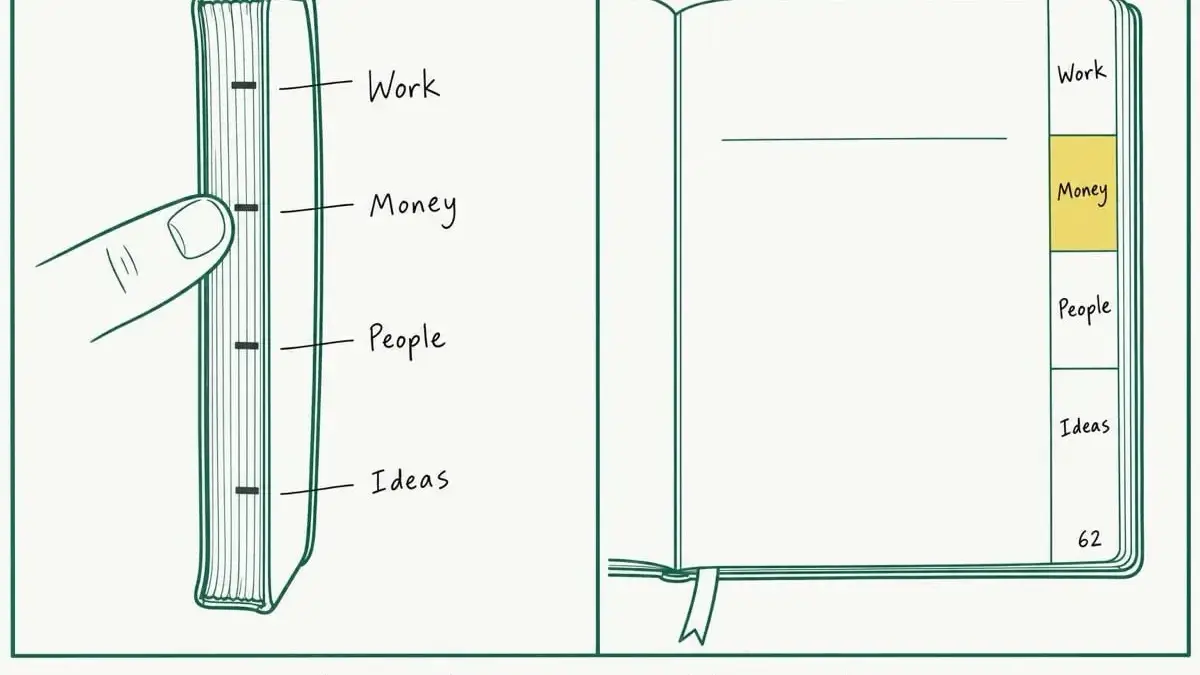
The foundational step involves numbering every page from front to back along the bottom outer corner. This single action forms the backbone of any index, yet it is frequently skipped. Next, rather than maintaining an unwieldy number of categories, users select four distinct markers that encompass the vast majority of their writing, such as Work, Money and Admin, People, and Ideas. Four serves as an optimal limit because choosing among six or more options introduces hesitation during fast-paced capture.
To operationalize the categories, users leave a narrow vertical strip down the outer margin of each page, divided top to bottom into four corresponding bands. When a page is predominantly dedicated to a specific category, that corresponding band is filled with the marker, letting the ink run right off the edge of the paper.
When the notebook is closed, viewing the page edges reveals a stack of visible dashes corresponding to active categories. Finding work-related notes no longer requires opening the book at all; running a thumb along the colored stripe exposes the relevant pages instantly.
A back-page index reserves the final two pages of the notebook for brief entries comprising a date, a short summary of three to six words, and a page number. Writing these lines immediately upon finishing a page, rather than saving them for a neglected weekly cleanup, maintains the system with minimal friction. A brief weekly review allows users to update missed lines, circle pending items, and carry them forward to a fresh page, preserving the system’s longevity.
A Practical Application in Daily Life
Consider a professional managing multiple demanding projects and household administration. Meeting notes might feature attendees across the top, decisions recorded down the page, action items marked with small square checkboxes for easy ticking, and open questions highlighted with margin symbols. Filling the designated work band and writing a brief index line takes mere seconds.
Days later, capturing ideas for a side project on a commute involves marking the ideas band. Recording a plumber’s price quote received over the phone on the next available page involves marking the money band. There is no need to reorganize the physical book; the notebook preserves its natural chronological flow while remaining completely searchable.
Weeks later, when details regarding a transaction are called into question, closing the book, checking the money-band stripe, and locating the relevant page takes only seconds. For topics remembered by concept rather than category, the back-page index bridges the gap. Forty lines of handwritten index entries can be scanned in under a minute, rendering a two-hundred-page notebook entirely accessible.
Choosing the Right Format and Tools
Selecting between a bound notebook and a refillable system depends entirely on the nature of one’s workflow. Individuals whose days are driven by time-sensitive meetings and daily chronological notes will find a bound notebook paired with an edge index more than sufficient. Conversely, project-centric work that demands the physical rearrangement of pages by client benefits greatly from a ring or refillable system.
The commercial success of products like the Hobonichi Techo or the TRAVELER’S notebook highlights a deeper truth: physical gear alone does not create a functional system. An effective index is what breathes utility into paper. Adopting a simple, low-cost notebook to test the indexing workflow proves far more effective than investing in an expensive planner that risks abandonment within months.
Ultimately, paper and digital tools excel at opposing tasks. Digital systems provide unmatched full-text search capabilities across years of notes, while paper eliminates the friction of unlocking a device or navigating notifications during a moment of deep thought. A balanced approach utilizes paper for capture and initial thinking, migrating information to digital formats only when collaboration, strict deadlines, or frequent referencing demands it.



Leave a Reply