
Somewhere in your house, there is a kit. It might be a watercolor set with only three colors used, a guitar with a broken string, or a telescope that cost significantly more than you care to admit to others. Each item arrived with genuine intent, and each has now devolved into glorified storage.
The conventional explanation for this phenomenon is simple: you lost interest. But looking closer suggests that reading reverses the dynamic. Almost nobody over the age of 70 suffers from an actual shortage of ideas. Lists of recommended hobbies for seniors are ubiquitous online, yet they tend to repeat the exact same suggestions. What is actually missing from the discourse is a practical way to determine—before any money leaves your bank account—whether a pastime truly fits the life you live. This means evaluating how your hands feel on an ordinary morning, how you manage a ride across town after dark, and what kind of tolerance you possess for a loud, crowded room.
The key is to pick by fit rather than by pure appeal. A hobby that looks wonderful on paper but fits badly in practice inevitably ends up abandoned in the back of a closet alongside the expensive telescope.
What Are Good Hobbies for Seniors Over 70?
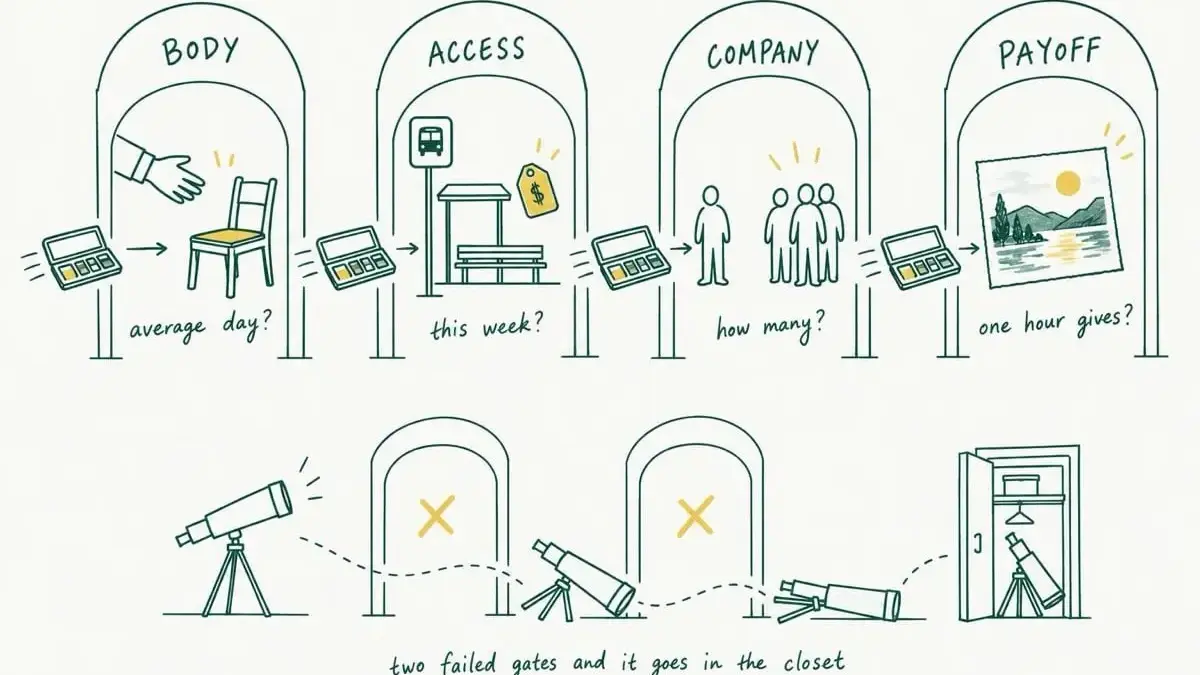
Good hobbies for seniors over 70 are not defined by broad categories, but rather by how well they match four critical criteria: what your body can realistically accomplish on an average day, how easily you can reach the activity, how much company you desire while doing it, and what a single session leaves behind. Activities like gardening, walking groups, card clubs, choir, birding, woodworking, quilting, photography, genealogy, language study, and volunteering all qualify for someone out there. However, the overarching perspective is that the specific category matters far less than structural compatibility.
Having an active hobby certainly tracks with an overall sense of wellbeing. A 2023 study that pooled five longitudinal surveys covering 93,263 adults aged 65 and older across 16 countries found that hobby engagement was closely associated with fewer depressive symptoms and higher self-reported health, happiness, and life satisfaction. Of course, those are broad statistical associations across entire populations rather than an absolute personal guarantee. What no research study can tell you is which exact hobby belongs to you.
Why Hobby Lists Stop Working After 70
Hobby lists tend to lose their utility after the age of 70 because they are generally written with an average body and an empty calendar in mind. They rarely price in the reality of arthritic hands, hearing loss that transforms a busy craft room into an exhausting chore, driving limits that end abruptly at dusk, or the daily responsibility of caring for a spouse at four in the afternoon. The underlying idea is rarely the problem; rather, it is the persistent gap between that idealized concept and an ordinary Tuesday.
A 2024 systematic review of 37 studies covering 26,961 adults aged 70 to 101 found that concerns regarding health and fitness were among the most commonly reported barriers to leisure, closely followed by environmental and practical obstacles. These constraints are entirely common rather than exotic. For instance, roughly half of all United States adults aged 65 and older experience arthritis. Furthermore, in a nationally representative audiometric sample, hearing loss was present in 63.1 percent of adults aged 70 and older.
Crucially, neither of these statistics rules anything out. Plenty of people with arthritis successfully quilt, and plenty of individuals with hearing aids sing enthusiastically in community choirs. These numbers simply explain why a casual suggestion to "just join a pottery class" lands very differently at 74 than it does at 44, and why that abandoned kit in the closet was never a reflection of personal character failure.
The Four-Fit Check: Body, Access, Company, and Payoff
To solve this disconnect, a practical framework known as the Four-Fit Check evaluates whether a hobby can survive past the initial wave of novelty. The evaluation asks four straightforward questions: Can you perform this activity on an average day rather than your absolute best one? Can you start it this week without needing a special favor or making a major financial investment? Does the amount of company involved match your personal preferences? And does a single session leave something tangible behind?

As a general rule of thumb, if a hobby fails one filter, it can usually be adapted; if it fails two, it belongs back on the shelf. Running all four checks before spending any money can save both frustration and financial resources.
The body fit filter evaluates a hobby against a normal, stiff-morning Tuesday. It examines how long an individual must stand, what is required of grip strength, knees, balance, eyes, and ears, and whether one can stop halfway through without ruining the project. Federal physical activity guidelines for older adults set a target of 150 to 300 minutes of moderate aerobic activity per week, alongside muscle-strengthening and balance work. However, the guidelines include a vital provision: when older adults cannot reach those thresholds due to chronic conditions, they should remain as physically active as their individual abilities and conditions allow. Balance warrants particular attention, given that 27.5 percent of US adults aged 65 and older reported at least one fall in the previous year.
Access fit is often skipped, yet it quietly ends more hobbies than outright boredom does. It forces an honest assessment of transportation logistics, first-month costs, and dependence on others. A hobby requiring a thirty-minute drive after sunset, an expensive starter purchase, and a coordinated schedule with someone else possesses multiple fragile points. In contrast, a library genealogy session located two blocks away has virtually none.
Company fit addresses the fundamental tension between wanting a social room or a quiet workbench with a closed door. While leisure research indicates that social activities carry strong associations with health and survival, solitary pursuits are also well represented. Connection remains important; a meta-analysis linking poor social relationships to increased risks of coronary heart disease and stroke underscores the value of maintaining ties. If your week already contains very few human interactions, designing a hobby with built-in proximity to others—such as a shared woodshop rather than a solitary garage—is a sound choice.
Payoff fit dictates that a hobby returning nothing within a single session will inevitably run out of willpower, which proves to be poor fuel at any age. The ideal session ends with something finished, something learned, or someone spoken to.
Practical Adaptations and Low-Cost Trials
For individuals managing limited mobility or low energy, selecting hobbies that work well while seated, stop cleanly at any point, and require zero transportation makes all the difference. Container gardening, watercolor and drawing, knitting with larger needles, model building, genealogy research, letter writing, audiobooks paired with a reading group, and online chess or bridge are all viable options. Adapted tools, such as raised surfaces that protect wrists and shoulders and structured twenty-minute blocks, ensure that a difficult day only costs a single block rather than an entire project.
Starting with low-cost or zero-cost options allows individuals to test the waters before making heavy financial commitments. Using library book clubs, walking and birding with a borrowed field guide, drawing with an inexpensive pencil set, and cooking from scratch lets people spend money in the second month rather than the first.
Giving every serious candidate a rigorous two-week trial—comprising four sessions using borrowed gear at the exact time of day the activity would normally occur—provides clear diagnostic information. Assessing whether one went without self-persuasion, whether the body felt worse the next morning, and whether there was a genuine desire to book the next session turns choosing a hobby into a practical testing problem rather than an elusive search for passion.

Leave a Reply