
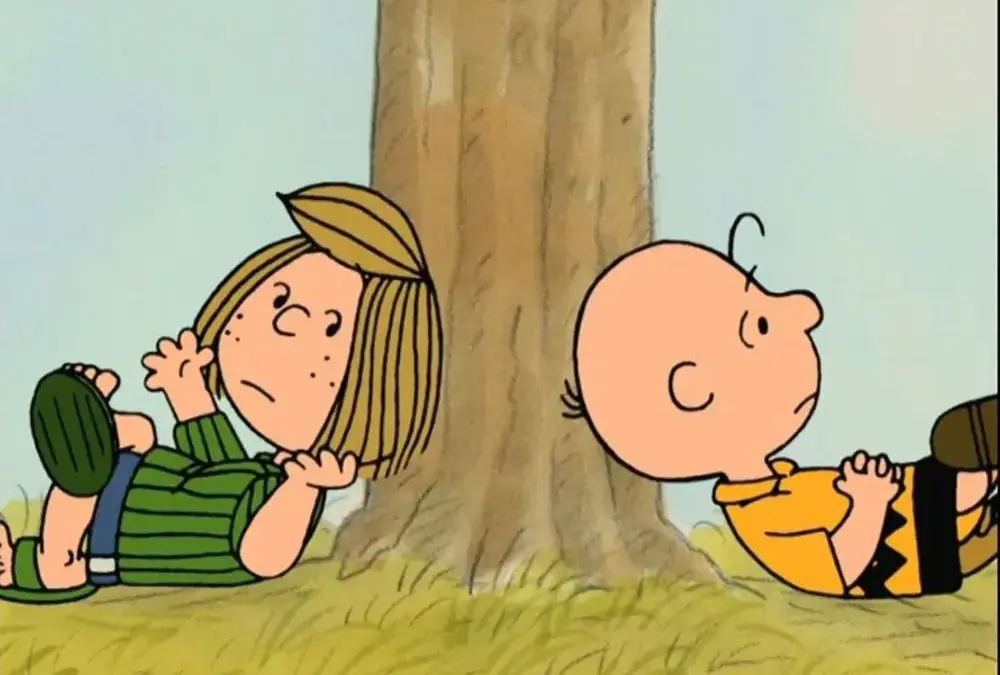
For anyone looking to dive deeply into the enduring legacy of Charles Schulz’s masterwork, investing in Fantagraphics’ The Complete Peanuts remains one of the finest ways to experience the medium of comic strips. Spanning 26 comprehensive volumes, the definitive set collects every single daily and Sunday strip published throughout the half-century run of the series, averaging roughly two years of content per book. While digital alternatives like Kindle editions exist for readers trying to manage limited shelf space, shelling out for a monumental 26-volume collection naturally encourages a physical approach to savoring the artwork and history.
Reading through The Complete Peanuts as a single, unbroken chronological run offers a uniquely immersive experience for dedicated fans and casual readers alike. It provides a front-row seat to the gradual evolution of both the characters and Schulz’s artistic style, tracking the transition from early, experimental gags featuring now-obscure figures like Violet to the eventual formation of the iconic, established crew. More than that, absorbing decades of strips in quick succession allows readers to develop deeply held opinions about 75-year-old comic strip characters—such as the realization that Peppermint Patty does not nearly receive enough historical credit for being the absolute best friend Charlie Brown ever had.
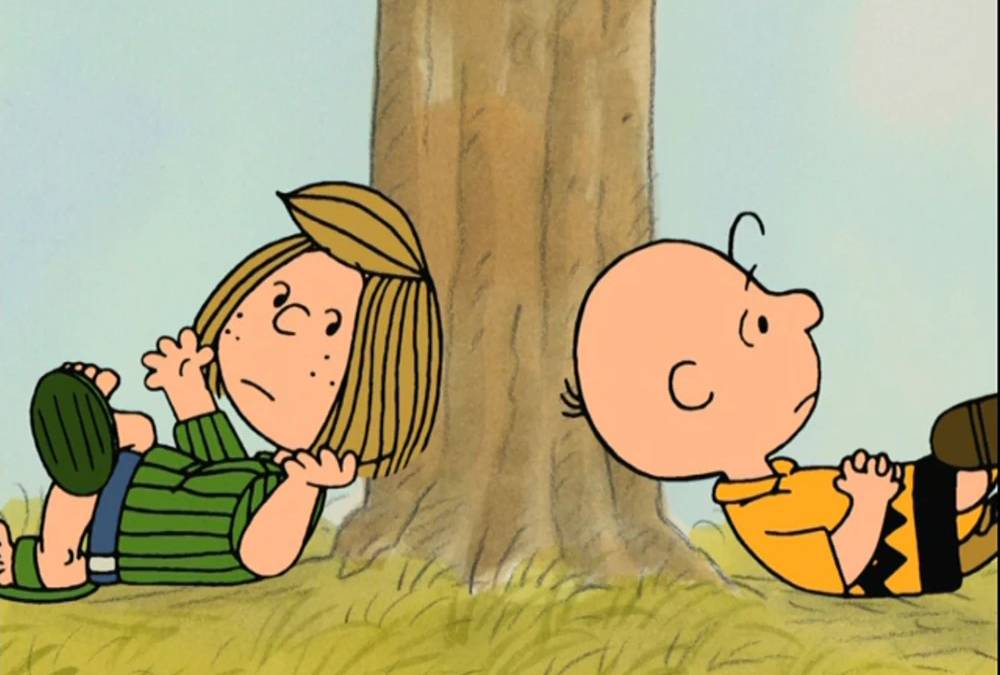
Friendship within the universe of The Complete Peanuts functions as an inherently incidental theme. Much like several other philosophical and emotional subjects touched upon in the daily panels, the strip itself rarely stops to deliver explicit, heavy-handed statements on the precise definition of camaraderie. Instead, explicit commentary on companionship is often relegated to official marketing and merchandising ventures, such as the 2016 compilation The Peanuts Guide to Friendship. Within the panels of the comic strip proper, Schulz rarely makes a definitive, sweeping statement about the mechanics of being a good pal—unless, arguably, Peppermint Patty happens to be involved in the storyline.
When Peppermint Patty makes her trademark entrances into the narrative, her appearances are frequently dedicated to her academic underachievement, her athletic leadership of a perpetually disorganized baseball team, or her famously unrequited and poorly expressed crush on Charlie Brown. As an easily distracted eight-year-old boy, Charlie Brown remains blissfully unaware of her romantic feelings. From his perspective, Patty’s intense devotion simply registers as a form of enthusiastic, albeit overwhelming, friendliness.
However, a thorough reading of the Peanuts canon, particularly as the strip progresses through the 1970s and beyond, reveals a subtle shift in interpersonal dynamics. The core cast members often appear to drive one another completely crazy. Each character embodies distinct eccentricities typical of childhood behavior, and while Charlie Brown maintains stable friendships with companions like Linus and Franklin, the underlying narrative engine of Peanuts relies heavily on keeping its protagonist in a state of perpetual melancholy. Consequently, Charlie Brown spends a substantial amount of panel time interacting with frenemies like Lucy van Pelt. Even his relationship with his beagle, Snoopy, carries a surprisingly adversarial and eccentric undertone that complicates traditional notions of pet-and-owner companionship.

Peppermint Patty, by contrast, consistently demonstrates unwavering loyalty to "Chuck" whenever she enters the scene. While she possesses her own share of childish eccentricities, unlike other members of the core cast, her unique quirks are rarely deployed to make Charlie Brown’s daily existence more difficult—at least, not intentionally.
A striking example of this steadfast loyalty unfolds during a memorable, month-long storyline in 1979 in which Charlie Brown is hospitalized. While Schulz never explicitly establishes the exact medical nature of his illness—focusing instead on the emotional ripple effects across the neighborhood—the storyline highlights how the rest of the cast processes his sudden absence. Lucy van Pelt privately admits to herself that she genuinely considers Charlie Brown a friend, though she would never voice such a sentiment aloud to him. Meanwhile, Snoopy belatedly wonders where the round-headed kid has vanished to, perfectly capturing the beagle’s characteristic self-absorption. Most crucially, both Peppermint Patty and her loyal sidekick, Marcie, make the deliberate journey across town to visit Charlie Brown at the hospital.
True to the classic conventions of comic strip logic, Patty and Marcie encounter immediate roadblocks upon arrival. In a classic illustration of absent parental supervision typical of the era, the girls are informed by hospital staff that they are far too young to visit a patient inside the building. Refused entry, Patty and Marcie refuse to abandon their mission. Instead, they settle onto a nearby park bench outside the medical facility, opting to stare up at what they deduce to be Charlie Brown’s hospital room window until the lights finally go out for the night.
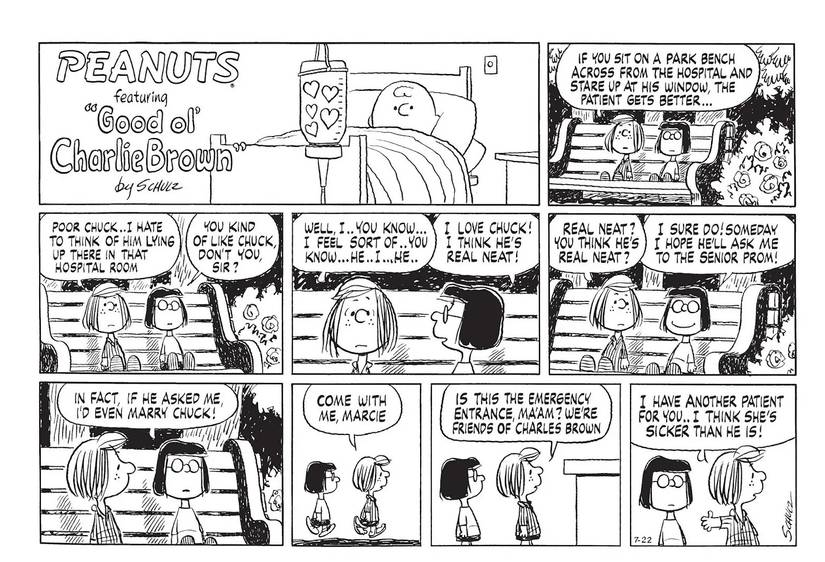
"It’s a well-known fact, Marcie, that a patient will recover faster if he knows a friend is staring up at his room," Patty declares with absolute conviction.
While Patty and Marcie’s hospital vigil aligns neatly with Patty’s recurring character trait of making a sudden, arbitrary decision and stubbornly sticking to it regardless of circumstance, the gesture stands out powerfully during a continuous, long-form reading of the series. Quietly, it ranks among the genuinely kindest acts any character performs for Charlie Brown throughout the entire multi-decade run of the Peanuts canon. Patty and Marcie are not present to stir up trouble, manipulate a situation, or score cheap comedic gags at Chuck’s expense. They are simply there to support their friend without reservation.
For a comic strip that has built its immense cultural reputation on a foundation of wholesome charm, genuine moments of unvarnished emotional sincerity are actually surprisingly rare within the original daily panels. True sentimentality in Peanuts was frequently reserved for branded merchandise, posters, or the beloved animated television specials rather than the daily newspaper prints. Consequently, when genuine, touching displays of friendship do occur within Schulz’s original work, they retain a distinct emotional resonance and lasting impact. It represents a subtle storytelling lesson that many subsequent comic strip creators and imitators ultimately failed to grasp.
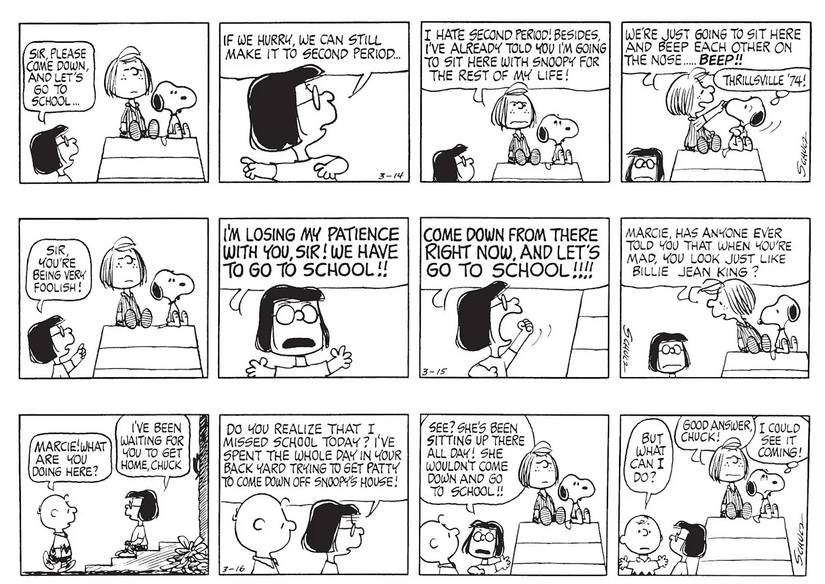
While attempting to distill a definitive thesis statement about friendship from a sprawling 50-year newspaper strip is a challenging endeavor, readers could certainly find far worse representations than the dynamic shared between Charlie Brown and Peppermint Patty. Patty may carry her own unique brand of eccentricity, just like every other child populating the Peanuts neighborhood, but her unwavering solidarity suggests that having a friend like her is an invaluable asset.



Leave a Reply