Ethereum co-creator Vitalik Buterin has stated that the network should actively promote Ether (ETH) as a store of value (SoV), moving away from the narrative that the asset primarily derives its value from burning transaction fees.
In a detailed discussion thread, Buterin argued that the concept of "ETH as a fee-burning token never was as strong as it seemed." He cautioned that optimizing the network strictly around fee-burning dynamics would negatively impact Ethereum’s core strengths, specifically its "decentralization and capture resistance." Instead, Buterin believes Ethereum’s long-term value should stem from the fundamental stability provided by its focus on "CROPS"—an acronym referring to censorship and capture resistance, open source, privacy, and security. He maintains that these characteristics will become increasingly valuable in an "era of AI disruption."
The debate surrounding Ethereum’s tokenomics traces back to the landmark 2021 EIP-1559 upgrade, which temporarily pushed the network into a deflationary state during periods of high fee revenue. This mechanism inspired prominent crypto commentators, including the hosts of the Bankless podcast, to coin the term "ultrasound money."
However, due to ongoing protocol design choices and scaling developments, transaction fees have steadily declined alongside total revenue, rendering the ultrasound money narrative increasingly unsustainable. Data shows that between January and October, median transaction fees dropped from 35 cents to just 3.5 cents, even as the total number of daily network transactions increased by more than 50%.
Reactions to Buterin’s statements were sharply divided across the broader crypto ecosystem. Prominent Bitcoin advocates, who view Bitcoin’s status as a store of value as sacred, were quick to criticize the shift. Held Media founder Dan Held dismissed Buterin’s comments as an attempt by the Ethereum community to pivot toward Bitcoin’s narrative after previous models lost momentum. "It’s wild that you think a protocol with a constantly changing monetary policy (just like fiat) can be a ‘sound money,’" Held argued. Conversely, defenders of the network pointed out that Ethereum’s monetary policy has remained strictly unchanged since The Merge in 2022, with subsequent updates serving to reduce rather than increase token issuance.

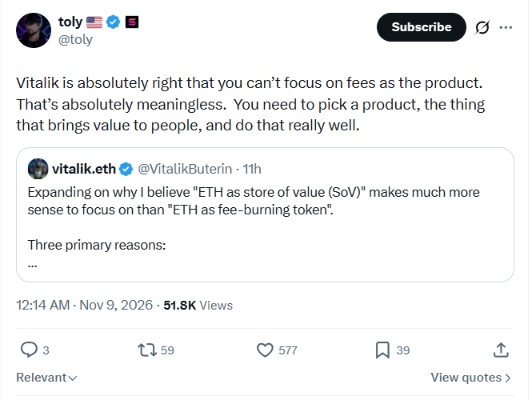
Meanwhile, Ethereum proponents welcomed the clearer narrative direction. MetaLeX attorney Gabriel Shapiro described Buterin’s comments as a "nature is healing moment," suggesting that on a fundamental level, ETH could eventually serve as a stronger store of value than both Bitcoin and privacy coin Zcash. Solana co-founder Anatoly Yakovenko also weighed in, noting that Buterin was "absolutely right that [you] can’t focus on fees as the product," while still offering a subtle critique of Ethereum’s overall ecosystem.
Democrat Sweep Spells Uncertain Future for Crypto Regulations
The political landscape in Washington, D.C., faces a major transformation following the recent midterms, introducing heightened uncertainty for digital asset regulations. Despite the crypto industry deploying massive financial resources—including $176 million spent across 100 congressional races, highlighted by a failed $64 million effort to unseat Senator Sherrod Brown—the direct influence of crypto super PACs appeared mixed at best.
While Democrats have secured control of both the Senate and the House of Representatives, industry advocacy groups like Stand With Crypto point out that nominal majorities of legislators in both chambers are now considered pro-crypto. Statistics indicate that 50 out of 100 senators are designated as pro-crypto compared to 33 anti-crypto lawmakers, while 241 members of the House support the industry against 106 opponents.
Despite these tallies, vocal critics of the digital asset sector are positioned to hold powerful committee assignments. Brown is expected to join the Senate Agriculture Committee, while Senator Elizabeth Warren is widely tipped to chair the Senate Banking Committee.
"The next Congress will bring a fundamentally different environment for crypto in Washington, and the industry should expect significantly more scrutiny," said Kyle Bligen, executive director at the Decentralization Research Center.
According to reports, Democratic lawmakers are already considering expanding proposals initially drafted by Representative Maxine Waters into a comprehensive market structure bill. While a slim chance remains for the revival of the CLARITY Act, observers note it would likely require stringent ethics provisions aimed squarely at addressing political controversies, such as those surrounding President Donald Trump’s family launching memecoins and a stablecoin.
"A sitting president’s family launching memecoins and a stablecoin is a real governance problem," said Hadley Stern, founder of Fidelity Digital. "If I’d done that at Fidelity, I’d have been walked out the same afternoon." The market reaction was swift, with the TRUMP memecoin plunging by a third over the week and ranking among the worst performers in the top 100 cryptocurrencies. Broader markets also reacted to the election results, with artificial intelligence-related stocks experiencing a sharp correction and Bitcoin slipping below the $76,000 threshold.
Fake Job Interview Led to Binance’s $6.34 Billion Hack
Security vulnerabilities continue to plague centralized institutions, highlighted by new revelations surrounding a massive breach. Binance disclosed that North Korean state-sponsored hackers first breached its systems back in June, when an employee inadvertently downloaded a compromised Homebrew installation while attempting to set up an AI coding tool. Although the exchange detected the intrusion early, attackers had already mapped out information regarding personnel working on Binance’s core wallet infrastructure.
By September, malicious actors posing as recruiters targeted another software engineer, tricking them into downloading a malicious file disguised as a coding test. On October 20, the attackers leveraged that compromised machine—alongside an internal AI tool—to infiltrate the systems of two additional engineers and deploy sophisticated malware. This multi-layered intrusion ultimately granted the hackers access to the exchange’s internal wallet-signing service, facilitating the theft of billions of dollars.
"This wasn’t one mistake or one breach—it was a months-long campaign," Binance co-CEO Richard Teng stated in a post on X.

Ethereum Dev Targets 2028 for Quantum Resistance, a Year Early
In core development news, Ethereum Foundation researcher Justin Drake has set an ambitious target of December 2028 to finalize the network’s post-quantum and post-AI transition, moving the deadline up by a full year compared to previous estimates. Speaking at Devcon 8 in Mumbai, Drake outlined the accelerated schedule, stating that developers now have a 24-month window to deliver three critical network upgrades.
The Ethereum Foundation’s previous roadmap, published in September, had established December 2029 as the target date for achieving full quantum resistance. However, near-term protocol updates currently face headwinds; core developers recently delayed the Glamsterdam upgrade indefinitely as they work to resolve complex security concerns tied to eight distinct smart contract invariants.
THORChain Restarts Despite FBI Warning
Decentralized liquidity protocol THORChain resumed trading operations across most major networks, directly ignoring an explicit directive from the Federal Bureau of Investigation not to process funds linked to the recent Binance hack. Following the restoration of support for networks including Bitcoin, Ethereum, Bitcoin Cash, Dogecoin, Litecoin, Tron, and Zcash, the protocol’s native token, RUNE, rallied roughly 15% over a 24-hour period.
According to blockchain analytics firm Chainalysis, THORChain had already processed over $46 million in funds connected to the exploit during the first 72 hours following the breach, generating approximately $200,000 in fees. Automated trading had previously paused due to an unrelated Ethereum block reorganization.
Addressing the defiance of federal law enforcement, THORChain co-founder JPThor argued that the incident demonstrated the protocol’s genuine decentralization. "The fact that the FBI did in fact call out the protocol—and nobody could do anything—means in fact the protocol is decentralized," he stated. "Nobody in their right mind in a western country would flagrantly ignore a direction like that."

Market Performance and Institutional Perspective
Market conditions remained under pressure as the week concluded. Bitcoin dropped 4.5% to trade near $74,302, Ethereum fell 6.3% to $2,117, and XRP retreated 5% to $1.11, bringing the total cryptocurrency market capitalization down to $2.49 trillion. Among the top 100 digital assets, altcoin gainers included Pieverse, up 39.2%, Injective, up 11.1%, and Tether Gold, up 4.2%. Conversely, the most significant weekly losses were recorded by Official Trump, down 32.8%, Worldcoin, down 20.8%, and Ethena, down 19%.
Addressing the fallout from the historic Binance security breach, Grayscale Head of Research Zach Pandl noted that while the multi-billion-dollar exploit would temporarily dampen market confidence, it would ultimately drive the industry toward more robust security standards.
"It also underscores the importance of institutional custody, such as offered by US-based crypto exchange-traded products," Pandl wrote in a report. He highlighted that such investment vehicles typically store assets with state-chartered banks and qualified custodians utilizing offline storage, multi-signature wallets, formal attestations, and comprehensive insurance policies.
Regulatory and security challenges extended beyond exchanges. Binance France informed local users via email that its operations in the country are winding down, with all customer accounts set to close by December 31. Users failing to withdraw remaining assets by late November face ongoing monthly maintenance fees. The move follows Binance’s earlier restriction of EU services after failing to secure required Markets in Crypto-Assets (MiCA) regulatory authorization before the July deadline.
Meanwhile, prediction markets and financial infrastructure also faced scrutiny. Researchers from Vanderbilt University highlighted suspicious betting activity on Polymarket and Kalshi ahead of the public release of New York Times/Siena political polls, raising questions regarding potential information leaks. Additionally, decentralized Visa debit card issuer Gnosis Pay disclosed a security breach affecting its legacy consumer card system on November 3, which exposed customer payment card numbers, home addresses, and cryptocurrency wallet information.