
Every year, the Office of the United States Trade Representative (USTR) undertakes a comprehensive review to identify the foreign online and physical markets that rightsholders consider to be the most severe threats to intellectual property. This influential initiative, known as the Notorious Markets list, traditionally highlights sprawling torrent indexes, cyberlockers, and unauthorized streaming portals that siphon billions of dollars in revenue from creative industries globally. In recent years, the scope of the review has expanded to encompass hosting providers, cloud services, and other technical intermediaries that facilitate the large-scale distribution of copyrighted material.
Last week, the Entertainment Software Association (ESA), the prominent trade organization representing major video game publishers in the United States, submitted its latest slate of recommendations for the upcoming review. While the submission features several familiar entities that have appeared on previous lists, it also targets a shadowy operator that possesses no traditional website, public storefront, or consumer-facing portal. This strategic shift underscores how the video game industry is aggressively adapting its enforcement tactics to combat the upstream sources of software piracy rather than solely focusing on downstream distribution hubs.
A Game Cracker as a Piracy ‘Market’
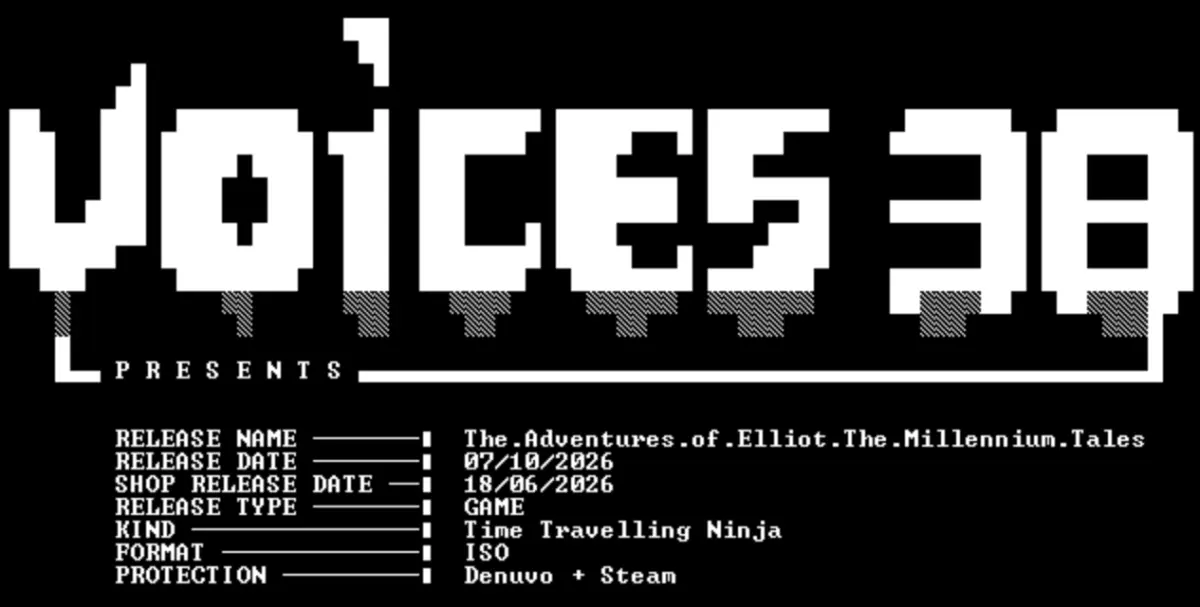
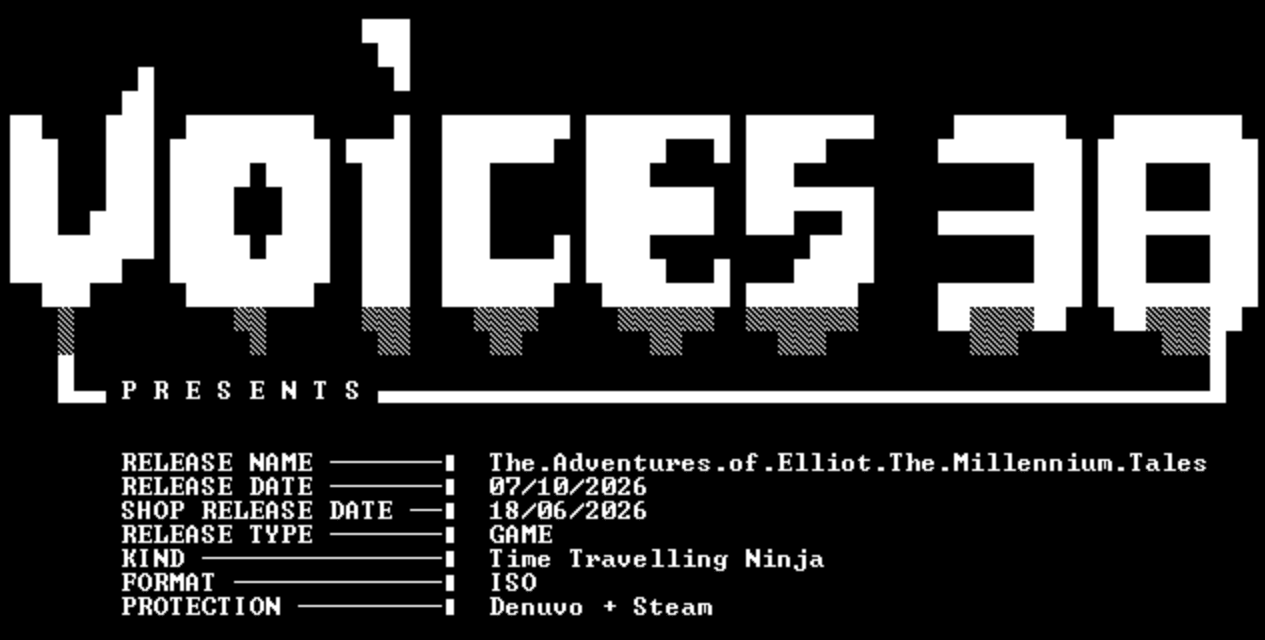
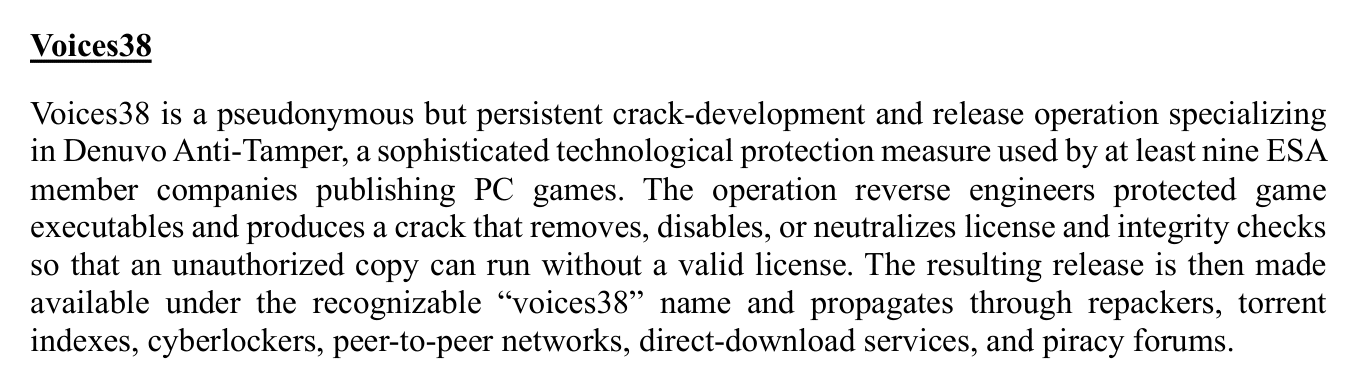
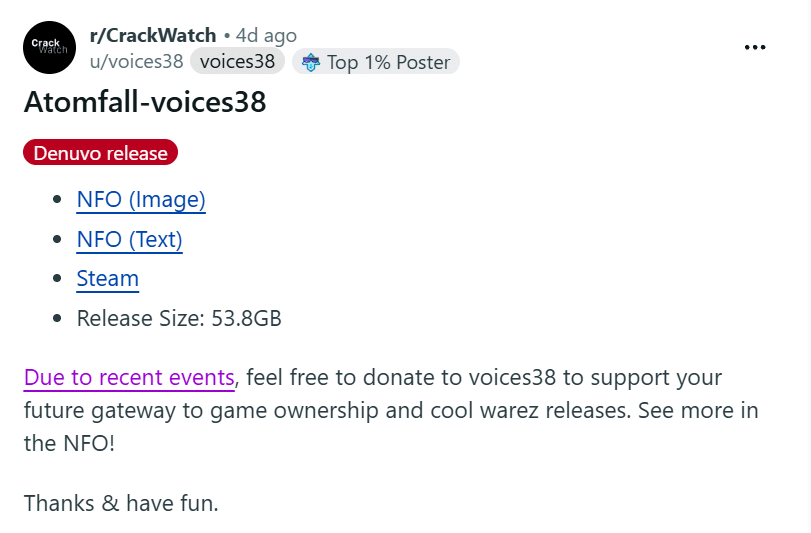
At the center of the ESA’s newest recommendations is an anonymous individual or collective operating under the handle "voices38." According to the trade group’s submission, this anonymous cracker has emerged as a persistent and highly specialized operation dedicated to defeating Denuvo Anti-Tamper, a robust technical protection measure utilized by at least nine of the ESA’s member companies to safeguard modern PC video games from unauthorized access.

The ESA notes that indexing communities, such as Reddit’s r/CrackWatch, currently attribute roughly two dozen high-profile cracked or bypassed game releases to the voices38 handle. The industry group emphasizes that this specific cracker occupies a foundational position within the modern piracy ecosystem. Rather than hosting the files directly for public consumption, voices38 produces the initial functional bypasses that are subsequently harvested by downstream entities, including popular repackers, public and private torrent trackers, cyberlockers, and dedicated piracy forums.
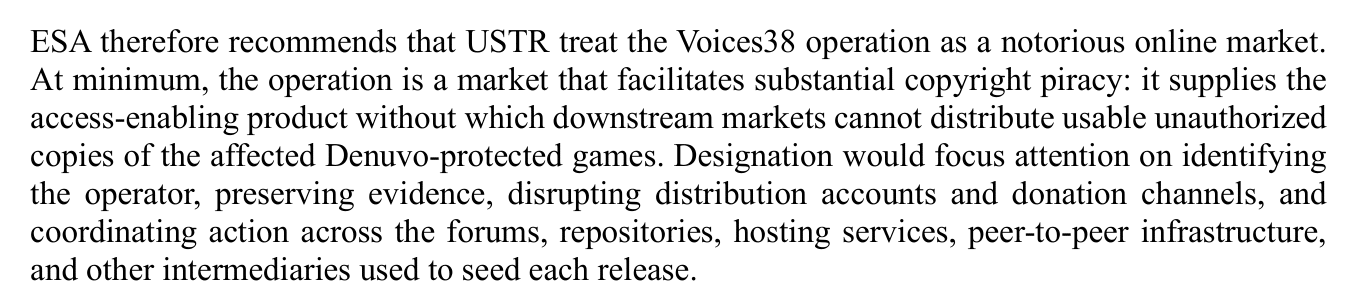
In its filing, the ESA argues that treating only downstream distribution services as illicit markets fundamentally overlooks the upstream operations that dictate whether protected digital goods can be offered to the public in the first place. Without the initial crack provided by operators like voices38, many protected titles would remain secure, effectively cutting off the downstream markets from offering functional unauthorized copies.
The fact that the cracker operates without a public identity or a traditional homepage should not preclude a Notorious Markets designation, according to the ESA. Instead, the trade association contends that formal inclusion on the list could serve as a valuable catalyst to help rightsholders coordinate international enforcement actions, identify the real-world operators behind the pseudonym, preserve digital evidence, disrupt distribution accounts, and cut off cryptocurrency donation channels across the diverse network of forums, repositories, and peer-to-peer infrastructure used to seed each release.
Lawsuit Doesn’t Stop the Cracks
The push to unmask the operator behind the handle is not limited to trade association petitions. Last month, Denuvo initiated legal proceedings against voices38 in a U.S. federal court in California, subsequently requesting judicial permission to issue subpoenas to major platforms including Discord, Valve, and Reddit in an effort to uncover identifying financial and communications data. While the ESA’s latest submission does not explicitly reference this ongoing litigation, both parallel efforts highlight a concerted industry-wide campaign to pierce the veil of anonymity protecting the cracker.
Despite the mounting legal pressure and scrutiny, the output of cracks has not meaningfully slowed down. Following a brief period of relative quiet, the voices38 handle released functional cracks for titles such as Atomfall and The Adventures of Elliot: The Millennium Tales, alongside a significant crackfix for the Dead Space Remake.
These newly released files swiftly migrated across the usual network of peer-to-peer torrent trackers and cyberlocker services. Prominent game repacker FitGirl quickly incorporated the latest releases into their distribution catalog, bringing attention back to another primary target featured prominently in the ESA’s regulatory submissions.
Billion-Dollar FitGirl
FitGirl, one of the most prolific and widely recognized repackers in the digital piracy landscape, has been a fixture on the U.S. government’s Notorious Markets lists for consecutive years, including the 2024 and 2025 iterations. In its latest filing, the ESA has strongly recommended that the repacker remain on the list for the upcoming review cycle, pointing to the site’s enduring resilience and massive scale despite aggressive countermeasures deployed by international authorities.
Although internet service providers in countries such as Germany, Italy, and Spain have implemented domain-level and network-level blocks against FitGirl’s web infrastructure, the ESA notes that these localized blocks have failed to produce meaningful behavioral changes from the site’s operators. Traffic metrics cited in the submission reveal that the repacker’s primary domain accumulated approximately 41.77 million visits in the month of August alone, continuing to offer unauthorized copies of titles published by ESA member studios.
The ESA highlights that formal takedown notices sent directly to the site’s operators are routinely ignored. According to the trade group’s tracking data, zero infringing links were removed from the platform between August 2025 and August 2026. To illustrate the economic impact of this ongoing availability, the game companies calculated staggering financial losses associated with the platform, presenting precise figures derived from peer-to-peer network activity.
Between March and August 2026, the ESA claims to have detected 15,484,145 unique users participating in peer-to-peer swarms for games that had been compressed and distributed by FitGirl. Multiplying this user count by a standard retail price point of $69.99 per game, the submission calculates an estimated lost commercial value of $1,083,735,308.55. This multi-billion-dollar valuation underscores the severe financial metrics rightsholders utilize to demonstrate the scale of the alleged harm to federal regulators.
Other prominent distribution platforms exhibit similarly low responsiveness to copyright enforcement efforts. The ESA noted that DODI-Repacks complied with only 22 percent of reported links, while the major Russian-language torrent portal RuTracker adhered to a mere 3 percent of the removal notices submitted over the past year. To combat these uncooperative hubs, the ESA suggests that tracking complex financial movements—including cryptocurrency transactions flowing through Know Your Customer-vetted exchange platforms such as Binance—represents a viable avenue for identifying the individuals profiting from these operations.
Handheld Consoles as ‘Superfakes’
This year’s USTR review features a specific regulatory focus on high-quality counterfeit goods commonly referred to in trade enforcement circles as "superfakes." Seizing upon this thematic emphasis, the ESA has formally introduced a category of physical hardware that it argues functions as the video game equivalent of superfakes: handheld emulation consoles that come preloaded with unauthorized libraries of classic and modern games.
Specifically, the trade association has nominated Anbernic.com, the official e-commerce storefront for a widely distributed line of portable emulation devices. The ESA states that these hardware units are routinely marketed, sold, or shipped with micro-SD memory cards containing hundreds or thousands of pirated video game titles pre-installed. These devices are frequently made available to consumers not only through dedicated manufacturer storefronts but also via mainstream global e-commerce giants including Amazon and eBay.
Beyond preloaded hardware, the ESA’s submission casts a wide net across auxiliary services that intersect with the video game economy. The document targets marketplace platforms such as G2A, FunPay, and Eldorado.gg, where users buy and sell pre-owned game accounts, virtual currencies, and in-game items. Additionally, the filing targets hardware and software cheat developers, such as the creators of the Cronus Zen device. The ESA argues that commercial cheating products should be classified as piracy threats because they systematically bypass and neutralize the technological protection measures implemented within protected games.
The ultimate determination regarding which of these nominated entities, platforms, and hardware manufacturers will appear on the final Notorious Markets list rests entirely with the USTR. Because the previous edition of the list was published in March, stakeholders and observers anticipate that the official release of the forthcoming review may take several months to materialize.



Leave a Reply