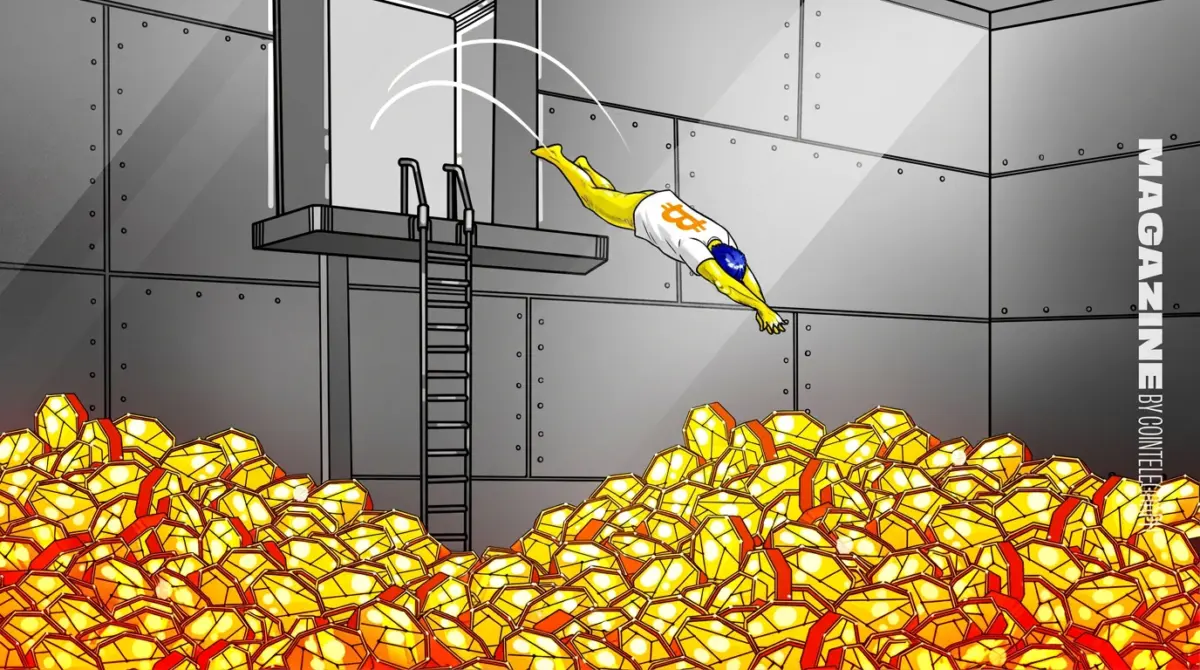
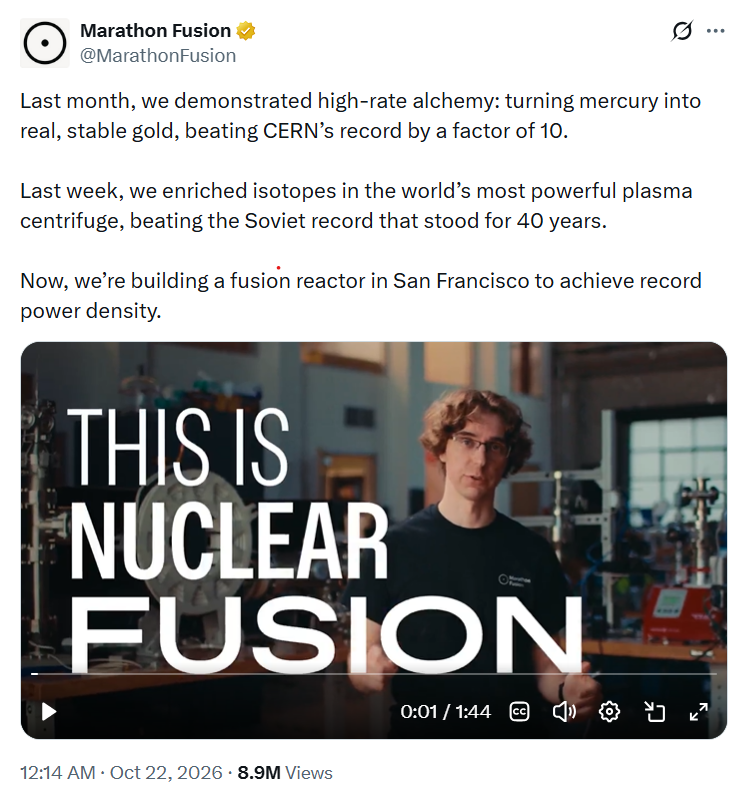
They say all that glitters is not gold, a classic adage that took on an entirely modern and literal meaning this month when an American fusion startup announced it had successfully produced gold from mercury. Rather than relying on ancient alchemical trickery or traditional mining operations, the process developed by Marathon Fusion hinges on the principles of nuclear transmutation.
According to a research paper published by the company, high-energy neutrons generated from a deuterium-tritium fusion reaction can be used to irradiate mercury-198. This specific irradiation process produces a radioactive isotope that subsequently decays into stable gold-197.
The announcement has quickly rippled across financial and technological circles, prompting online commentators to jokingly refer to the breakthrough as an “infinite mint bug” for a precious metal that has served as a cornerstone of human commerce and a universal store of value for centuries. Naturally, the development has also reignited ongoing debates regarding Bitcoin, an asset often celebrated as digital gold due to its own algorithmic, hard-capped supply.
Coinbase Chief Executive Officer Brian Armstrong was quick to weigh in on the development, suggesting that the news ultimately plays right into Bitcoin’s narrative strengths. Armstrong compared the concept of creating net-new gold through advanced laboratory methods to the modern lab-grown diamond industry, which has expanded rapidly in recent years. In a post shared on social media, Armstrong highlighted the immutable nature of the leading cryptocurrency, emphasizing that no scientific breakthrough or human invention could ever manipulate its foundational monetary policy. There will simply only ever be 21 million bitcoins in existence.
Meanwhile, Marathon Fusion co-founder and chief executive Kyle Schiller revealed that the breakthrough has already attracted significant attention from unexpected quarters, potentially following a path similar to the jewelry market disruptions seen with synthetic diamonds. Schiller noted that the startup has fielded a surprisingly high volume of inquiries from individuals and entities interested in utilizing the lab-produced precious metal for jewelry applications, though he expects that, much like conventional gold, it would primarily find a home as a long-term store of value.
However, before traditional gold investors and long-term "gold bugs" begin panicking over an imminent collapse of the precious metals market, industry analysts emphasize that Marathon’s achievement remains a long way from proving that gold can be economically produced at industrial scale.
Nikos Kavalis, managing director at precious metals research firm Metals Focus, noted that global markets are nowhere near a stage where this form of production carries any real economic significance. Pointing to the persistent allure of turning base metals into wealth, Kavalis remarked that while allusions to alchemical dreams certainly make for captivating headlines, traditional gold miners will undoubtedly get to keep their jobs for the foreseeable future.

Can Gold Ever Really Be Manufactured at Scale?
While the underlying nuclear physics process is scientifically sound, transitioning from a controlled laboratory demonstration to an economical, large-scale industrial operation presents an entirely different set of complex engineering challenges.
Marathon reported that it had successfully produced stable gold at a rate roughly ten times that of previous records set by CERN, the prominent European particle physics laboratory where researchers utilize massive particle accelerators to study the fundamental building blocks of matter. During its operational runs between 2015 and 2018, CERN’s ALICE experiment produced an estimated 29 picograms of gold nuclei, though those particles existed for mere fractions of a second before being destroyed in high-energy collisions.
Marathon has not publicly disclosed the exact physical quantities of gold produced during its initial experiments. Jake Harter, a research engineer at the company, explained that current yields remain extremely microscopic. However, the startup has outlined ambitious goals to scale its operations and reach macroscopic milligram quantities by 2027.
Consequently, the much larger figures cited in Marathon’s research paper are forward-looking projections based on the theoretical output of a fully realized future fusion power plant, rather than a reflection of current production volumes. The theoretical models estimate a production rate of approximately two tonnes of gold per gigawatt of thermal fusion power annually. To put that scale into perspective, data from the World Gold Council shows that global mining operations yielded 3,672 tonnes of gold in 2025 alone, meaning a single future fusion plant’s projected output would remain relatively modest by comparison.
Even to achieve those future targets, Harter pointed out that the company would first need to heavily scale up the production of the enriched mercury required for the transmutation process, alongside the fundamental engineering task of constructing and operating a commercial fusion reactor. Maturing this technology will require extensive ongoing studies focusing on materials compatibility, specialized mercury pumping systems, and efficient gold extraction techniques.
Could Gold Follow the Lab-Grown Diamond Playbook?
It is difficult for market observers to avoid drawing direct parallels between Marathon’s nuclear-produced gold and the trajectory of lab-grown diamonds. Over the last several years, wholesale prices for synthetic diamonds have plummeted by more than 90% as production methods have scaled and matured globally. Unlike older, less sophisticated diamond substitutes such as cubic zirconia, modern lab-grown diamonds share a chemical composition identical to mined diamonds, offering the same physical properties at a fraction of the cost. This precedent naturally raises questions about whether a similar fate could eventually await gold.
Nagham Hassan, a market analyst at investment platform eToro, acknowledged that the comparison to the diamond industry is understandable from a conceptual standpoint, but stressed that the fundamental economics are entirely different. While diamond manufacturing became progressively cheaper as factories expanded their output, producing gold via nuclear fusion demands extraordinarily complex, capital-intensive infrastructure that does not yet exist on a commercial scale.
Another notable complication involves the radiological state of the newly manufactured metal immediately following the transmutation process. Harter noted that the resulting gold would need to be safely stored for a little over a decade to allow its radioactivity levels to decay down to negligible background levels comparable to everyday objects like bananas. Nevertheless, because the vast majority of investment-grade gold is held securely in vaults rather than circulated immediately, he does not view a mandatory cooling-off period as an insurmountable barrier to eventual commercialization.
The more pressing uncertainty remains whether the overall economics will ever realistically align. Kavalis reiterated that there has been no tangible demonstration of commercial viability, noting that while the startup has published theoretical revenue projections, comprehensive data detailing the actual operational costs of running such reactors at scale is still missing.
Would Bitcoin Benefit if Gold Became Less Scarcity-Driven?
Bitcoin has long been characterized by its proponents as digital gold, primarily because its issuance schedule is strictly governed by open-source protocol rules enforcing a hard cap of 21 million coins. While enthusiasts like Armstrong argue that human ingenuity cannot alter the mathematical certainty of Bitcoin’s supply, the theoretical prospect of unlocking a new, non-traditional source of gold supply through advanced technology like nuclear fusion introduces a fascinating variable into long-term macroeconomic discussions.
In theory, a dramatic expansion in the accessible global supply of any scarce asset would place downward pressure on its open-market valuation, provided all other economic factors remain equal. Fabian Schär, a professor of distributed ledger technology and fintech at the University of Basel, noted that under the purely hypothetical assumption of inexpensive, large-scale production, gold would ultimately be no exception to fundamental supply and demand dynamics.
However, with the world’s first commercial fusion reactors still estimated to be at least a decade away, and with substantial questions lingering over the economic feasibility of nuclear alchemy, the breakthrough is unlikely to exert any noticeable influence on Bitcoin prices or precious metal markets in the near term. For now, Marathon Fusion’s work remains a compelling scientific experiment with intriguing long-term implications rather than an immediate disruption to global commodity markets.