

Crypto investors across the United States who failed to report trades and transactions in previous tax years may soon breathe a sigh of relief, thanks to a legislative measure currently advancing through the US Congress. The proposal aims to establish a structured and predictable pathway for individuals to correct past discrepancies without facing the severe uncertainties or extreme penalties that have long troubled the digital asset community.
At the center of this legislative movement is Section 502 of the Digital Asset Tax Certainty Act, designated as H.R. 10357. This specific provision would mandate that the United States Treasury secretary establish a specialized Digital Asset Voluntary Disclosure Program within 12 months of the bill officially becoming law.
If enacted, the program would allow eligible taxpayers to correct past digital asset tax violations by filing amended tax returns and paying the underlying tax owed, along with applicable interest and a designated program penalty. This development comes at a critical time as the digital asset industry continues to mature and integrate more closely with traditional financial reporting systems.
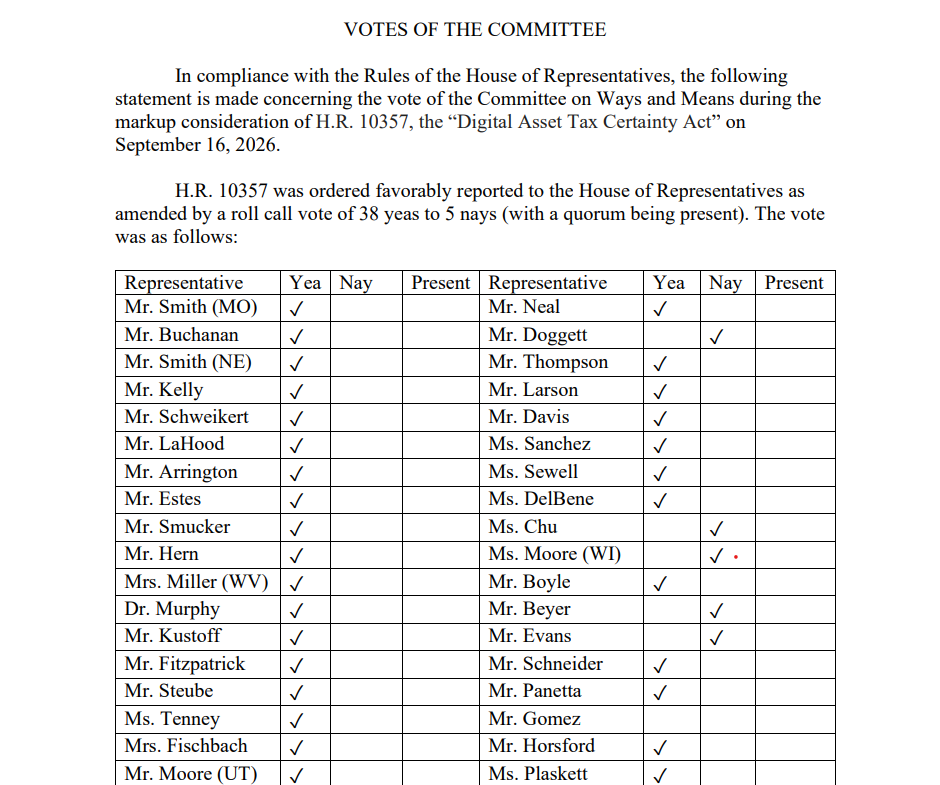
The legislative process has already seen significant milestones. The House Ways and Means Committee approved the bill by a decisive 38-5 vote on September 16. Despite this strong committee approval, the legislation has not yet become law; it still requires passage through the full House of Representatives and the Senate before it can be presented to the president for a signature.
Andrew Gordon, the executive director of Digital Asset Tax Action, highlights the profound impact this potential change could have on everyday participants in the digital asset economy. Observing that the measure has flown largely under the radar, Gordon notes that it represents a substantial shift that would ultimately assist a vast number of ordinary taxpayers who have struggled to navigate complex reporting standards over the years.
A Gap in the System
The introduction of the Digital Asset Tax Certainty Act coincides with a period of heightened scrutiny and transition for American crypto investors. Users across the country are currently grappling with their first filing season under the newly implemented 1099-DA broker reporting rules. These updated regulations grant the Internal Revenue Service unprecedented visibility into individual cryptocurrency transactions, fundamentally changing how trading activity is monitored and documented.

While industry advocates generally agree that these new rules will streamline reporting and bring greater clarity going forward, they leave a glaring gap for the years leading up to their implementation. Gordon points out that a remarkably large share of investors failed to report their transactions correctly over the years. Furthermore, existing administrative procedures simply do not offer taxpayers who made honest mistakes a predictable or reliable way to resolve their historical liabilities.
For many participants, the realization that they fell short of compliance comes as a stressful surprise. According to Gordon, a crypto investor who discovers that they mismanaged their reporting or omitted transactions altogether currently faces a frustrating lack of viable options. Years after the fact, individuals often discover that they fundamentally misunderstood the complex tax treatment governing crypto-to-crypto trades, or that they struggled to accurately track and aggregate activity across multiple different trading platforms and decentralized applications.
What Taxpayers Could Get
To understand the significance of the proposed program, it helps to examine the current landscape of IRS compliance mechanisms. The agency’s existing Voluntary Disclosure Practice is primarily designed for taxpayers who willfully violated tax rules and consequently face potential criminal exposure and severe legal repercussions.
For everyday taxpayers who made honest reporting errors, the primary route has been to file amended returns. However, the penalty treatment under this traditional route lacks the predictability and specific framework that provision 502 seeks to introduce for digital assets.
Sharon Yip, a certified public accountant and the founder of Crypto Tax Advisors, notes that reporting errors among ordinary, non-willful crypto investors are remarkably common. Drawing from her extensive professional experience, Yip explains that many clients initially failed to report their crypto activity because they operated under the mistaken belief that no tax liability was triggered until they converted their digital assets back into fiat currency, such as US dollars. Other clients relied heavily on incomplete or fragmented exchange records, or inadvertently misclassified specific types of transactions.
Yip emphasizes that there is currently no standardized process that affords non-willful crypto investors predictable penalty treatment or a clear, straightforward resolution. In her view, a crypto-specific voluntary disclosure program could effectively fill this institutional gap by providing a defined correction period, reduced and predictable penalties, and much-needed certainty for taxpayers who choose to come forward of their own accord.
What the Bill Would Offer
Under the framework outlined in Section 502, participating taxpayers would generally be required to file amended returns within 24 months of the program being officially established. The legislation establishes two distinct penalty tracks depending on the nature of the taxpayer’s past omissions.
Significantly lower rates are designated for taxpayers who certify under penalty of perjury that their past violations were neither fraudulent nor willful. Individuals who qualify under this track would face a 0% penalty on the first $25,000 of tax deficiency per year, and a modest 5% penalty on amounts exceeding that threshold, provided they file their corrections within the first 12 months of the program’s operation.
Conversely, for individuals who do not make this certification, much harsher rates apply. These taxpayers would face a 25% penalty on the first $25,000 of deficiency and a 40% penalty on amounts above that level. Furthermore, these rates increase if taxpayers fail to meet the initial application window.
The legislation also provides relief from specified civil penalties. Additionally, taxpayers who decline to certify receive critical protections against criminal referrals based on information they properly disclose for the tax offenses covered by the provision.
Yip advises that taxpayers should carefully review their historical transaction records across all exchanges and digital wallets to identify which specific tax years require correction before attempting to assess whether their past mistakes were genuinely non-willful. Because making a false certification carries severe legal consequences under the penalty of perjury, she strongly recommends seeking professional guidance whenever uncertainty arises.
The potential implementation of Section 502 arrives as a welcome prospective remedy for a populace that remains largely uneducated about the finer points of digital asset taxation. Highlighting the scale of the issue, a comprehensive 2026 report published by CoinTracker and Coinbase revealed that only 49% of crypto users correctly understood that selling cryptocurrency can constitute a taxable event. As Congress continues deliberations on H.R. 10357, millions of participants across the United States wait to see if a structured path to compliance will soon become a reality.



Leave a Reply