
Fourteen distinct items populate the list, with eleven marked as high priority. Two arrived directly from a manager during the morning hours, three emerged from a pressing customer escalation, and one is a strategic memo that has been pushed forward across four consecutive Mondays. Every single item on that ledger is defensible. That is precisely where the systemic failure begins.
Priority levels are ostensibly designed to sort through this professional congestion, but in practice, they frequently serve merely to rename it. Adding a categorization field containing P1, P2, and P3 designations often results in a scenario where, within a single month, every request that holds any significance to anyone arrives pre-stamped as a top-tier emergency. The digital labels become tidier, yet the professional finds themselves once again standing at seven o’clock on a Thursday evening, forced to choose which solemn promise they will break.
Labels are fundamentally not the operational mechanism of prioritization. A priority level only functions effectively when it exacts a genuine cost—when it takes something concrete away, such as a time slot, a day, or another task’s rightful place in line. A level that costs nothing gets spent with absolute freedom, rendering a scale where everything sits at level one merely a task list operating with extra, deceptive steps.
Understanding what these levels truly mean, how to establish a scale that demands an actual choice, and how to navigate situations where external parties assign those designations requires looking closely at the mechanics of workload management.
What Priority Levels for Tasks Actually Are
Priority levels for tasks are defined as a fixed set of labels designed to rank incoming work by the potential damage it prevents and the velocity with which it must move. Within IT service management, these labels traditionally emerge from a structured matrix combining impact—the measurable scale of business loss—with urgency, which dictates the expected speed of resolution. The highest combination of these factors maps directly to Priority One, designating a critical status. On a personal task list, the label is supposed to execute the exact same mechanical function: clarifying what must be done immediately and what must be dropped in order to make that execution possible.
This operational heritage carries substantial weight. Incident response teams write down their top-tier classifications in painstaking, unambiguous detail. One major network vendor specifically defines a Priority One event as a major business outage affecting critical sites, multiple geographic locations, multiple VPN users, or core applications. Notably absent from that strict definition is any consideration of who asked for the fix, how loudly they demanded it, or how recently the trouble ticket landed in an inbox.
Debates regarding the ideal number of levels feature no universal consensus. Software providers often operate with three tiers, ranging from urgent to normal, while enterprise names like Cisco deploy four severity levels descending from critical business impact down to requests carrying zero business disruption. Other service platforms utilize five distinct tiers, with lower numerical values consistently denoting greater impact.
Across these variations, the exact count of levels is not what dictates whether a scale succeeds. Instead, the written entry test established for each individual level determines its viability, a crucial component that professionals rarely port over to their personal organization systems.
Why Priority Labels Stop Meaning Anything by Week Three
Task labels inevitably inflate for a straightforward structural reason: applying the label costs nothing, whereas sacrificing a Tuesday afternoon carries a heavy toll. Anyone can mark a request as urgent at zero financial or operational cost, including the worker themselves. Consequently, the top tier fills rapidly until it completely ceases to carry any informative value.
By the third week of such a system, a top-tier designation no longer signifies a genuine crisis. Instead, it merely indicates that a task is recent, loud, or requested by someone holding a senior title. The scale fails not because individuals deliberately abuse it, but because nothing within the framework is scarce.
Urgency cues wield a profound psychological influence on human choice. Behavioral experiments have repeatedly demonstrated that individuals frequently select objectively lower-payoff tasks simply because those tasks carry an urgent or expiring cue, even when alternative options promise significantly greater value. Researchers note this phenomenon as the mere urgency effect. While these findings derive from controlled consumer experiments rather than an evaluation of a corporate inbox, they illustrate a fundamental human tendency that must be accounted for when designing professional workflows. When eleven different items are marked as high priority and a single one bears a red warning flag, the psychological pull toward the artificially urgent item remains strong.
The traditional distinction between the urgent and the important, a concept heavily relied upon in productivity literature, traces its lineage back decades. Originally articulated during a public address in August 1954, the formulation separated problems into two distinct categories, noting that urgent problems are rarely truly important, and important problems are rarely immediately urgent. The subsequent two-by-two grid popularized as a foundational matrix for time management represents a later adaptation of this philosophy.
While this philosophical division remains valid, it is inherently incomplete on its own. A simple grid sorts tasks into boxes and hands them back to the overwhelmed worker, who is still left facing a dozen critical tasks and only a single available day. Furthermore, re-sorting work is not a cognitively free exercise. Laboratory studies examining task switching indicate that the time cost associated with alternating between different responsibilities grows alongside the complexity of the rules governing them. Deciding what matters dozens of times throughout a single day imposes a heavy cognitive tax, directly driving the severe decision fatigue that manifests late in the afternoon when task lists remain untouched since the midday break.
A Four-Level Scale That Forces a Choice
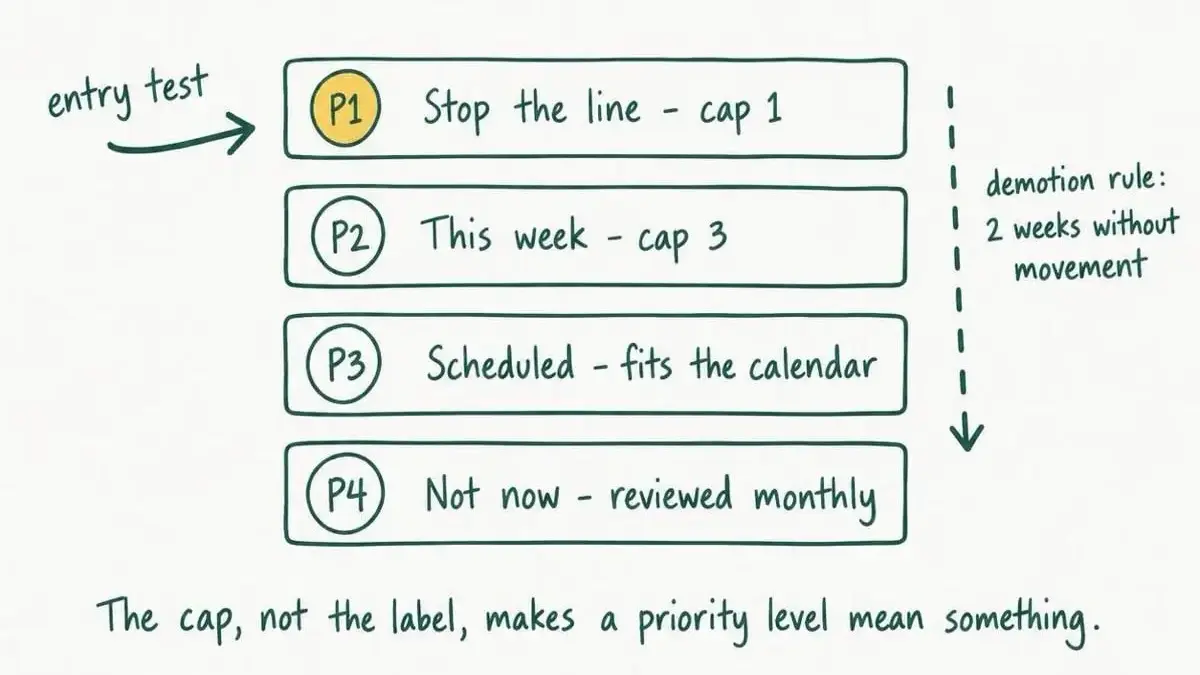
Constructing a reliable scale requires borrowing the rigorous impact-and-urgency logic native to incident management while integrating the missing personal components: a strict numerical cap on how many items can occupy each level, and a clearly stated cost for placing an item there.
The top tier, designated as a stop-the-line mechanism, is reserved strictly for work that actively prevents immediate damage. Its entry test requires that someone outside the immediate team is actively blocked at that very moment, or that a dated organizational commitment will fail on that exact day. The operational cost of invoking this level is absolute: every other ongoing task shifts forward by a full day, and that adjustment must be communicated openly. The cap for this critical level is strictly set at a single item.

The second tier covers commitments that have been explicitly made to a named individual within the current week. To pass the entry test, the task must carry a firm due date falling inside the current business week, and the worker must be able to readily name the specific person who is waiting for the deliverable. The operational cost dictates that no new entries enter this tier until an existing one is officially closed, with an active capacity cap limited to three open items.
The third tier accommodates scheduled work—legitimate projects that possess a designated time slot or calendar block but do not constitute an emergency for the current week. These items are subjected to weekly reviews, where they either advance upward in priority or are systematically removed from the active rotation.
The final tier holds everything else honestly, surviving only if it genuinely warrants trading away a slot in a higher tier. These lower-priority items undergo monthly reviews and face automatic deletion after a specified period of inactivity.
The implementation of strict capacity caps forms the engine that drives this entire framework. Rooted in foundational queueing theory principles, holding an excessive number of items open simultaneously stretches the average duration required to complete any single task. Four open commitments do not reach completion any faster simply because they are all labeled with high importance; instead, they finish significantly later, one by one, while the worker carries the crushing psychological weight of managing them all concurrently.
Establishing strict entry tests in advance, rather than attempting to judge the validity of each incoming request in the heat of the moment, provides the necessary structural defense. Formalized, rule-based predictions consistently outperform ad-hoc human judgment made under pressure. A rule established calmly on a Sunday is considerably harder to rationalize away during a high-pressure exchange late on a Tuesday afternoon.
What This Looks Like on an Ordinary Tuesday
Consider the operational reality of an executive running operations for a mid-size logistics firm. At the start of an ordinary Tuesday, the morning begins with an empty top-tier slot, while an important board memo serves as a scheduled weekly commitment carrying a strict Thursday deadline and a named reader.
Mid-morning brings an unexpected warehouse integration failure that instantly blocks two key customers from viewing their active shipments. Applying the written entry test, this failure qualifies immediately as a top-tier emergency because external parties are actively blocked. Importantly, the board memo does not quietly degrade or rot in the background; it is formally shifted to Wednesday, and the executive directly notifies the stakeholder of the adjustment. Making this announcement aloud removes the hidden friction of a silently broken promise.
Later in the day, a senior executive requests a complex pricing analysis to be delivered as soon as possible. Because the top-tier emergency slot is already occupied, the operational response relies on a clear capacity statement rather than a vague complaint about being overwhelmed. Presenting transparent operational boundaries—offering to initiate the new analysis once the integration issue is resolved or taking it on immediately while the integration waits—transforms a stressful confrontation into a manageable resourcing discussion.
As the afternoon concludes, multiple new requests arrive. Because none of them meet the stringent criteria for the current week’s commitments and the capacity caps are already reached, they are assigned future calendar dates rather than inflated priority adjectives. The workday ends with the critical integration repaired and the strategic memo successfully adjusted by mutual agreement, preventing an ordinary day from devolving into unproductive motion masquerading as progress.
When Someone Else Sets Your Priorities
The most frequent objection raised against any strict priority scale is the reality of external control. When corporate leadership marks every incoming email as critical, or when major clients escalate issues by sheer volume of communication, an internally designed scale seemingly holds no authority. Yet the framework retains its utility because its primary output is not merely a sorted list of tasks; rather, it is a visible operational trade that an external party must explicitly approve or decline.
When a request arrives pre-labeled as an urgent emergency, the conversation shifts away from arguing over semantics and centers on a single, inescapable question: what existing work must move to accommodate this new demand? Most reasonable stakeholders will answer this resourcing question honestly once the trade-off is made transparent. Those who refuse to acknowledge capacity limits provide valuable diagnostic information about the organizational culture.
If an enterprise already enforces an overarching corporate prioritization framework, mapping personal tiers to match those institutional definitions eliminates vocabulary disputes entirely. External severity levels map directly into internal personal categories, while the strict capacity caps are fiercely defended at the individual level. Maintaining these boundaries prevents the overwhelming saturation that paralyzes productivity.
What to Check After Two Weeks
Implementing this system can begin simply by defining the entry test and capacity cap for the top priority level on a single line of text. This concise standard serves as the smallest viable version of the entire framework, immediately forcing the first honest refusal of non-essential work.
Over a subsequent two-week trial, monitoring specific metrics reveals the true health of the system. Counting the number of declared top-tier emergencies provides immediate feedback; exceeding a couple of such events per week indicates that the entry test is insufficiently rigorous and must be tightened until the designation carries a genuine operational cost. Simultaneously, tracking the ratio of closed weekly commitments against newly opened ones reveals whether the capacity caps are genuinely binding or merely decorative.
These objective measurements strip away self-deception, exposing not what an individual intended to accomplish, but what their operational system actually permitted them to execute. Confronting those realities provides the actionable clarity required to reclaim professional control.



Leave a Reply