
Three filled notebooks sit quietly on a bookshelf, and a fourth lies open on the desk. Buried somewhere within those bound pages is a crucial client figure mentioned in passing during a Tuesday meeting in March, the name of a reliable plumber recommended by a neighbor, and a detailed project outline written hastily on a train that arguably surpasses anything produced since.
The reality of the situation is clear to anyone who relies on physical paper: every piece of vital information is trapped inside, yet none of it is accessible.
The traditional paper notebook frequently transforms into a write-only device. It excels at the moment of capture, proving completely useless the moment retrieval becomes necessary. Most people respond to this structural failure by purchasing a more expensive notebook, which fundamentally changes nothing, or by starting a fifth journal, which only compounds the disorganization.
A hybrid organization strategy derived from Japanese stationery concepts aims to solve this retrieval crisis, requiring just a fraction of maintenance time per page.
Why a Notebook Fills Up and Stops Being Useful
A traditional paper notebook ultimately fails at information retrieval due to one fundamental structural flaw: writing occurs in the order events happen, while retrieval is required in the order matters actually matter. Pages accumulate chronologically by date, whereas questions arrive by topic. Bound books lack any intrinsic connection between the two, leaving manual flipping as the only available search tool. Once a journal passes forty or fifty pages, flipping ceases to function as a search mechanism and instead resembles archaeological excavation.
Popular alternatives continually attempt to solve this challenge at the exact moment of capture, which represents the worst possible timing. Dedicating a separate notebook to every individual project guarantees that the correct book will invariably be left behind in another bag. Pre-printed tabs assume that categories were fully understood and established in January. Colored pens demand immediate aesthetic and categorical decisions while a conversation is actively taking place. Meanwhile, the alternative approach of manually transcribing every handwritten note into a digital application each evening essentially amounts to a second job—and it is invariably the first habit abandoned during a stressful week.
This common frustration does not stem from a failure of personal discipline. Traditional organizational systems unfairly demand categorization while the user is still actively listening and processing information. The initial capture of ideas must remain simple, fast, and unfiltered, or it simply will not happen. When a notebook functions primarily as a dumping ground for an overwhelmed mind, the system is working as intended; the sorting process simply belongs elsewhere—specifically, after the fact, at the edge of the page.
Dissecting the Japanese Notebook Organization Approach
When exploring Japanese notebook organization systems, researchers typically encounter two distinct categories. The first comprises commercially available Japanese planners and notebook ecosystems designed around rigid formats. The second involves a circulating page-edge indexing technique with no officially documented origin. While the consumer products are easily verifiable, the folklore surrounding the indexing trick remains largely anecdotal.
Prominent commercial examples include the Hobonichi Techo, a popular planner family built around a strict daily page format, and the MIDORI TRAVELER’S notebook, which features a durable leather cover designed to house swappable paper refills. These products offer different solutions to the same core design question, both adopting a firm position that most Western planners actively avoid: the format is fixed, and the user commits to it entirely.
The page-edge indexing technique operates as the complementary half of the strategy. Rather than relying on centuries-old traditions, efficient analog systems take the fixed-format, single-book philosophy shared by these Japanese stationery products and overlay a lightweight retrieval layer.
By operating a single notebook as a continuous chronological stream while shifting all categorization to the page edges and back pages, users eliminate the need to make organizational decisions while actively writing. Capture remains entirely uninterrupted, while retrieval gains immediate structure without the two ever competing for attention.
Implementing Structural Retrieval Without Friction
Deploying a functional analog retrieval system requires only a current notebook, a standard pen, and a single marker or highlighter. The minimalist setup avoids unnecessary purchases, prioritizing long-term maintenance over aesthetic appeal.

The foundational step involves numbering every page sequentially from front to back along the bottom outer corner. This single mechanical action creates the possibility of an index, yet it remains the step most frequently overlooked.
Next, users establish a limited set of categorical markers—typically four broad subjects that encompass the majority of their daily writing, such as work, finances and administration, personal contacts, and creative ideas. Restricting categories to a strict limit prevents hesitation during the fast-paced capture phase.
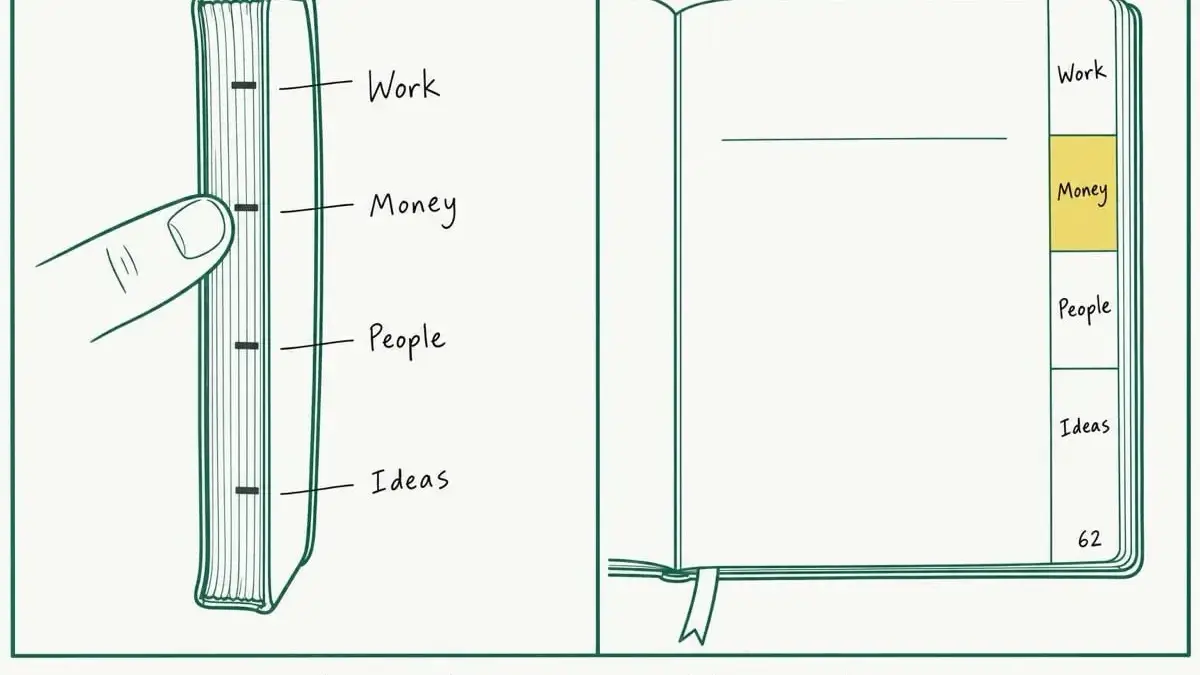
To visualize these categories, a narrow strip is reserved down the outer margin of each page, divided top to bottom into corresponding bands. When a completed page focuses primarily on one subject, the corresponding band is filled with a marker, extending the ink right off the edge of the paper.
Closing the book reveals a physical stack of page edges where recurring topics form visible vertical stripes. Locating past work notes no longer requires opening the book at all; the user simply thumbs the corresponding colored stripe along the margin.
For topics that defy simple categorization by stripe alone, the final two pages of the notebook are reserved as a chronological index. Each entry requires a single concise line combining the date, a short description, and the page number. Writing this line immediately upon closing a page takes only seconds, transforming a passive notebook into an active reference archive.
A brief review session at the end of the week allows users to catch any missed entries and transfer unresolved action items to fresh pages, ensuring the system remains sustainable over the long term. When the notebook eventually fills, photographing the index pages provides a searchable digital archive before the physical book is safely shelved.
The Analog-Digital Divide in Modern Note-Taking
The ongoing debate between paper and digital tools often centers on false equivalencies. Digital platforms excel unconditionally at global search functions; full-text searches across years of digital entries outperform any manually maintained index, and paper cannot compete with that raw speed.
Conversely, paper dominates the critical window of time immediately preceding the act of writing—requiring no device unlock, no application selection, and generating no distracting notifications in the middle of a complex thought.
The most effective modern workflow embraces a functional division of labor. Capturing thoughts, brainstorming, and initial processing happen best on paper to minimize cognitive friction. Transferring notes into a digital format is reserved specifically for information that crosses distinct thresholds: when collaboration requires sharing, when hard deadlines demand digital alerts, or when a piece of reference material has been manually looked up more than twice.
Data that requires daily numerical tracking, such as fitness metrics or strict budgeting, naturally belongs in specialized digital applications from the outset.
Ultimately, the effectiveness of any notebook system relies not on expensive stationery or complex multi-tiered structures, but on reducing friction at the exact moment of capture. By separating the unfiltered flow of daily thought from the structured indexing of page edges and back-page logs, users can transform the traditional write-only journal into a genuinely functional physical archive.



Leave a Reply