
It starts with fourteen distinct items on a daily schedule, eleven of which have been stamped with a high-priority marker. Two of these urgent demands arrived via email from a supervisor early in the morning, three more emerged from a sudden customer escalation, and one is a long-standing strategy memo that has been pushed back across four consecutive Mondays. Every single item on the inventory is entirely defensible upon inspection. That precise reality forms the core of the problem.
Priority levels exist theoretically to sort through this professional congestion. In practice, however, they frequently serve merely to rename it. Organizations introduce a field for tracking designations such as P1, P2, and P3, and within a single month, every request deemed important by any stakeholder is pre-stamped as a top-tier priority. The labels appear tidier on a dashboard, yet professionals still find themselves at seven o’clock on a Thursday evening struggling to decide which professional promise they are forced to break.
Labels fundamentally fail as a mechanism when they lack scarcity. A priority designation only functions effectively when it exacts a genuine cost: consuming a specific slot, a particular day, or another task’s place in line. A ranking system that costs nothing to apply gets spent with total freedom, transforming a scale where everything is designated as top-tier into a list that merely incorporates extra steps. Understanding the true mechanics of task hierarchy requires examining both historical precedents in incident management and the structural flaws that cause daily schedules to collapse by the third week of implementation.
What Priority Levels for Tasks Actually Are
Priority levels for tasks represent a fixed set of systemic labels used to rank work based on the potential damage it prevents and the speed with which it must move. In the realm of IT service management, these labels typically derive from an analytical matrix combining impact—the measurable scale of business loss—with urgency, which dictates the expected speed of resolution. The highest combination of these metrics maps directly to Priority 1, categorized as critical. On a personal task list, a label theoretically performs the exact same operational function: determining what work must be executed immediately and what must be dropped to accommodate it.
This operational heritage holds significant meaning because incident response teams typically document their top-tier designations in rigorous, painful detail. One major network vendor, for instance, defines a Priority 1 situation strictly as a major business outage affecting critical sites, multiple geographic locations, multiple VPN users, or core operational applications. Notably, this objective definition omits who asked for the intervention, how loudly they demanded it, or how recently the request landed in an inbox.
Organizations and software providers utilize varying quantities of levels within their frameworks, proving that there is no singular universal standard. One software provider relies on a streamlined three-tier approach consisting of P1 Urgent, P2 High, and P3 Normal. Cisco systems utilize four distinct severity levels, ranging from Severity 1 for critical business impact down to Severity 4 for routine requests carrying no business impact. PagerDuty notes that schemes commonly run from P1 through P5 or SEV-1 through SEV-5, where lower numbers designate greater impact, with labels configurable depending on account requirements.
Three, four, or five levels are all utilized in production environments across serious enterprises. The total count of levels, however, is not what makes a scale function. The written entry test established for each individual level dictates its success, a critical component that personal task management frameworks frequently omit.
Why Priority Labels Stop Meaning Anything by Week Three
Labels inevitably inflate for a straightforward structural reason: assigning a high-priority label costs nothing, whereas the professional day possesses a finite number of hours. Anyone can mark a request as urgent at zero cost, including the individual managing the schedule, causing the top tier to swell until it completely loses informative value. By the third week of such a system, a P1 designation no longer signifies genuine criticality. Instead, it merely indicates that a task is recent, loud, or requested by a senior figure. The scaling system fails not because individuals deliberately abuse it, but because nothing within the framework requires sacrifice.
Urgency cues exert a powerful influence over human decision-making processes. Across multiple experimental studies, participants consistently opted for objectively lower-payoff tasks simply because those tasks carried an urgent or expiring cue, even when alternative choices offered significantly higher returns. Researchers identified this phenomenon as the mere urgency effect. While those investigations utilized consumer choice experiments with manufactured deadlines rather than monitoring corporate inboxes, the underlying tendency remains a psychological factor that professionals must design around rather than ignore. The dynamic aptly describes the chaotic environment where eleven tasks are marked high and a solitary item carries a red flag.
The classic distinction between urgent and important tasks, heavily relied upon in productivity literature, dates back decades. President Dwight D. Eisenhower introduced the concept during an address in Evanston, Illinois, attributing the line to a former college president who noted that urgent problems are rarely important, and important problems are never urgent. The two-by-two grid subsequently popularized as the Eisenhower matrix represents a later adaptation widely taught as a foundational time management tool.
While useful, this binary distinction remains incomplete. A grid sorts tasks into four conceptual boxes and hands them back to the user, leaving the individual with eleven items trapped in the important box and only a single Tuesday to address them. Furthermore, re-sorting tasks is far from effortless. Laboratory studies examining task switching indicate that the time cost of alternating between assignments increases alongside the complexity of the rules governing them, though cues can mitigate the transition friction. Deciding what matters repeatedly throughout a busy day imposes a distinct cognitive tax, which explains why decision fatigue frequently manifests by late afternoon, leaving task lists untouched since midday.
Designing a Scale That Forces Structural Choices
Establishing an effective task hierarchy requires borrowing the impact-and-urgency logic from formal incident management while incorporating the two crucial elements that personal task lists routinely omit: a strict numerical cap on how many items can occupy each level, and a defined operational cost for placing an item there.
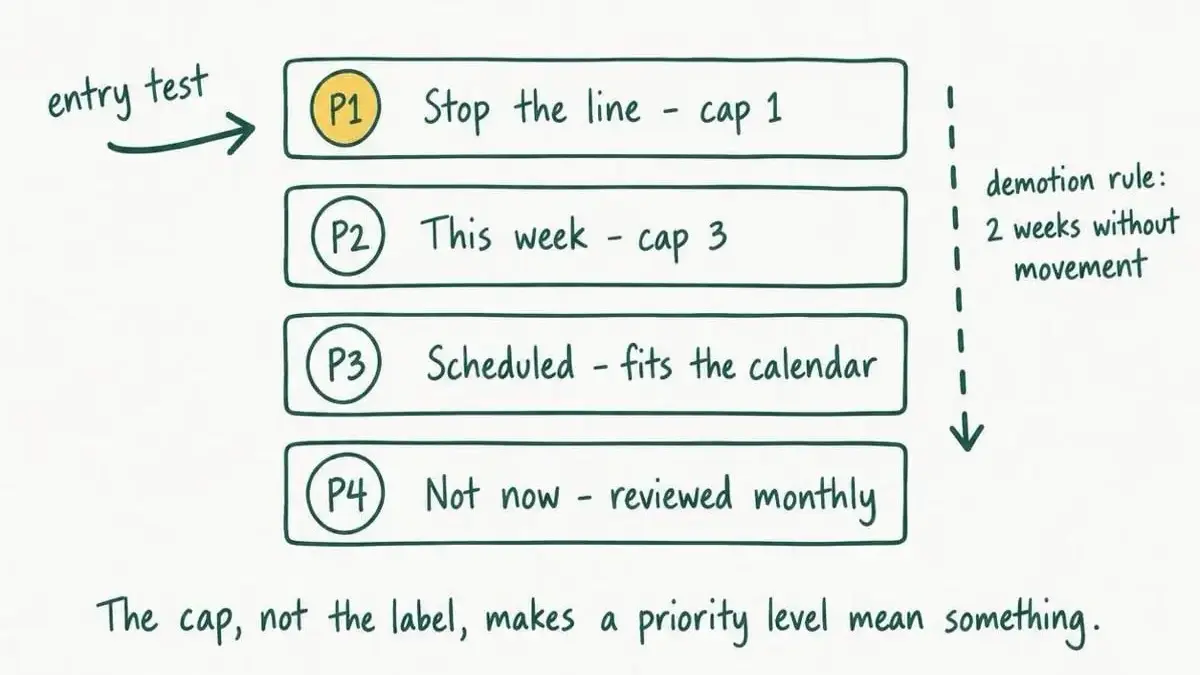
Under a structured four-level model, the top tier represents work that prevents immediate damage today, strictly defined as a scenario where someone outside the immediate team is blocked right now, or a dated commitment will fail before the day ends. This level carries a strict cap of a single item. The operational cost of invoking this top tier is absolute: everything else on the schedule moves forward by a full day, and that postponement must be communicated out loud.

The second tier covers dated commitments made to a specific, named individual that feature a due date falling within the current week. This category maintains a strict cap of three open items, and no new commitments of this tier can enter the system until an existing one is officially closed. The third tier accommodates scheduled operational work possessing a concrete calendar block or a defensible future date, subject to weekly reviews where items either advance or are removed. The final tier holds everything else honestly, functioning as a holding space for lower-priority items that undergo monthly reviews and eventual deletion if left unaddressed.
The inclusion of strict numerical caps is what allows the broader framework to function. Economic and operational principles such as Little’s Law dictate that holding a larger volume of open items in a system inevitably stretches the average completion time for each individual task. Four open commitments labeled as equally urgent do not reach completion any faster simply because they bear matching high-priority designations; instead, they finish later, one by one, while the professional carries the cognitive weight of all four simultaneously.
Establishing written entry tests in advance, rather than attempting to judge each incoming request impulsively, provides the necessary structural counterweight. Formal predictive models consistently outperform ad-hoc human judgment under pressure because predefined rules established during calm periods are considerably more difficult to rationalize away during a stressful afternoon encounter.
The Reality of Managing Priorities on an Ordinary Tuesday
To understand how a structured priority scale functions in practice, consider the daily routine of Marcus, an operations manager at a mid-sized logistics company. On a typical Tuesday morning, Marcus maintains a board memo categorized as a secondary-tier commitment with a Thursday deadline and a designated reader. His top-tier priority slot sits completely empty, representing the ideal start to a productive workday.
Midway through the morning, a warehouse integration unexpectedly breaks, leaving two key customers unable to view their shipments. Under the written entry test, this event qualifies instantly as a top-tier emergency because external individuals are actively blocked. Crucially, the pending board memo does not automatically get downgraded into oblivion, nor does it silently rot on the schedule. Instead, it is consciously rescheduled for Wednesday, and Marcus explicitly informs the relevant stakeholder about the shift. Making the announcement out loud serves as the operational mechanism to prevent broken promises from incurring hidden future costs.
Later in the day, a senior executive requests an urgent pricing analysis to be completed immediately. Because the single top-tier slot is already occupied by the warehouse integration, Marcus utilizes the capacity statement enabled by his structured framework. Rather than simply declaring that he is overwhelmed, he offers two concrete operational alternatives: beginning the analysis once the integration issue is resolved or taking it on immediately and letting the warehouse fix wait. This approach reframes the dynamic from a personal complaint into a transparent resourcing decision.
Toward the end of the afternoon, multiple new requests arrive via email. Because they fail to meet the stringent criteria for the higher tiers and those categories are currently capped, the new items are assigned future calendar dates rather than inflated urgency adjectives. Marcus concludes his workday with the critical system failure resolved and the pending board memo successfully rescheduled through mutual agreement, demonstrating how a functional scale prevents ordinary days from dissolving into cyclical busywork disguised as progress.
Navigating Priorities Imposed by Others
The most frequent objection raised against personal priority scales is that individuals rarely possess absolute control over their incoming demands. When a senior executive labels every communication as critical or a major client demands immediate attention by sheer volume of requests, a self-imposed framework appears powerless. In reality, however, a structured scale remains highly effective because its primary output is not merely a sorted list of tasks, but a visible trade-off that requires external approval or decline.
When a request arrives pre-labeled as urgent by an outside party, the argument shifts away from debating the label itself. Instead, the focus centers on a single clarifying question regarding operational capacity: what existing work must be moved to accommodate the new demand? Most senior stakeholders respond constructively when presented with a clear resourcing choice rather than an emotional pushback.
If an organization already enforces a standardized corporate ranking scale, individuals can map their personal framework directly to the enterprise taxonomy to eliminate vocabulary disputes. Corporate high-priority designations naturally align with top personal tiers, while routine requests flow into lower categories. Defending the structural cap remains the most vital rule because the cap embodies the actual promise made to oneself and others. Operating without limits—where every incoming task is treated as an overriding priority—remains the most reliable pathway to cognitive overload and professional paralysis.
Evaluating System Performance Over Time
Implementing a priority framework begins with a simple, foundational step: drafting the entry test and the numerical cap for the top operational tier on a single line of text and placing it directly alongside active tasks. This concise sentence establishes the first mandatory boundary, forcing the initial honest rejection of non-essential demands while the remaining tiers are progressively defined.
Measuring the ongoing effectiveness of the system requires tracking a few key metrics over a consecutive two-week period. Counting the total number of top-tier emergencies declared provides immediate feedback; if more than two such declarations occur in a week, the entry test is insufficiently rigorous and must be tightened until using the label carries a noticeable operational cost. Similarly, comparing the volume of secondary commitments closed against the number newly opened reveals whether the system’s caps are genuinely binding or merely decorative.
These analytical counts provide insights that a standard, unstructured task list never reveals: not merely what an individual intended to accomplish, but what their operational system actually permitted them to execute. Confronting those realities provides valuable data, establishing a foundation for sustainable productivity once the boundaries are clearly documented and enforced.



Leave a Reply