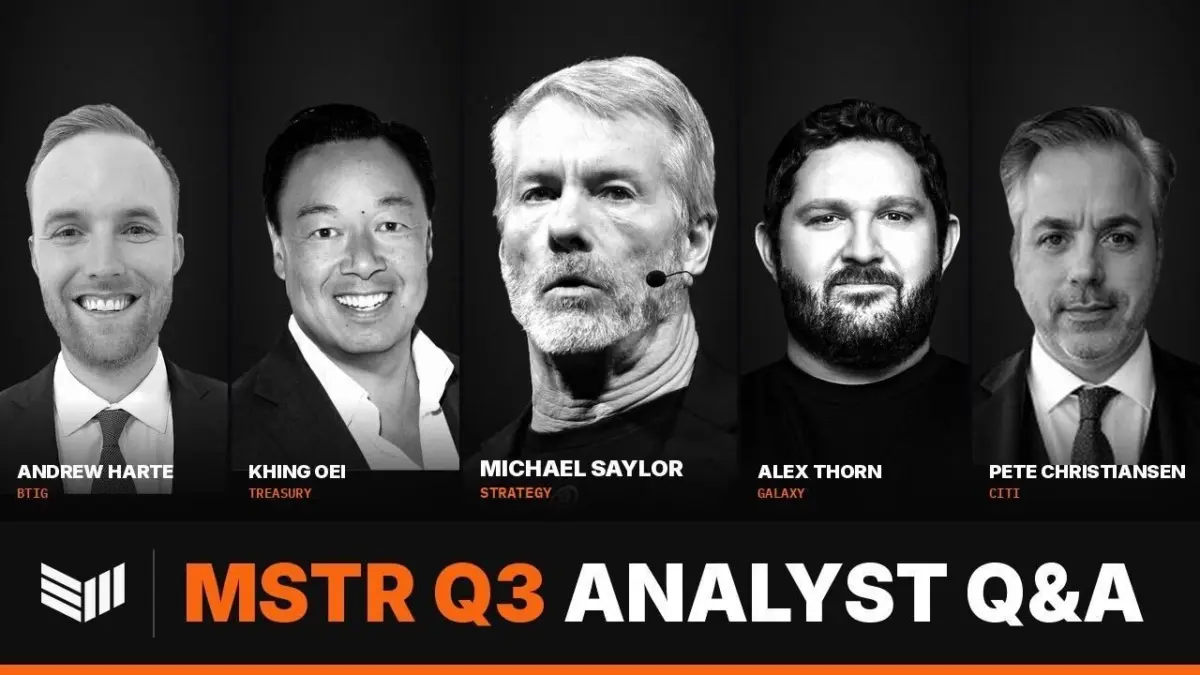
Strategy (MSTR) executives Michael Saylor and Phong Le recently sat down for an extensive analyst Q&A session following the company’s third-quarter earnings call. The discussion provided market observers and shareholders with a deep dive into Strategy’s evolving financial architecture, addressing critical topics ranging from digital credit expansion and the performance of the company’s Stretch (STRC) fixed-income product to preferred securities, the broader financialization of Bitcoin, and the long-term potential of tokenization.
During the earnings call, Strategy’s leadership fielded questions from prominent financial analysts representing major institutions, including Andrew Harte of BTIG, Khing Oei of Treasury, Alex Thorn of Galaxy, Pete Christiansen of Citi, and independent market analyst Scott Melker. The conversation offered a transparent look at how the corporate treasury pioneer plans to navigate its next phase of growth, contrasting its current balance sheet strength with the dynamics of previous market cycles.
Strategy’s Balance Sheet vs. the Last Bull Market
The discussion opened with an examination of Strategy’s current balance sheet and how it compares to the company’s position during the previous major bull market. Executives emphasized that the scale of capital access and institutional integration has fundamentally shifted. Rather than relying solely on traditional playbook mechanics, Strategy has steadily refined its capital-raising strategies to support its aggressive accumulation of Bitcoin while mitigating systemic risk.
As the dialogue progressed into capital allocation and credit creation, Saylor and Le underscored a fundamental economic reality: generating meaningful volumes of digital credit requires a substantial and resilient capital base. According to the executives, Strategy’s unique market positioning allows it to leverage its balance sheet in ways that traditional corporate treasuries cannot, transforming corporate debt markets through a Bitcoin-backed standard.
Capital Access and the Equity ATM
A recurring theme among analysts was the timing and mechanics of Strategy’s equity offerings. Specifically, participants pressed leadership on when Strategy plans to turn its equity At-The-Market (ATM) facility back on. While specific operational triggers were weighed against market liquidity and premium-to-net-asset-value metrics, the executive team reiterated their disciplined approach to capital dilution and accretion. The ability to tap equity markets efficiently remains a core pillar of Strategy’s strategy, ensuring that new share issuance directly enhances the per-share value of its underlying Bitcoin holdings over time.
The conversation then shifted toward fixed-income instruments, focusing heavily on the performance and mechanics of the Stretch (STRC) product. Analysts questioned why it took four months for STRC to return to par value following previous market fluctuations. Leadership provided detailed color on the structural nuances of the instrument, explaining how secondary market liquidity, yield expectations, and arbitrage dynamics played a role in the stabilization process.
Managing Preferreds: STRC, STRD, STRK, and STRE
Beyond STRC, the Q&A explored the broader suite of preferred securities offered by the company, including STRD, STRK, and STRE. Analysts sought clarity on the long-term outlook for these various instruments and how Strategy intends to manage them within its overarching capital structure.
Particular attention was directed toward the euro-listed STRE instrument, which presents unique operational and regulatory hurdles compared to its domestic counterparts. Management discussed the complexities of managing cross-border digital credit products within fragmented regulatory frameworks, highlighting both the hurdles and the strategic value of establishing a footprint in European capital markets.
The Financialization and Tokenization of Bitcoin
A significant portion of the latter half of the Q&A was dedicated to the broader macro theme of Bitcoin’s financialization. When asked whether Strategy is actively financializing Bitcoin, the executives addressed the philosophical and practical implications of turning the premier digital asset into a foundational tier-one reserve asset for the global financial system.
The discussion naturally extended into how institutional adoption is actively damping Bitcoin’s historical volatility. Drawing historical parallels to industrial pioneers such as Thomas Edison and John D. Rockefeller, Saylor and Le illustrated how nascent, highly volatile commodities inevitably transition into stable, institutionalized financial assets once mature capital markets and credit instruments are built around them. By introducing structured credit products and institutional-grade financial wrappers, Strategy is playing a central role in this maturation process.
The dialogue also touched on the cutting edge of digital asset infrastructure: tokenization. Analysts questioned whether Strategy has plans to issue a tokenized version of MSTR specifically tailored for U.S. investors. While emphasizing the immense promise of tokenization—chiefly the creation of truly frictionless, open, and global free markets—executives pointed out the elephant in the room: the current absence of a clear, unified U.S. token standard. Until regulatory clarity is established domestically, the full potential of tokenized corporate securities remains constrained by jurisdictional fragmentation, even as global demand for such innovations accelerates.
As the Q&A session concluded, the comprehensive exchange reinforced Strategy’s position at the vanguard of Bitcoin corporate adoption and digital credit innovation. By addressing institutional concerns head-on, Saylor and Le provided the market with a clearer roadmap of how the company intends to scale its financial architecture in tandem with the maturation of the digital asset economy.