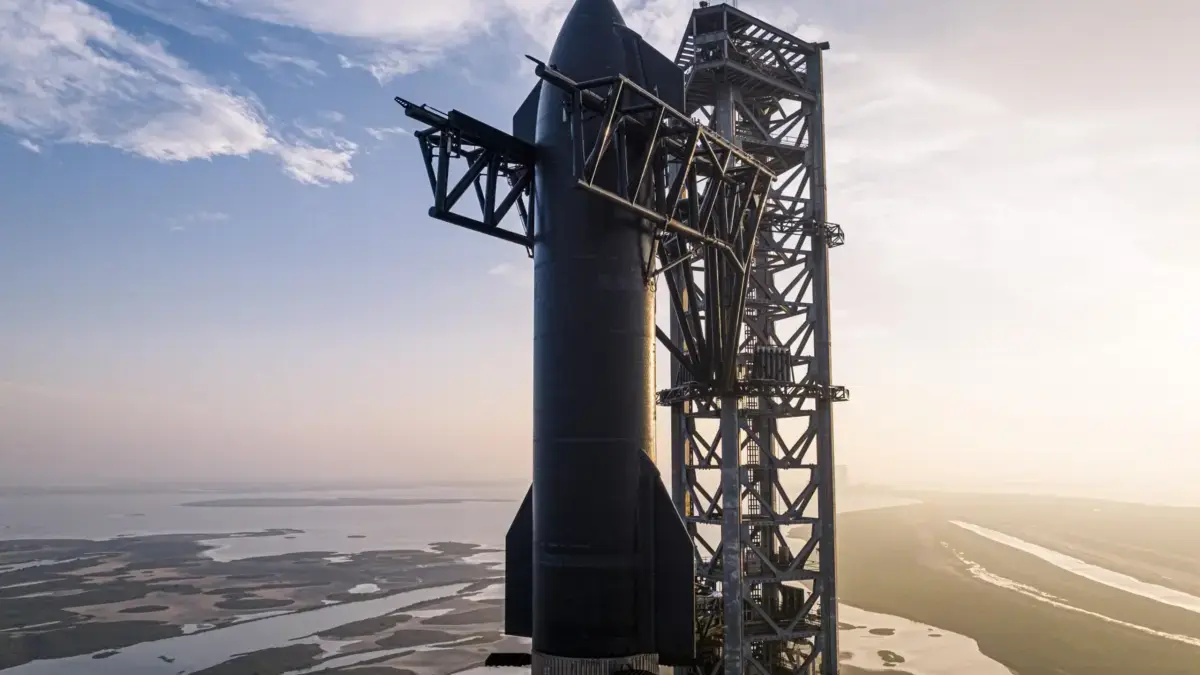
In a defining moment for commercial aerospace development, SpaceX has successfully captured a returning Starship spacecraft using its towering "Mechazilla" launch and catch tower infrastructure. The dramatic mid-air maneuver, witnessed as the vehicle descended through cloud cover to ease itself gracefully between the mechanical arms at approximately 4:20 PM ET, marks a massive leap forward for the company’s fully reusable transportation system architecture.
While SpaceX has previously mastered the art of "chopstick" catches with its Super Heavy boosters during earlier flight tests—capturing the massive first-stage rockets out of the air to eliminate the need for traditional landing legs—this flight test represents the first time the sophisticated capture mechanism has been successfully executed on the upper-stage Starship vehicle itself. The achievement brings CEO Elon Musk’s ultimate vision of rapid and complete rocket reusability significantly closer to daily operational reality.
The milestone arrives amid a complex flight profile for Starship Flight 15, which experienced mixed outcomes across its various flight regimes. Earlier in the mission, the company was forced to abort a planned catch of the mission’s Super Heavy booster due to an unexpected guidance issue. Instead of settling safely into the waiting arms of the launch tower, the massive booster was redirected away from the site and subsequently detonated over the Gulf of Mexico.

Engineers and mission controllers at SpaceX are currently working to analyze telemetry and video data to determine the precise root cause of the guidance anomaly that forced the booster’s mid-air abort. Despite the loss of the first-stage hardware, the subsequent successful capture of the Starship upper stage demonstrated the extraordinary precision, adaptability, and resilience of the overall program engineering.
The success of the upper-stage catch validates months of intense structural testing, guidance software refinements, and aerodynamic modeling. During the final moments of the descent, observers watched as the spacecraft plunged through thick cloud cover, executed a precise flip maneuver to orient itself into a vertical position, and steadily bled off speed before hovering gently into the embrace of the Mechazilla arms.
Speaking during the company’s recent third-quarter earnings call, Elon Musk addressed the inherent risks and experimental nature of the flight test campaign, noting that success is never guaranteed on these early developmental flights, though he expressed confidence in the rapid iteration cycle of the engineering teams. The ability of SpaceX to bounce back from the booster loss and successfully execute the unprecedented upper-stage catch underscores the pragmatic philosophy that defines the company’s development roadmap.
As investigations into the booster’s guidance failure continue, the successful capture of the Starship spacecraft provides engineers with invaluable data for future flights. With previous test campaigns proving that booster landing anomalies can be quickly identified and resolved, the aerospace community looks forward to the next iteration of Starship testing, where SpaceX will attempt to harmonize both halves of the launch architecture for simultaneous, successful catches.