

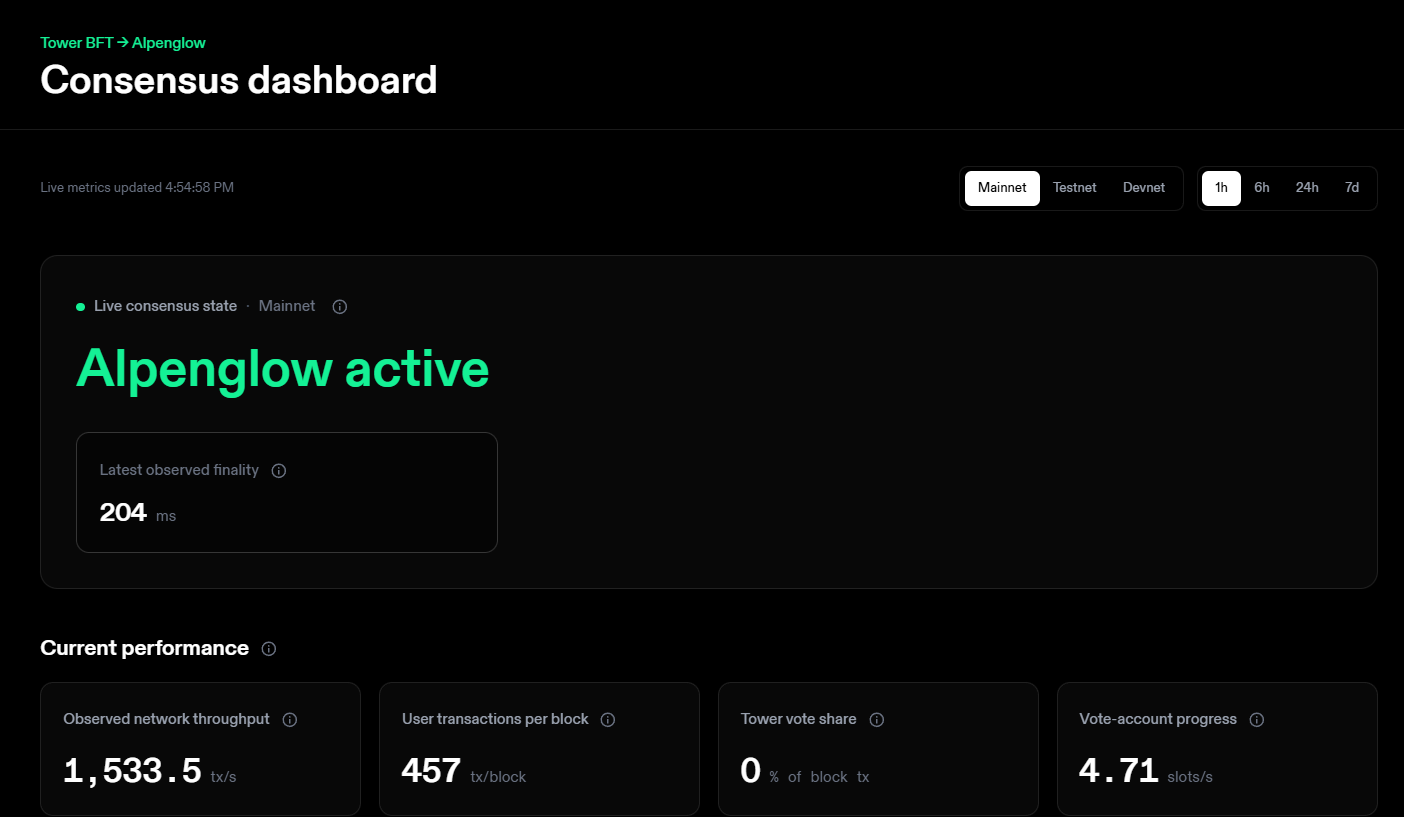
Solana’s first major consensus upgrade, Alpenglow, officially went live on the network’s mainnet at approximately 1:54 pm UTC on Wednesday, marking a historic technological milestone for the high-performance blockchain. The activation has been independently verified and monitored through the Solana Foundation’s dedicated Alpenglow dashboard, signaling the rollout of a protocol overhaul designed to fundamentally alter how transactions are validated and finalized across the ecosystem.
The primary objective of the Alpenglow upgrade is to dramatically reduce transaction finality by roughly 99%. According to projections outlined in the Solana Foundation’s initial announcements regarding the roadmap, the upgrade aims to compress finality times from an average of about 12.8 seconds down to a blistering 150 milliseconds. This near-instantaneous speed is intended to bridge the performance gap between decentralized blockchain architecture and traditional Web2 systems, unlocking entirely new use cases for decentralized finance, payments, and real-time interactive applications.
The architecture of Alpenglow is being rolled out in carefully orchestrated phases to ensure network stability while systematically dismantling and rebuilding core components of the network’s consensus engine. Its first phase introduces Votor, a critical subsystem that replaces the legacy voting and finalization mechanism. Votor transitions the network to a direct validator voting model backed by a certificate-based system, which is the foundational engine engineered to drive transaction finality down to that targeted 150-millisecond threshold. Following the stabilization and widespread adoption of Votor, a subsequent phase will introduce Rotor, an advanced block data-distribution protocol meant to eventually replace the network’s existing Turbine system.

Historically, Solana has relied on its TowerBFT consensus model to secure the network, process blocks, and achieve distributed agreement among its globally dispersed validators. Alpenglow represents the first time the network has executed a fundamental overhaul of this core consensus layer since its genesis block. By targeting a 150-millisecond finality window, the Solana Foundation and its supporting developer ecosystem are striving to deliver near-immediate transaction certainty to everyday end users. In practical terms, this dramatic reduction in latency could translate into vastly superior user experiences for peer-to-peer payments, high-frequency trade settlements, and consumer-facing applications that demand instant responsiveness.
As the network adjusts to the new paradigm, metrics fluctuate while validators adopt the software. At the immediate press time following activation, data displayed on the Alpenglow tracking dashboard indicated a transitional transaction finality of roughly 6.6 seconds alongside a robust network throughput of 4,721 transactions per second. Observers and developers alike are closely monitoring these metrics to gauge how quickly the network achieves its ultimate performance targets in a live, adversarial production environment. Cointelegraph has also reached out directly to the Solana Foundation for formal commentary regarding the fine-tuned finality measurements observed in testnet environments and projected performance expectations for real-world application deployments.
Alpenglow Marks “Biggest Change” for Solana’s Core Protocol: Anza
The magnitude of the Alpenglow deployment has been widely acknowledged by core engineering teams within the ecosystem. Back in May, researchers at Anza—a prominent Solana Labs offshoot—published a comprehensive blog post detailing the roadmap and describing Alpenglow as introducing the "biggest change to Solana’s core protocol" since the blockchain’s inception.
The Anza research team, consisting of Quentin Kniep, Kobi Sliwinski, and Roger Wattenhofer, emphasized the broader macroeconomic and infrastructural implications of achieving a 150-millisecond latency target. They asserted that reaching speeds comparable to traditional internet infrastructure allows Solana to directly compete with centralized Web2 systems in terms of sheer responsiveness. According to the researchers, this leap forward has the potential to make blockchain technology commercially and technically viable for entirely new categories of consumer applications that previously found distributed ledger technology too sluggish for practical daily use.
Alpenglow’s mainnet arrival is part of a broader, aggressive timeline of infrastructural enhancements that Solana core developers have pursued throughout the year. In August, the network successfully reduced its blockchain slot time for the very first time since genesis. This change formed an integral part of the Solana Foundation’s strategic plans to systematically halve slot times down to 200 milliseconds, a multi-stage initiative aimed at systematically improving network latency and accelerating overall transaction confirmations. The final stage of that ambitious slot reduction plan was successfully completed and integrated in October.
Looking ahead past the successful deployment of Alpenglow, Solana validators show no signs of slowing down their development cadence. The community is already preparing for the rollout of Agave 4.5, an upcoming software upgrade that proposes expanding the capacity of versioned transactions by raising the supported account limit from 64 to 96 accounts per transaction. According to documentation provided by the Solana Foundation, this expansion could significantly optimize swap routing paths and yield better execution prices for decentralized exchange users. While still actively in development, the Agave 4.5 upgrade is tentatively planned for a mainnet release in December 2026.
Market participants have also reacted to the steady flow of technological upgrades and network optimizations. Market data from CoinMarketCap indicates that the native asset of the ecosystem, Solana, experienced a price increase of nearly 3% during the 24-hour window leading up to the Alpenglow activation. This upward movement helped offset a portion of the broader 42% price correction that the token had sustained over the preceding twelve-month period, reflecting a complex interplay between macroeconomic market cycles and continuous, heavy fundamental development within the core protocol layer.



Leave a Reply