
The legal battle between sports broadcaster beIN Sports and Swiss non-profit DNS resolver Quad9 has escalated significantly. Following a series of court orders requiring public DNS resolvers to block access to pirate streaming websites in France, beIN Sports has returned to the Paris Judicial Court to demand heavy financial penalties against Quad9 for failing to comply with the mandates.
Since 2024, French courts have repeatedly ordered public DNS infrastructure providers to restrict access to unauthorized sports streaming domains. While some providers, such as OpenDNS, chose to suspend their services in France entirely rather than comply with the directives, Quad9 elected to remain operational in the country. However, the non-profit foundation took a defiant stance, stating that it could not accurately isolate French users without relying on flawed location databases, and announced its intention to appeal the rulings while continuing to leave the targeted domains unblocked.
Now, that refusal to block has brought the foundation to a critical juncture. Quad9 confirmed that beIN Sports has petitioned the Paris Judicial Court for steep financial penalties, seeking €10,000 per domain, per day. With 58 domains ultimately included in the blocking order, the potential fines add up to €580,000 per day, accumulating into millions of euros per week and presenting an existential threat to the small non-profit organization.
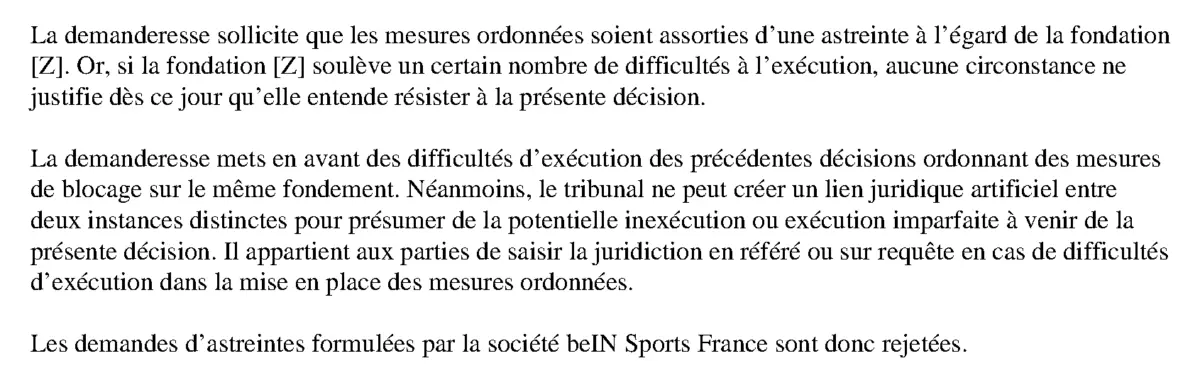
beIN Returns for Penalties
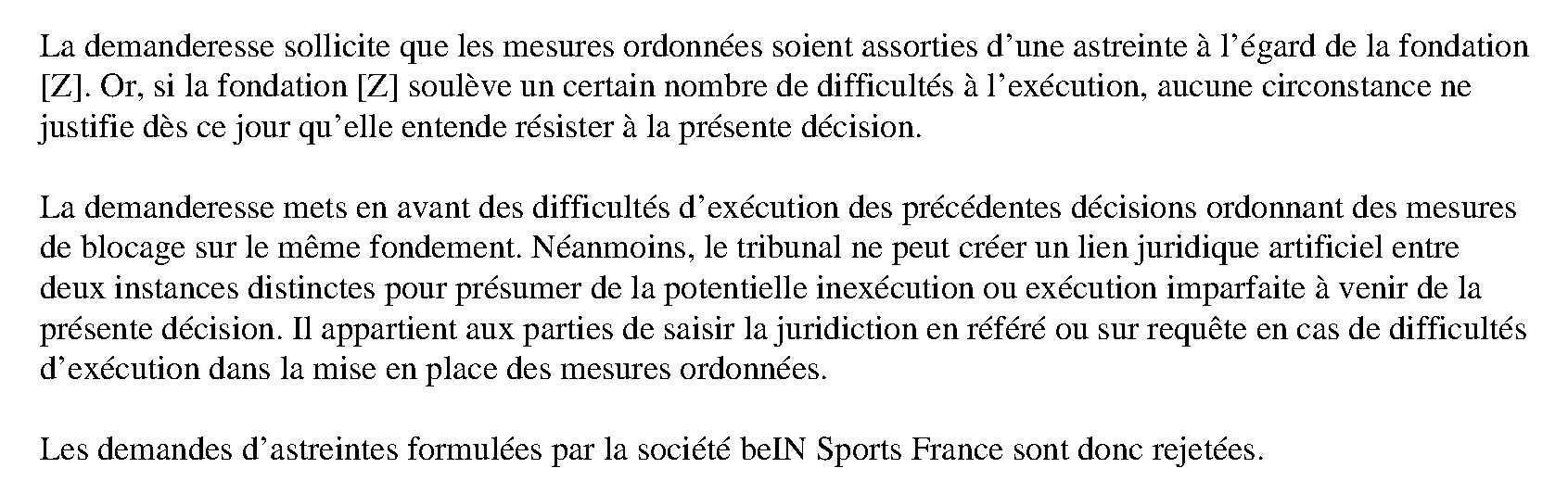
The confrontation began earlier in the proceedings when beIN Sports initially requested financial penalties alongside its original blocking application. At the time, the broadcaster asked the Paris court to impose a €2,000 daily penalty for every domain that Quad9 failed to restrict. Notably, Quad9 was singled out for this specific penalty request, while other DNS resolvers named in the suit did not face the same immediate threat.
During that initial phase, the Paris Judicial Court declined beIN’s request. The presiding judges reasoned that there was insufficient indication at that point that the foundation actively intended to resist the order, noting that the parties could return to court if compliance issues arose later.
True to that assessment, beIN Sports has now returned to the judiciary, armed with a vastly expanded list of domains and a drastically higher penalty demand. According to Quad9, the broadcaster is now asking for €10,000 per domain, per day, across 58 separate web addresses. The case was heard before the Paris court last Thursday, and a final decision on whether to impose the multi-million-euro penalties is expected in three weeks. If approved, the fines would apply retroactively from the moment the order was issued, compounding the financial pressure on the Swiss foundation.
Despite facing potentially bankrupting sanctions, Quad9 has maintained its position and explained in detail why it continues to leave all 58 domain names fully accessible to its user base.

The DNS Blocking Problem
From a purely technical perspective, Quad9 acknowledges that it possesses the capability to block the disputed domain names and thereby avoid regulatory and financial pressure. However, the foundation argues that doing so in a manner compliant with the French court order is practically impossible.
The core of the technical dilemma lies in the architecture of recursive DNS resolvers. Quad9 does not collect personal data from its users, meaning it cannot inherently verify their geographic locations. To comply with a localized ruling like the one issued in France, the provider would have to rely on third-party geolocation databases to map incoming IP addresses to physical territories. Quad9 argues that these external databases are frequently incomplete, inaccurate, and legally unreliable for enforcement purposes.
"There is no legally useful way for us to define a French user," Quad9 representatives explained.
The foundation has encountered similar jurisdictional and technical hurdles in other European nations. In Germany, Sony Music previously took Quad9 to court over global pirate site blocking demands. According to Quad9, German judges initially ruled that the foundation’s attempts to limit a block strictly to German users were inadequate. Although Quad9 ultimately won that case on appeal after a lengthy legal battle, the underlying technical challenge of localized DNS filtering remained unresolved.
When the Paris court issued its May order targeting WTA tennis match streams, the judges noted that the defendants had failed to adequately demonstrate that restricting the blocks exclusively to French territory would be financially prohibitive or technically impossible.
Quad9 also has the theoretical option of implementing a global block on the disputed domains, a step it took temporarily in Germany under similar financial threats in 2023. However, the foundation stated that its actions in Germany were executed as a temporary measure during ongoing litigation and that each jurisdiction must be evaluated on its own merits.
"We remain entirely confident in our core argument: DNS recursive resolvers are the wrong place to counter the problem of online piracy, and will result in significantly worse outcomes for the citizens of France," Quad9 stated.
Independent research supports the concerns raised by smaller infrastructure providers. Earlier this year, a report published by the Internet Society warned that mandated DNS blocking disproportionately harms smaller and non-profit operators who lack the vast compliance resources of major tech conglomerates. The report cautioned that jurisdiction-specific blocking orders risk excluding non-profit and independent operators from the market entirely if they cannot absorb the mounting staffing and infrastructure costs.
Leaving France?
If the Paris court rules in favor of beIN Sports and imposes the requested daily penalties, Quad9 will face a difficult set of choices to ensure its own survival. The foundation outlined three primary options should the fines be enacted.
First, Quad9 could attempt to implement a targeted block specifically for users located in France. However, the foundation maintains that such measures remain inherently inaccurate due to the limitations of IP geolocation databases, leaving the organization perpetually vulnerable to further legal challenges and fines.
Second, Quad9 could choose to block the domains on a global scale. The foundation argues that doing so would effectively allow French commercial jurisdiction and intellectual property enforcement to dictate internet access for users worldwide.
Third, Quad9 could follow the precedent set by OpenDNS, which completely suspended its public resolver services in France following the initial 2024 blocking orders. Whether such a withdrawal could be executed with precision remains an open question for the foundation.
Quad9 noted that it has yet to formally discuss these potential courses of action with its Foundation Council. Any decision will need to balance the imperative of remaining law-abiding with the necessity of protecting the organization from catastrophic financial ruin.
"Additionally, we are required by Swiss law to abide by our founding principles of privacy, security, and stability of the internet and how those principles are applied to our user community in a consistent and predictable manner in all areas," Quad9 noted.
‘Recklessly Dangerous’
The regulatory environment in France is poised to become even more stringent, complicating the landscape for DNS operators. In July, the French Parliament approved new legislation permitting the automated, real-time blocking of pirate sports streams. Under this framework, new domains can be added to restriction lists dynamically during live broadcasts, with the regulatory authority ARCOM reviewing the additions after the fact.
Quad9 views this expansion as a hazardous escalation of an already flawed enforcement model. The foundation argues that granting an unspecified list of commercial entities the unencumbered power to dictate real-time internet blocks is unnecessary and counter-productive.
"An unfettered, unencumbered and delegated power given to an unspecified list of commercial parties to block any content they desire seems to us recklessly dangerous, un-necessary, and counter-productive," the foundation stated.
Furthermore, Quad9 warns that such aggressive dynamic blocking will inadvertently drive internet users toward less secure systems located in unregulated or unknown jurisdictions. The foundation also contends that the sheer volume of real-time updates will preclude meaningful vetting, weaponizing the fundamental mechanisms of the Domain Name System against ordinary end users.
"Dynamic injection of false answers weaponizes the DNS against end users," the foundation said. "This blocking method will be proven to be ineffective, wasteful, and will not achieve the goal of removing the content which remains as reachable as ever."
The immediate next steps in the legal confrontation rest with the Paris Judicial Court. A formal ruling on beIN Sports’ penalty request is expected to be delivered later this month, after which Quad9 is anticipated to announce its definitive response. Representatives for beIN Sports declined to comment on the ongoing legal proceedings.


Leave a Reply