

The illicit streaming landscape is facing heightened scrutiny in European regulatory circles as a massive mobile piracy operation comes under fire. The pirate streaming application known as MovieBox has exploded in popularity, racking up more than 300 million downloads exclusively through the Palm Store—the native app marketplace preinstalled on millions of budget smartphones distributed across developing markets.
This staggering user acquisition has turned the application into a major thorn in the side of global rightsholders. Major entertainment industry stakeholders have formally flagged the software to the European Commission, pushing for its inclusion on upcoming regulatory watchlists. Among the most vocal complainants is French pay-TV titan Canal+, which has escalated the matter by explicitly linking the operation of the illicit application to the smartphone manufacturing conglomerate behind its primary distribution channel.
The current controversy follows a turbulent period for the streaming platform’s web-based infrastructure. Last year, copyright enforcement authorities in Nigeria celebrated a major victory when they successfully forced the suspension of MovieBox.ng, a pirate streaming portal that was pulling in tens of millions of monthly visits from eager users looking for free entertainment.
However, much like many modern digital piracy syndicates, the operators proved resilient. The site swiftly migrated its operations to a fresh domain, shifting traffic while its dedicated Android application remained readily accessible to millions of consumers worldwide. Despite regional enforcement efforts aimed at web domains, the app itself continued to thrive, shielded by its deep integration into hardware ecosystems rather than relying solely on traditional open-web discovery.

The battleground has now shifted to Brussels, where major content protection organizations are pressing the European Commission to take formal notice of the platform. In official submissions prepared for the Commission’s upcoming 2027 Counterfeit and Piracy Watch List, both the Motion Picture Association and Canal+ have detailed the sprawling scale of the MovieBox operation, presenting it as a prime example of large-scale commercial infringement operating in plain sight through corporate-backed app stores.
From 243 to 305 Million Downloads
At the heart of the rightsholders’ complaints is the sheer velocity of the app’s distribution. Both the MPA and Canal+ have drawn direct attention to the unique app distribution channel that has fueled MovieBox’s meteoric rise. In its comprehensive overview of prominent piracy apps targeting the European market, the MPA noted that MovieBox had already amassed more than 243 million downloads originating from the Palm Store alone.
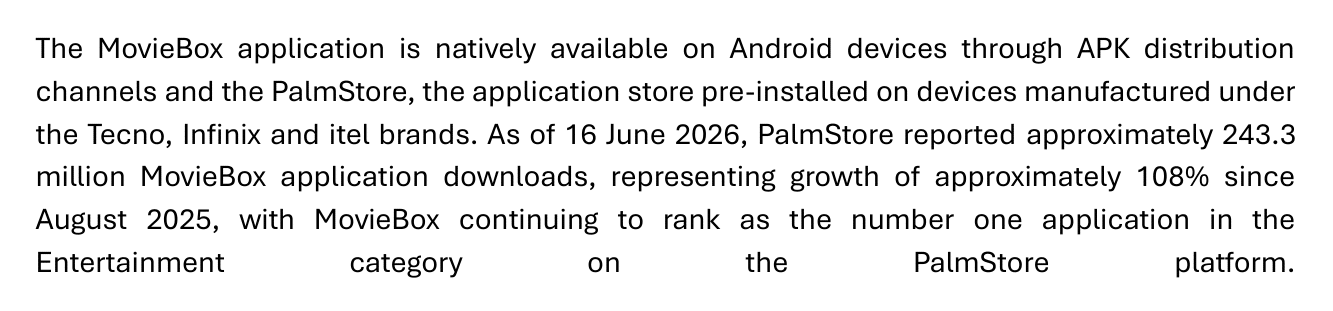
For millions of consumers, the Palm Store is not an app marketplace they actively choose to download; rather, it arrives preinstalled on mobile devices manufactured by Tecno, Infinix, and itel. These three distinct consumer electronics brands all operate under the umbrella of Transsion, a major Chinese smartphone maker that captured a dominant 61.5 percent share of all mobile phone sales across the African continent in 2024, according to the company’s own corporate filings.
Canal+ has provided a more granular breakdown of the application’s trajectory, noting that MovieBox successfully pivoted to a new web address following the enforcement actions targeting its Nigerian domain in 2025. According to the French pay-TV giant, the application experienced a massive surge in user acquisition following this transition, completely defying enforcement efforts. The site remains fully operational today, and the accompanying Android application has experienced exponential growth, more than doubling its download figures in less than a single calendar year.

In its regulatory submission, Canal+ emphasized the unprecedented scale of this expansion. As of mid-June 2026, internal metrics reported by the Palm Store indicated approximately 243.3 million downloads of the MovieBox application. This represented a staggering growth rate of roughly 108 percent compared to figures recorded in August of the previous year. Furthermore, the application consistently maintained its position as the number one most-downloaded offering within the Entertainment category on the Palm Store platform.
Yet, even these eye-watering figures quickly became outdated as the application continued its relentless upward climb. Recent audits of the Palm Store listing reveal that download metrics have since surged past 305.6 million installations, representing an influx of more than 60 million new users in a span of less than four months.
The public-facing profile of MovieBox makes no secret of its infringing nature. The app’s official store listing explicitly promotes free access to copyrighted movies, television series, and premium live sports broadcasts. Promotional descriptions boldly invite consumers to enjoy live sports streaming directly within the application, highlighting coverage of Europe’s top five premier football leagues. Additionally, the platform utilizes promotional artwork featuring globally recognized intellectual property, including major franchises associated with Marvel and Disney.
Transsion’s Own App Store
A critical element of the controversy is the nature of the Palm Store itself. It is not an independent third-party marketplace operating at arms-length from hardware manufacturers. Instead, in a draft prospectus filed for a planned public listing in Hong Kong, Transsion explicitly classifies the Palm Store as its proprietary app distribution platform. The company reported that the ecosystem attracted an average of more than 180 million monthly active users over the course of the previous year.
The same corporate prospectus sheds light on the commercial mechanics underpinning the platform. Transsion details that it typically monetizes its app store by charging third-party developers fees calculated directly on the volume of installations processed through its distribution network. While industry observers and rightsholders point to this revenue-sharing model, it remains publicly unconfirmed whether these specific installation fees applied to the distribution of MovieBox.
Closely Linked Ecosystems
While hosting a piece of software within an application marketplace does not automatically implicate the store owner in the illicit activities of the developer, Canal+ argues that the relationship between MovieBox and the corporate structures surrounding Transsion runs significantly deeper than standard platform hosting.
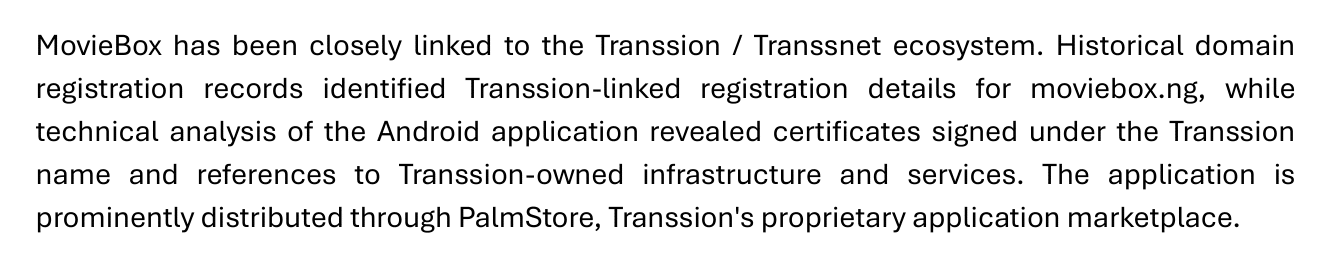
In its dossier submitted to European regulators, Canal+ asserts that MovieBox has maintained close operational ties to the broader Transsion and Transsnet ecosystem. Historical domain registration records analyzed by rightsholders reportedly uncovered registration details tied directly to Transsion-linked entities during the active lifecycle of the original Nigerian web domain. Furthermore, technical security analysis conducted on the Android application revealed digital certificates signed under the Transsion name, alongside embedded references pointing to infrastructure and web services owned by the smartphone maker.
While the submission stops short of explicitly alleging that Transsion directly owns or operates the MovieBox service, the evidence presented highlights a troubling overlap in technical infrastructure and corporate footprints. Canal+ further highlights the involvement of Excellent Innovation Limited, a Hong Kong-registered corporate entity that investigators link to MovieBox through a web of overlapping domain registrations, SSL certificate allocations, developer attributions, and international trademark filings. Records on the Palm Store platform officially designate this same Hong Kong firm as the primary developer behind the application.

In contrast, the submission filed by the Motion Picture Association takes a slightly different tack, omitting any direct mentions of Transsion. The Hollywood-backed group limits its assessment to the belief that the core operations of the MovieBox enterprise are directed out of China, focusing its regulatory pressure on the broader availability of the app across developing markets.
Complicating the commercial dynamics further, Canal+ maintains a direct financial interest in the territories most heavily impacted by the app’s distribution. The French conglomerate holds ownership stakes in MultiChoice, the dominant pay-TV provider behind DStv, which competes directly for subscribers in the exact African markets where Transsion’s mobile devices and the Palm Store enjoy near-monopoly hardware penetration.
As the regulatory review process moves forward, key questions remain regarding whether formal outreach has been directed toward Palm Store or Transsion management to demand the removal of the infringing software. Neither of the public submissions clarifies whether rightsholders have formally issued takedown notices to the platform operators prior to involving European authorities.
Before the European Commission finalizes its updated watch list, the targeted services will be afforded an opportunity to present their side of the story. Standard operating procedures dictate that the Commission makes reasonable efforts to contact reported service providers, formally inviting them to submit written responses addressing the allegations leveled against them by rightsholders.
The release of the updated Counterfeit and Piracy Watch List is anticipated in the spring of next year. European officials have repeatedly clarified that inclusion on the watch list does not constitute a formal legal finding of wrongdoing or a definitive confirmation of statutory violations. Instead, the catalog serves as a diplomatic and regulatory instrument designed to encourage commercial operators, platform hosts, and foreign governments to take voluntary proactive measures against widespread intellectual property infringement.


Leave a Reply