

By Staff Reporters
If you have been visiting Opensource.com recently, you may have noticed that things have been uncharacteristically quiet across the publication. For a site that has spent more than a decade serving as a central hub for stories about creating, adopting, and sharing open source solutions, a lull in activity is bound to catch the attention of its dedicated readership.
There is a very good reason for this pause, however. Behind the scenes, the community is hard at work on something entirely new. While there are not yet many specific implementation details or formal launch dates to announce to the public, there is already an abundance of foundational philosophy, history, and vision to talk about. And what better way to start a conversation about a sprawling, collaborative network than by looking at the very fabric of the entire internet itself?
The Internet, and Top-Level Domains
To understand where the community is heading, it helps to examine where the digital world began. Most internet users know that the internet is, fundamentally, a network. By definition, a network is simply a group of interconnected connections—a concept captured neatly in the term "internet" itself, which serves as a portmanteau of "interconnected" and "network."
In its earliest conceptualization and implementation, the internet consisted of just two primary networks: the military network and the academic network. These early environments were tightly controlled and served specific, specialized groups of researchers and defense personnel. However, as technology advanced and the network gained popularity far outside those initial domains, it quickly became apparent that different designations were desperately needed. A mechanism had to be introduced to differentiate between a commercial entity, a charitable organization, a university, or a governmental department.

These vital designations ultimately became known as top-level domains, commonly abbreviated as TLDs. Today, internet users can choose from a massive array of available TLD extensions, reflecting the hyper-diversified nature of the modern web. But for a very long time, there were only a handful of these foundational suffixes.
The original TLDs remain remarkably popular and culturally embedded in how we navigate the web today. Most internet users instinctively know that when they type a .com address into their browser, they are visiting a commercial site. Conversely, when they navigate to a .org address, they understand they are accessing a non-profit website intended for public service, advocacy, or community organization rather than profit generation. These suffixes were designed to tell a story about who is behind the screen and what purpose the network serves.
Open Source Is a Network
Just as the internet relies on interconnected infrastructure and clear organizational designations, the world of open source operates as a vast and multifaceted network. Open source can take many forms depending on the context, the participants, and the goals of the project. It can be commercial, driven by enterprises looking to build robust software ecosystems. It can be non-profit, championed by foundations dedicated to protecting user freedoms. It can be academic, emerging from university research labs, or it can be cultural, shaping how communities collaborate and share knowledge globally.
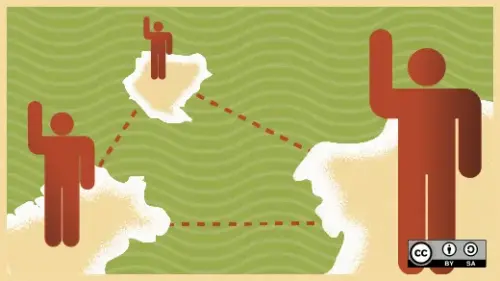
No matter what form it takes, however, open source is always a network. Sometimes that network is literally composed of computers routing packets across the globe, but most importantly, it is a network of people.
Human connection is the beating heart of the open source movement. Whether people are gathering physically at an international conference, informally chatting at a local pub, or collaborating asynchronously in an online chat room, open source is, at its core, a community of individuals working toward common goals.

For the past twelve years, the website Opensource.com has been proudly supported by a commercial entity. That institutional backing provided the resources necessary to publish thousands of stories, tutorials, essays, and news pieces about open source software, hardware, culture, and philosophy. Yet, there is a fundamental distinction to be made between the infrastructure that supports a platform and the human beings who populate it.
The people—representing the readers, contributors, advocates, and creators that make up the Opensource.com community—are not commercial entities. They are people. They are individuals driven by a passion for shared knowledge, collaborative creation, and the democratization of technology.
Now, a new chapter is about to unfold. In just one month, Opensource.com is going to resolve that underlying bug and step into its next evolution. Stay tuned as the community prepares to share the full details of what is next on the horizon.


Leave a Reply