

The community behind Opensource.com is hard at work on something new, signaling a major transition for the long-running publication. Readers who have visited the site recently may have noticed a distinct quietness across its digital pages. That relative silence is not a sign of winding down, but rather the opposite: a period of intense behind-the-scenes development as a brand-new project takes shape.
While specific details and concrete announcements regarding the upcoming project are still under wraps, there is already plenty to discuss about the direction of the platform and the underlying philosophy driving its evolution. To understand where the community is heading, organizers suggest starting with a foundational element of the digital world that touches every web user: the structure of the entire internet itself.
The Internet, and Top-Level Domains
To appreciate the current transition, it helps to look at the architecture of the modern web. The internet is, by definition, a network—a vast, sprawling group of interconnected connections. In fact, the very word "internet" is a portmanteau derived from "interconnected" and "network."
Historically, the internet began as a network of interconnected networks that originally consisted of just two primary pillars: a military network and an academic network. As the digital frontier expanded and the internet gained widespread popularity outside of those two specialized groups, it quickly became apparent that different designations were desperately needed. Systems had to evolve to easily differentiate between a commercial entity, a charitable organization, a university, a governmental department, and other distinct types of organizations operating in the public sphere.

These organizational designations are formally known as top-level domains, or TLDs. Today, internet users can choose from a remarkably wide array of TLDs, ranging from specialized industry extensions to geographic identifiers. However, for a long time, there were only a handful of available options.
Those original TLDs remain remarkably popular and deeply ingrained in internet culture. Most web users instinctively understand that when they navigate to a ".com" address, they are visiting a commercial site, whereas a ".org" address typically signifies a non-profit organization, and ".edu" points toward an academic institution. These suffixes act as digital signposts, communicating the fundamental nature of the entity behind the screen before a visitor even reads a single sentence of content.
Open Source is a Network
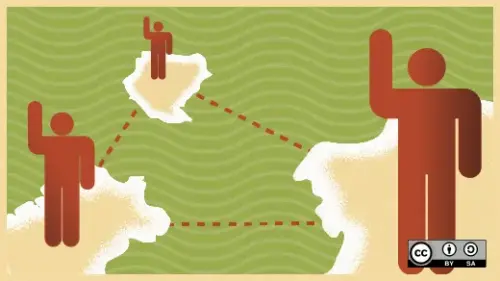
Just as the internet relies on a sprawling infrastructure of interconnected networks, open source can be many things at once. It can take commercial forms, operate as a non-profit initiative, thrive within academic halls, or drive cultural movements. Yet, no matter what specific form open source takes, its core essence is always that of a network.
Sometimes that network is literally composed of computers, servers, and repositories of code, but most importantly, it is fundamentally a network of people. Whether open-source contributors, maintainers, and enthusiasts are gathering together in person at a large international conference, meeting informally at a local pub, or collaborating asynchronously in an online chat room, open source is first and foremost a community of living, breathing human beings.

For the past twelve years, the website Opensource.com has been supported and sustained by a commercial entity. That corporate backing provided the resources necessary to build a globally recognized platform dedicated to publishing stories about creating, adopting, and sharing open source solutions. However, the people—the readers, writers, advocates, and contributors who make up the actual heartbeat of the Opensource.com community—are not corporate entities. They are human beings.
That distinction between corporate support and human-driven community forms the crux of the current transition. Organizers view the upcoming project as an opportunity to better align the platform’s structure with the organic, human-centric nature of the open-source movement itself.
The countdown is now officially underway. In just one month, Opensource.com is set to resolve that fundamental structural question and unveil the next phase of its journey. Community members, readers, and open-source advocates are advised to stay tuned for the official reveal, while continuing to follow updates and stories about the open-source way through the platform’s official channels.


Leave a Reply