Artificial intelligence safety for both adults and children has come under intense scrutiny as questions multiply regarding how conversational bots impact human mental well-being. Beyond ongoing debates surrounding energy consumption, data ethics, and economic disruption, educators, mental health professionals, and parents are increasingly concerned about the psychological effects of generative AI on developing minds. Concurrently, governments worldwide are enacting stricter digital age-gating legislation, recognizing that unrestricted access to social media, generative AI apps, and the broader internet poses unique risks to adolescent development.
The leading developers of conversational AI—including OpenAI, Google, Meta, Apple, Microsoft, xAI, and Anthropic—find themselves at the center of this regulatory and cultural shift. In response, tech giants have rolled out a patchwork of age-verification mechanisms, specialized teen accounts, and parental supervision tools. However, the effectiveness of these protections varies significantly across platforms. For parents, guardians, and educators seeking to understand what young users may encounter online, a detailed examination of the current safety landscapes across the major AI chatbots reveals both promising protections and critical vulnerabilities.
ChatGPT
OpenAI’s ChatGPT offers one of the most structured frameworks for minor oversight among leading AI providers. The platform sets its minimum user age at 13, requiring explicit parental consent for anyone under the age of 18 seeking to create an account. To enforce this policy, OpenAI deploys automated age-prediction systems that analyze behavioral signals, including the times of day an account is active and the specific topics discussed within prompts.
Accounts belonging to users under 18 are automatically enrolled in "ChatGPT for Teens." This specialized experience places a stronger emphasis on educational utility through a dedicated study mode, while implementing age-appropriate content filters designed to reduce exposure to sensitive topics. Built-in guardrails restrict chats involving sexual or romantic roleplay, graphic violence, and self-harm. These protections operate in tandem with platform-wide safety mechanisms that restrict discussions of physical harm and illegal acts for all users.
Parents can link their own OpenAI accounts to a teen’s account to establish administrative supervision. To set up these features on the web interface, parents can navigate to their profile icon, select Settings, choose Parental controls, and follow the prompts under Add family member.
Once connected, parents can configure operational time limits and adjust content sensitivity controls. However, privacy boundaries remain firmly in place: parents cannot view exact prompt histories or transcript logs. Furthermore, while parental consent is mandatory under OpenAI’s terms of service, the system technically permits teens to disconnect the parental link from their end.
OpenAI also maintains a free, unauthenticated web version of ChatGPT that allows anonymous browsing. The company states that anonymous sessions automatically apply default under-18 safety filters, though these unregistered sessions prevent users from saving chat histories or archiving past conversations.
Gemini
Google integrates its Gemini AI assistant directly into its broader ecosystem, tying access privileges to Google Account infrastructure. Standard Google rules dictate that users under the age of 13 cannot maintain independent accounts; they must belong to a family group managed by an adult through Google’s Family Link portal.
For parents managing accounts via Family Link, specific controls for Gemini remain somewhat limited. Parents can toggle overall access to the AI assistant on or off, but granular parameters—such as daily screen time limits—are applied universally across all enabled applications on the child’s device rather than specifically within the Gemini interface.
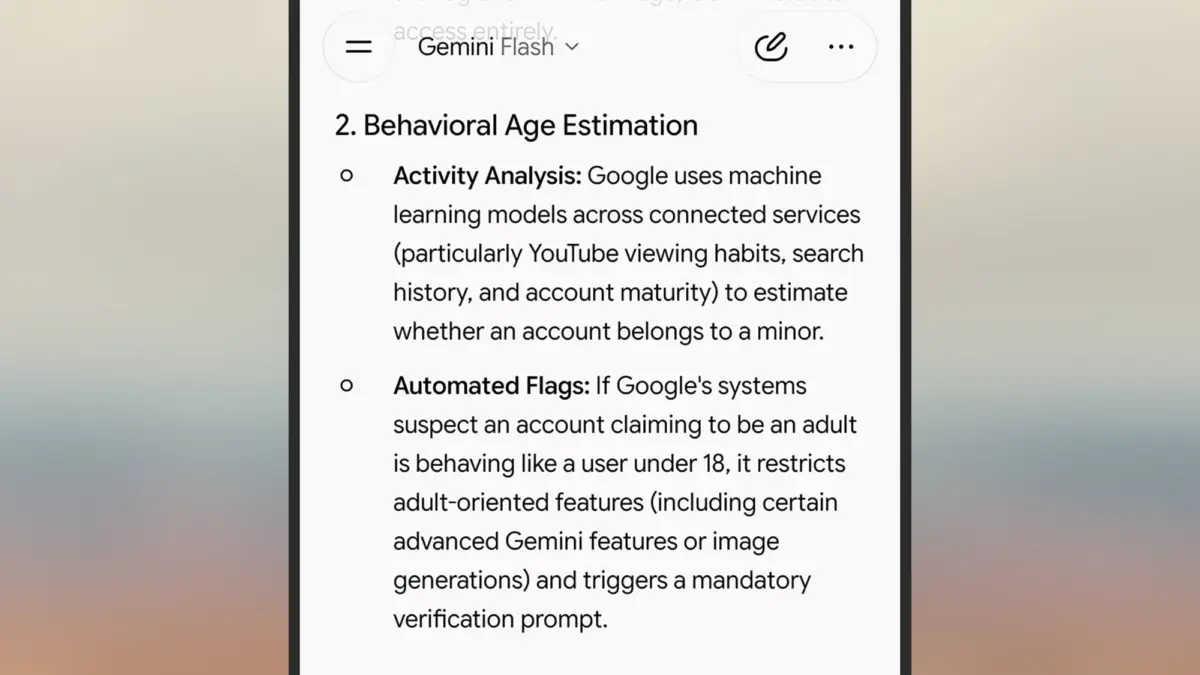
For all users identified as under 18 through Google’s age-estimation algorithms, additional safety layers take effect regardless of whether the account is attached to a managed family group. Gemini is programmed to refrain from assuming persistent fictional personas when interacting with minors, a design choice intended to guard against emotional dependence on the synthetic assistant. The system also actively discourages cyberbullying and harassment while implementing filters to restrict discussions surrounding age-gated substances such as alcohol and vaping products, as well as mental health conditions like eating disorders.
These minor-specific protections build upon Gemini’s standard safety guardrails, which steer users away from content involving self-harm, suicide, physical violence, and illegal acts, offering crisis hotline resources when distress is detected. Nevertheless, Google acknowledges that its automated content filters are not entirely foolproof.

Additionally, an unauthenticated web access loophole exists: anyone can initiate a web-based chat with Gemini without logging into an account. While these anonymous sessions enforce strict usage caps and prevent conversation saving, they rely solely on standard safety restrictions rather than the enhanced protective protocols enforced for registered minor accounts.
Meta AI
Meta has integrated its generative AI technology directly into its core communication platforms, including WhatsApp and Instagram, alongside standalone mobile apps and web portals. Meta AI adheres to the company’s broader social media policies, setting a baseline age requirement of 13 and applying protective restrictions to all accounts belonging to users under 18. The company relies on automated age-detection tools to flag accounts suspected of being operated by underage users who may have misreported their birth dates.
Under-18 users on Meta Teen accounts encounter firm conversational blocks if they attempt to engage Meta AI in romantic or sexual roleplay, or seek advice regarding alcohol and illicit substance use. When users prompt the assistant with topics related to self-harm, suicide, or eating disorders, Meta AI is programmed to pause the interaction and direct the user toward professional support services.
Parental supervision for Meta AI is centralized through the Meta Family Center portal. Connecting a parent account to a teen’s profile is optional for adolescents, but when established, it provides parents with high-level summary reports regarding the general topics their children discuss with the AI. Crucially, parents do not receive full transcripts or exact text prompts. However, if a teen initiates conversations regarding suicide or self-harm, the system can trigger automated alerts directly to the linked parent account.
Across its entire user base, Meta enforces restrictions prohibiting the generation of adult content, cyberbullying, drug-related discussions, and instructions for illegal acts, providing automated crisis interventions whenever self-harm is detected.
Siri AI
Apple ties access to its upgraded Siri AI features directly to Apple Account credentials. Users must be at least 13 years old to maintain a standard account capable of accessing advanced AI features. Children under 13 must use managed accounts created explicitly by an adult, which restricts them to legacy Siri functionality. Apple requires birth dates upon account creation and has begun integrating stricter age-assurance processes globally, reflecting legislative mandates such as the California Digital Age Assurance Act.
In most U.S. states and international jurisdictions, teenagers aged 13 and older can utilize Siri AI features without mandatory parental account linking. Consequently, the safety guardrails applied to teenagers are largely identical to those enforced for adult accounts. Apple’s system maintains a conservative baseline posture, strictly blocking commands or prompts related to self-harm, suicide, graphic violence, explicit sexual content, and illegal activities.
Parental management of Siri AI relies on device-level and OS-level oversight. Through updated features introduced in software releases like iOS 27, parents can manage Siri AI within a Family Sharing group.
By accessing Settings, selecting their profile name, and entering the Family management menu, parents can utilize Screen Time settings to govern overall app availability. Parents also have the ability to explicitly disable specific Siri AI capabilities on a child’s device, such as built-in writing assistance tools or generative image creation capabilities.
Copilot
Microsoft’s Copilot assistant operates within the broader Microsoft account framework. Account creation requires users to be at least 13 years old, and Microsoft employs backend age-awareness detection technologies to identify accounts where users may have provided false dates of birth.
Parental oversight for teenage Copilot users is conducted via the Microsoft Family Safety portal. From this platform, parents can grant or revoke access to Copilot entirely, schedule operational time windows, and disable specific system features, such as voice mode interaction or image generation. Similar to competitors, Microsoft preserves teen privacy by withholding full chat transcript logs from parents.

Parental linking remains optional for users between the ages of 13 and 17. However, Microsoft automatically applies underlying protective restrictions for all accounts identified as belonging to minors. Underage accounts do not receive personalized search results or targeted advertising, and the AI is programmed to deliver age-appropriate responses when handling complex or sensitive topics.
System-wide, Microsoft Copilot prohibits content related to self-harm, explicit adult material, harassment, violence, and illegal acts. Prompts containing references to drug abuse or suicide automatically trigger resources for support helplines rather than conversational answers, regardless of the user’s age. Unlike some of its competitors, Microsoft requires users to log in to an account, eliminating anonymous, unauthenticated web access to Copilot.
Grok
Developed by xAI, Grok presents a markedly different approach to minor safety compared to its industry peers. Accessible via the X platform (formerly Twitter) and standalone applications, Grok’s terms of service state a minimum age requirement of 13. However, an evaluation by Common Sense Media indicates that the platform’s age-verification mechanisms are largely ineffective at preventing underage access.
As a result, minors using Grok often encounter an environment identical to that experienced by adults. Independent safety assessments from Common Sense Media highlight that Grok features comparatively weak safety guardrails, exposing users to risks involving explicit sexual content, violent material, mental health vulnerabilities, and crude or offensive conversational responses.
The platform has previously faced criticism for generating explicit deepfake imagery and has historically maintained a more permissive content moderation stance under xAI leadership. While illegal activities are formally prohibited in its terms of service, xAI’s official documentation acknowledges that interactions with Grok may naturally incorporate coarse language, crude humor, sexual context, or violent themes.
Although xAI offers a "Grok Kids Mode" designed to limit conversational topics and block explicit media, the feature relies entirely on user self-declaration and is easily bypassed. Based on these safety deficits, child safety advocacy groups strongly advise parents to restrict adolescent access to the platform altogether.
Claude
Anthropic takes a rigid approach to youth safety by prohibiting anyone under the age of 18 from creating a Claude account. To enforce this ban, Anthropic monitors technical and behavioral signals during account usage. If an account triggers suspicion of being operated by a minor, the platform requires immediate identity and age verification through third-party tools such as facial age estimation or Yoti verification services.
Because Claude does not offer free, unauthenticated web browser access, the strict 18-plus registration policy effectively prevents minors from accessing the tool through official channels, provided they do not bypass behavioral detection algorithms.
For adult users, Claude incorporates broad well-being safeguards. System prompts related to self-harm or suicide trigger immediate referrals to crisis helplines. Anthropic strictly prohibits content involving illegal activities, hate speech, and explicit adult material. Furthermore, the company has implemented system-level updates aimed at reducing AI sycophancy—preventing the assistant from unthinkingly validating harmful or delusional statements made by users.
Platform-Level Protection Strategies
While individual AI platforms offer varying degrees of built-in oversight, technology analysts emphasize that software-level controls operating at the system level provide an essential secondary layer of protection. Parents looking to safeguard young users can complement platform-specific AI settings by configuring native parental control suites across operating systems—including iOS, Android, Windows, and macOS—to restrict app installations, enforce browser filtering, and set hard usage limits on AI applications.