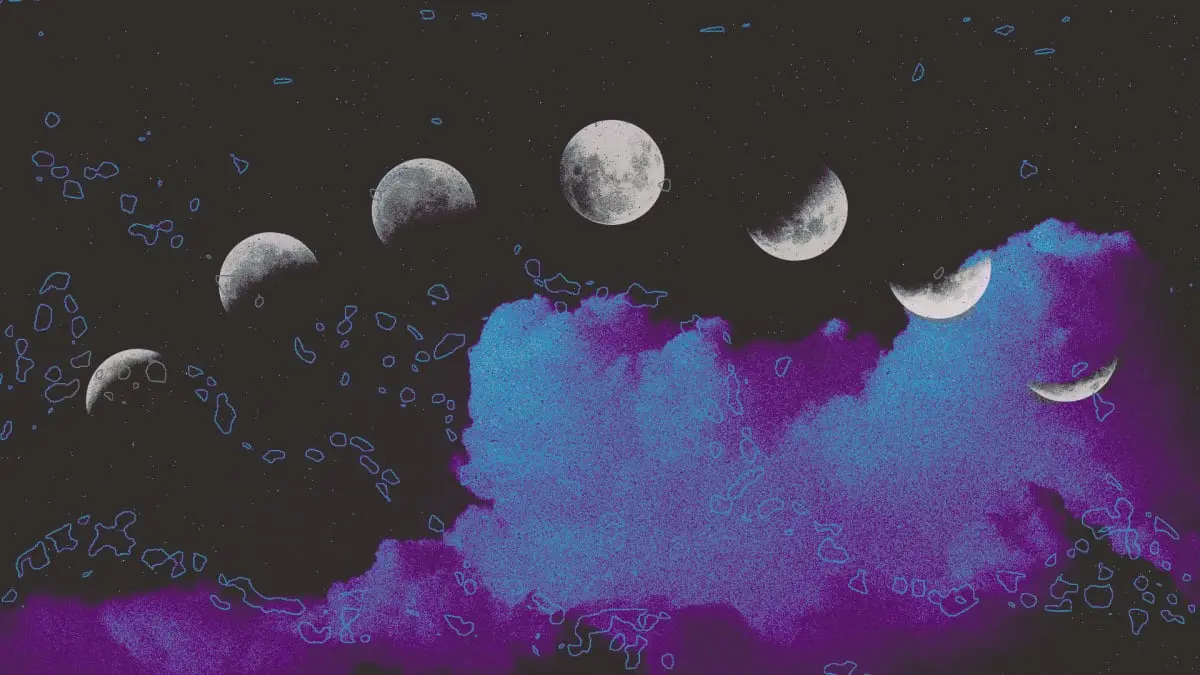
With zero percent of its illuminated surface visible from Earth on Monday, November 9, astronomers and casual observers alike are experiencing a period where lunar features are completely hidden from view. This dramatic cosmic disappearance marks a fundamental turning point in the ongoing lunar cycle, clearing the evening sky of moonlight and providing optimal conditions for deep-space observation, astrophotography, and stargazing enthusiasts who rely on dark skies to view distant stars, planets, and constellations.
What is today’s Moon phase?
As of Monday, Nov. 9, NASA’s Daily Moon Guide tracker confirms that the Moon is officially in the New Moon phase. During this precise alignment, the lunar disk presents an entirely dark profile to observers on Earth. Because the illuminated side of the Moon is facing directly away from our planet toward the sun, there is no reflected sunlight bouncing off the lunar surface toward our line of sight.
This absence of reflected light means that prominent lunar features—such as the vast volcanic plains known as maria, towering highlands, and ancient impact craters—cannot be discerned through binoculars or telescopes. Instead, the night sky offers a stark, unblemished canvas, which simultaneously frustrates casual lunar observers while delighting astronomers who benefit from the lack of interfering moonlight during deep-sky observations.
When is the next Full Moon?
While the current night sky remains darkened by the New Moon, the lunar cycle is already progressing toward its next major milestone. The transition from total darkness back to full illumination is steady and predictable, culminating in the next Full Moon, which is scheduled to take place on November 24.
In the days following the current New Moon phase, the lunar disk will gradually emerge from shadow, beginning with a faint, growing sliver of light that expands across the surface night by night. This progression builds anticipation for late November, when the Moon will once again dominate the night sky with its fully illuminated face, providing ample brightness for evening illumination and a striking visual spectacle for observers worldwide.
What are Moon phases?
To understand why the Moon transforms from a bright, glowing orb into an invisible shadow and back again, astronomers look to the mechanics of orbital geometry. It takes the Moon approximately 29.5 days to pass through a complete, uninterrupted lunar cycle. As the Moon travels in its elliptical orbit around Earth, the relative positions of the Earth, Moon, and sun shift continuously.
This constant movement changes the angle at which sunlight reaches the lunar surface and, consequently, alters what we are able to observe from our vantage point on Earth. These shifting angles produce the familiar sequence of lunar phases, progressing systematically from the New Moon through the waxing stages to the Full Moon, before waning back down into darkness and starting the entire cycle over again, as detailed by NASA.
The complete lunar progression encompasses eight distinct phases, each representing a specific stage in the Moon’s monthly journey around our planet. The sequence begins with the New Moon, during which the Moon positions itself directly between Earth and the sun, rendering the Earth-facing side completely dark and effectively invisible to the naked eye.
As the Moon continues along its orbital path, it enters the Waxing Crescent phase. During this stage, a small, delicate sliver of light begins to appear on the right side of the lunar disk for observers located in the Northern Hemisphere. This illuminated area steadily grows over the subsequent days until the Moon reaches the First Quarter phase, where exactly half of the lunar surface is lit on the right side, creating a classic half-Moon appearance in the evening sky.
Following the First Quarter, the Moon enters the Waxing Gibbous phase. At this point, more than half of the lunar face is lit up by the sun, though it has not yet reached full illumination. The progression continues until the Moon arrives at the Full Moon phase, where the entire face of the lunar disk is fully illuminated and prominently visible across the night sky.
Once the peak of the Full Moon has passed, the cycle shifts into its waning stages. The Waning Gibbous phase marks the beginning of the Moon’s retreat from full illumination, with the right side of the disk—from the perspective of the Northern Hemisphere—beginning to lose its light. This is followed by the Third Quarter, also frequently referred to as the Last Quarter phase. During the Third Quarter, the Moon once again appears as a half-lit disk, but the illumination has shifted to the left side.
The final leg of the monthly journey brings the Waning Crescent phase. In this concluding stage, only a thin, fading sliver of light remains visible on the left side of the lunar disk. Shortly after this final crescent fades, the Moon completes its roughly 29.5-day revolution, returning to the alignment of the New Moon and preparing to repeat the ancient, predictable cycle once more.