While courts in the United States have recently pulled back on holding internet service providers financially responsible for the piracy of their subscribers, lawmakers south of the border are charting a decisively stricter path. Mexico is moving forward with sweeping legislative changes that place the onus squarely on telecom companies to police their networks or face severe financial penalties.
On Tuesday, Mexico’s Senate overwhelmingly approved a crucial reform to the country’s Federal Copyright Law. The legislative amendments tie internet service provider liability directly to the implementation and enforcement of a strict policy designed to terminate the internet connections of repeat copyright infringers. The vote passed with approximately two-thirds of the Senate in favor, overcoming resistance from opposition lawmakers who raised concerns over the practical implementation and potential collateral damage of the rules.
Because the Chamber of Deputies already approved the identical legislative text back in October, the decree now heads directly to the desk of President Claudia Sheinbaum. Her administration originally proposed the statutory changes in May with the explicit objective of bringing Mexican intellectual property laws into full alignment with the United States-Mexico-Canada Agreement, commonly known as the USMCA.
The legislative push also follows intense lobbying from American rightsholders and trade organizations. In January, the International Intellectual Property Alliance, a major copyright industry coalition, filed a scathing critique complaining that Mexico’s previous 2020 legal reforms failed to establish a clear principle of secondary liability for commercial entities that induce or promote copyright infringement. Subsequently, in April, the Office of the United States Trade Representative moved Mexico to a lower tier of its annual Special 301 piracy watch list, explicitly citing the pending draft
amendments as a positive step forward.

Expanding Safe Harbor Mandates to Consumer ISPs
The latest legislative action builds upon an earlier shift that took place in 2020, when Mexico first integrated DMCA-style safe harbor protections into its national copyright framework. While those initial provisions shielded hosting platforms and search engines from liability, they were contingent upon maintaining a clear policy to terminate accounts belonging to repeat copyright infringers. However, those rules left a notable gap, as they did not apply directly to standard consumer internet service providers.
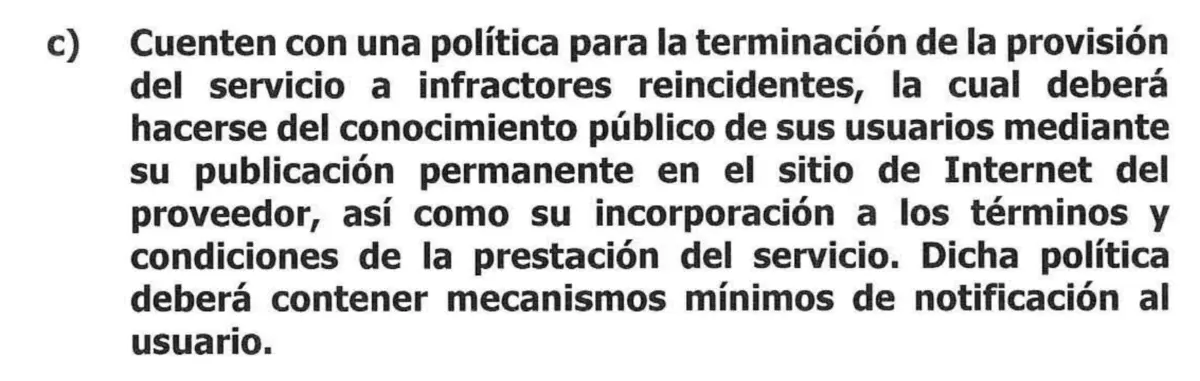
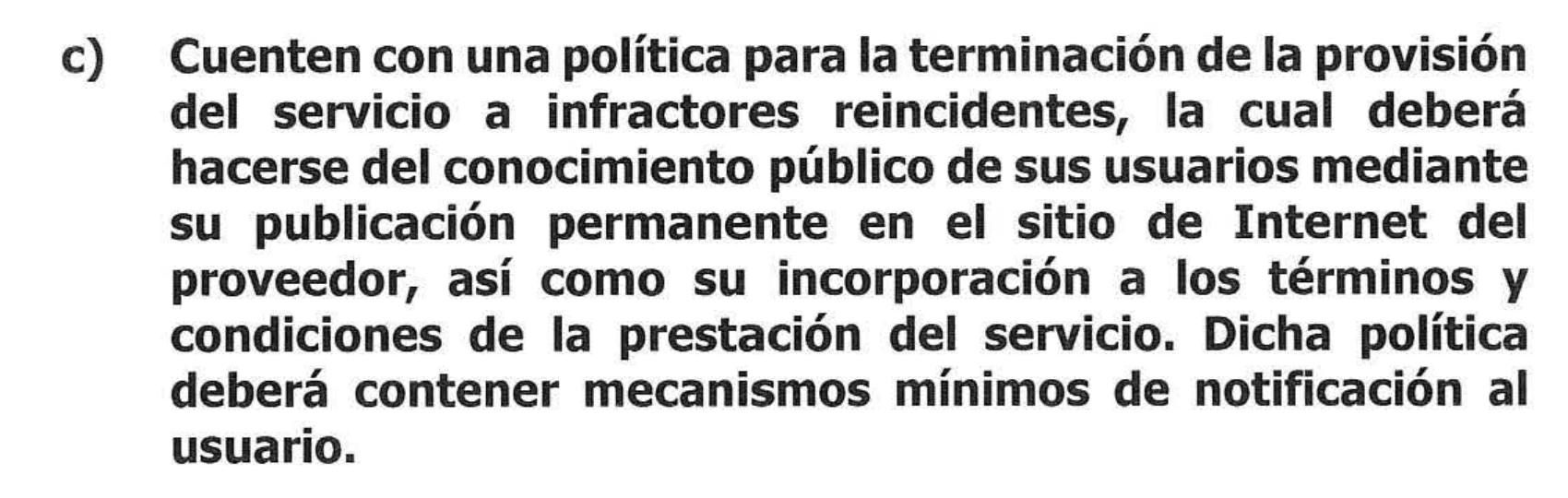
The newly approved amendments effectively close that loophole. Under the updated legal framework, access providers are now legally required to maintain an active policy for terminating the internet service of subscribers who repeatedly infringe upon copyrights. Furthermore, this policy cannot be hidden away in obscure paperwork; it must be published permanently on the provider’s official website and explicitly integrated into their terms of service. Additionally, the rules mandate that providers must implement a basic, accessible mechanism through which users can be notified of accusations.
Crucially, the legislation specifies that what faces termination is the physical internet connection itself, rather than merely an isolated user account. According to reports from Mexican business outlet EL CEO, this means major national access providers such as Telmex and Izzi will be legally compelled to formulate, publish, and enforce these rigorous termination policies.
Internet service providers that fail to comply with these updated requirements risk losing their safe harbor protections entirely. Under the statutory framework, any ISP that falls short of these conditions becomes directly liable for the copyright infringements of its users if the company is found to have knowingly contributed to, induced, or otherwise caused the infringement. The same strict liability standard applies if an ISP maintains the technical capacity to control the infringing user and simultaneously profits directly from the unauthorized activity.
Should an infraction occur, the Mexican Institute of Industrial Property holds the authority to levy substantial fines against non-compliant providers. Depending on the scale and nature of the specific infringement, these penalties can reach up to roughly 4.7 million pesos, which equates to approximately $250,000 USD.
Defining the Threshold for Repeat Infringers
Despite the high stakes for both providers and consumers, the newly minted law contains a significant ambiguity: it does not explicitly define what constitutes a "repeat infringer," nor does it establish a precise numerical threshold of piracy accusations required before a subscriber’s connection must be severed.
According to Aurora López-Portillo, director of legal services at the intellectual property firm ClarkeModet, the legislative vacuum means that each individual provider will be forced to determine its own internal threshold for termination. Speaking to EL CEO, López-Portillo noted that ISPs would be well-advised to verify whether incoming piracy accusations actually hold evidentiary weight. She suggested that providers should ideally afford users a fair opportunity to respond and defend themselves, even though such procedural safeguards are not strictly mandated by the bare text of the law.
During the intense Senate debate on Tuesday, opposition lawmakers voiced serious apprehension regarding these exact grey areas. Senator Gabriel Elizondo cautioned his colleagues that modern households frequently share a single broadband connection among multiple individuals. Consequently, the unauthorized downloading or sharing activities of one family member could inadvertently leave an entire household completely offline, disrupting remote work, education, and daily communication.
In an attempt to mitigate these potential abuses, opposition lawmakers had previously proposed amending the legislation to require a formal judicial order before any consumer internet service could be suspended. However, that proposal was ultimately rejected, leaving the enforcement mechanism largely in the hands of the private telecom companies and regulatory bodies.
A Divergent Path from U.S. Jurisprudence
The timing of Mexico’s legislative tightening stands in sharp contrast to recent legal developments in the United States, highlighting a widening philosophical divide between North American neighbors regarding the responsibilities of internet infrastructure companies.
In the United States, the Digital Millennium Copyright Act also conditions safe harbor protection on the implementation of a policy that provides for the termination of repeat infringers in appropriate circumstances. However, the American legal landscape shifted dramatically in March of this year when the U.S. Supreme Court completely wiped out a staggering $1 billion jury verdict against internet provider Cox.
The U.S. Supreme Court ruled that merely knowing about widespread piracy on a network and failing to eradicate it is legally insufficient to hold an ISP liable for contributory copyright infringement. Writing for the majority in the landmark opinion, Justice Clarence Thomas emphasized that existing legal precedents do not penalize a company simply for providing a vital public utility with the general knowledge that a fraction of its user base will misuse it to break the law.
“Under our precedents, a company is not liable as a copyright infringer for merely providing a service to the general public with knowledge that it will be used by some to infringe copyrights,” Justice Thomas wrote.
Mexico’s newly approved statutory framework deliberately charts a different course. Rather than shielding infrastructure providers who fail to actively police their subscriber bases, Mexican law treats compliance with safe harbor conditions—including the active enforcement of a repeat infringer policy—as an indispensable prerequisite for immunity. If a Mexican provider drops these safety requirements and subsequently contributes to, induces, or profits from copyright infringement with knowledge of the activity, it opens the door to immediate regulatory sanction and financial liability.
The new repeat infringer mandates are scheduled to formally take effect 180 days after their official publication in Mexico’s national gazette. As the countdown to implementation begins, both the telecommunications industry and consumer advocates are left waiting to see how major providers will define the elusive threshold of a repeat infringer, and how many accusations it will ultimately take to pull the plug.