

Mutsamudu, Comoros — MEXC, a recognized pioneer in zero-fee digital asset trading, has released its financial and operational data for August, highlighting a dramatic expansion in its traditional finance (TradFi) trading products. According to the platform’s latest monthly metrics, trading volume across stock, index, and ETF futures skyrocketed by 130% compared to the previous month. At the same time, the breadth of the platform’s offerings grew significantly, with the total number of available contracts increasing by 35% to surpass 400 distinct listings.
The report also underscored strong momentum in the spot market. Tokenized stocks and exchange-traded fund (ETF) spot trading volumes experienced a robust 30% month-on-month increase, accompanied by positive gains across nearly all existing listings. This widespread upward trajectory points to an increasingly active user base looking for diverse exposure to global financial markets through digital asset infrastructure.
Memory and Semiconductor Trading Broadens Across U.S. and Korean Markets
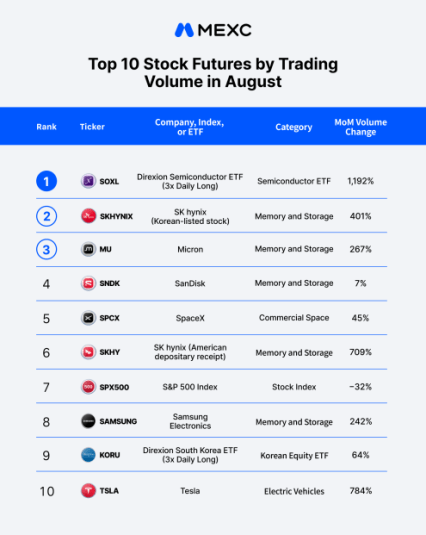
The most pronounced shift in August’s stock futures trading activity was a broadening of focus. While previous months had often seen volume concentrated in a single dominant memory stock, August saw robust participation across multiple U.S. and Korean memory and storage equities. Notably, five of the top ten stock futures ranked by trading volume were linked directly to memory and semiconductor storage companies.
SK hynix emerged as a standout performer, capturing the second overall spot in trading volume and ranking first among individual stock futures. Trading volume for the SKHYNIX futures contract surged by approximately 401% month-on-month. Meanwhile, Micron (MU) secured the third position overall, registering a remarkable 247% increase in volume.
The appetite for Korean equities and market instruments showed exponential growth. The combined trading volume for stock futures tracking Korean companies and markets—specifically SKHYNIX, SKHY, SAMSUNG, and KORU—surged by approximately 348%. Consequently, their collective share of total stock futures trading volume nearly doubled, climbing from 14% in July to 27% in August. At the same time, SanDisk (SNDK) continued to record positive volume growth, although its proportional share of total volume shifted from 25% down to 11% amid the influx of new market leaders.

Trading activity similarly spilled over into specialized semiconductor exchange-traded funds. SOXL stock futures, which track a prominent semiconductor ETF offering triple-daily long exposure, claimed the top spot as trading volume surged by an astounding 1,192%. This massive influx of capital propelled the contract’s share of total stock futures trading volume from less than 4% in July to 20% in August. Similarly, SOXS stock futures—designed to provide a triple inverse daily leveraged exposure to the U.S. Semiconductor Index—recorded a healthy 436% volume growth.
In contrast, broader market instruments experienced a divergence in investor interest. Trading volume for SPX500 stock futures, which track the benchmark S&P 500 Index, declined by approximately 32%. Market observers noted that this downward movement reflected a clear sector rotation, with traders pivoting away from broad-market indices and toward high-beta, sector-specific technology and semiconductor exposures.
Beyond the technology and semiconductor sectors, alternative asset classes also captured significant trading interest. Stock futures linked to commercial space exploration via SpaceX (SPCX) and electric vehicles through Tesla (TSLA) saw their respective trading volumes rise by approximately 45% and 784%. These assets secured the fifth and tenth positions respectively, illustrating sustained retail and institutional engagement with high-profile growth industries. Platform administrators noted that all rankings were based on individual stock futures listings, with SKHYNIX and SKHY tracked and evaluated separately.
Tokenized Stocks and ETFs Record 30% Spot Volume Growth
In the spot market division, MEXC reported that trading volume for tokenized stocks and ETFs rose by approximately 30% month-on-month in August. This asset category expanded its footprint within the platform’s broader ecosystem, increasing its share of total TradFi spot trading volume from 63% in July to 73% in August.
A key characteristic of this growth was its distribution. Rather than being concentrated in a handful of outlier assets, approximately 99% of all existing tokenized stock and ETF listings recorded higher trading volumes during the month. Furthermore, the top ten assets accounted for a modest 12% of the segment’s total volume, underscoring a remarkably broad-based participation model across the entire catalog of offerings.
Among individual listings, Circle (CRCL) captured the top spot with trading volume climbing 69% month-on-month. Other financial technology and digital asset equities, including Coinbase (COIN) and Robinhood (HOOD), also secured positions within the top ten. Combined trading volume across these three crypto-adjacent listings rose by 47%, signaling strong parallel interest in the equities of companies bridging traditional finance and the digital asset economy.
Artificial intelligence infrastructure also maintained a powerful presence in spot trading. Nebius (NBIS), an AI cloud infrastructure firm, ranked third overall, registering an impressive 188% month-on-month growth rate—the highest expansion seen among the platform’s top ten spot assets. Meanwhile, NVIDIA (NVDA) placed fifth with a 54% increase in trading volume. These figures highlighted that AI-related capital allocation on the platform was not restricted solely to semiconductor manufacturing, but extended deeply into cloud computing and digital infrastructure services.
Expanding Global Access and 24/7 Market Liquidity
The underlying driver behind these record-setting metrics is MEXC’s cross-market architecture, which enables users to trade products linked to U.S., Korean, and Hong Kong equities using USDT through a single unified account. This design aims to eliminate traditional jurisdictional silos, simplifying multi-market access for international traders. Furthermore, the platform’s stock futures support continuous long and short position management around the clock, allowing participants to trade even when underlying traditional stock exchanges are closed.
This flexibility was particularly evident during the weekends. Stock futures trading activity conducted during August’s ten weekend days accounted for approximately 11% of the entire monthly volume, demonstrating sustained demand for continuous price discovery and hedging capabilities outside standard banking hours. To celebrate these milestones and encourage platform adoption, the MEXC "0808: Stock Season" zero-fee event attracted more than 86,000 participating users, collectively saving traders over $1 million in operational fees.
Vugar Usi, CEO of MEXC, attributed the platform’s stellar performance to structural shifts in global investor behavior.
"The sustained growth in stock-related trading across multiple asset classes and markets underscores the accelerating global demand for accessible, diversified market exposure," Usi stated. "We remain committed to expanding our equity-linked offerings and simplifying access for users worldwide, consolidating trading into a single account and delivering on our core proposition: trading Wall Street, without walls."
Founded in 2018, MEXC operates as a global multi-asset trading platform designed to provide a zero-fee gateway to a wide array of financial opportunities. Serving users across more than 170 markets, the exchange facilitates efficient access to cryptocurrencies, traditional equities, tokenized assets, and derivatives through a centralized account structure. As the boundaries separating traditional finance from the digital asset ecosystem continue to blur, the platform maintains its focus on delivering deep liquidity, broad asset coverage, and a high-performance trading environment tailored to modern market participants.


Leave a Reply