
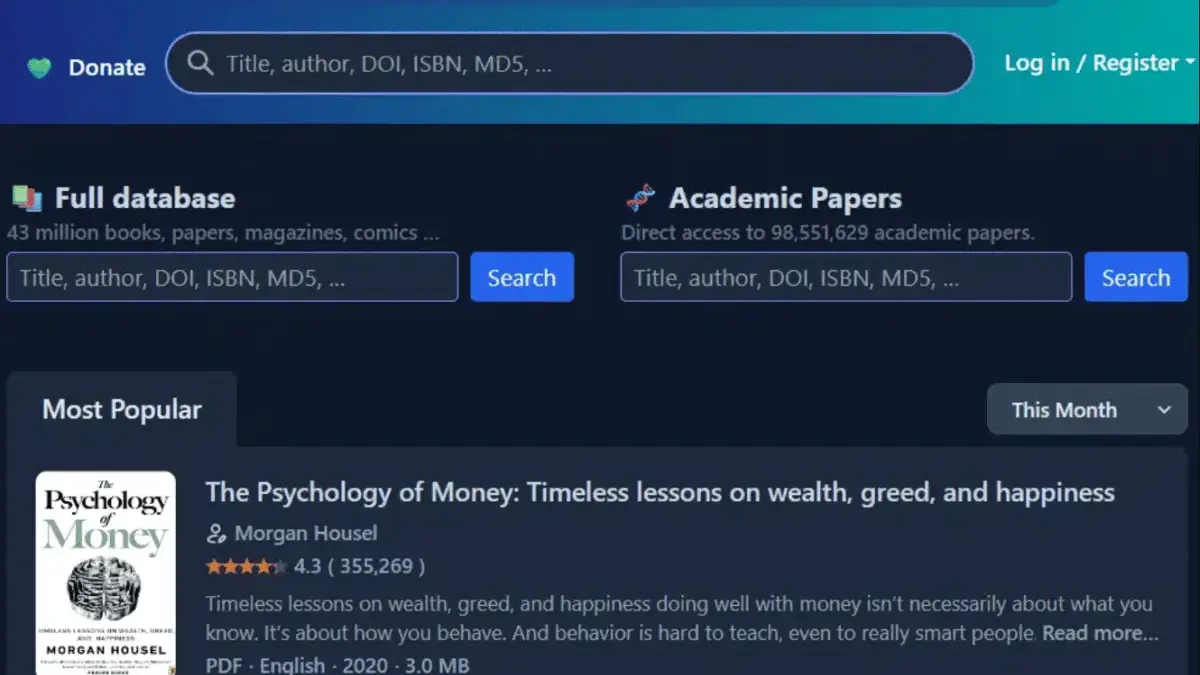
A coalition of major book publishers has formally asked a New York federal court to issue a $19.5 million default judgment against the shadow library WeLib. The site, which has operated anonymously, is accused of heavily copying its underlying code and the vast majority of its digital collection directly from Anna’s Archive, another prominent shadow library that suffered a nearly identical legal defeat earlier in the year. In a curious twist of legal drafting, the publishers’ own court filings appear to have "copied" text from their prior lawsuit against Anna’s Archive, including references to features and behaviors unique to that platform rather than WeLib.
The legal battle sheds light on the murky, highly derivative nature of the modern shadow library ecosystem. Last year, the operators of Anna’s Archive publicly cautioned their user base about the emergence of WeLib, describing it as a newcomer in the underground digital library space. According to warnings published by Anna’s Archive at the time, WeLib had mirrored most of its collection and built its infrastructure using a fork of its codebase. Because WeLib allegedly failed to contribute any new collections or code improvements back to the shared ecosystem, the team behind Anna’s Archive advised prospective users to steer clear of the site, writing that they recommended not using them.
Months later, a collective of prominent book publishers arrived at a strikingly similar conclusion regarding WeLib’s origins, albeit through the lens of copyright enforcement. In June, major publishers filed a formal lawsuit against WeLib in a New York federal court. The complaint alleged that the pirate site was established only after its operators misappropriated both the source code and the overwhelming majority of contents belonging to Anna’s Archive. Despite these serious allegations of systemic copyright infringement, WeLib’s anonymous operators chose not to respond or mount a defense in court. This failure to appear prompted the publishers to press forward, and the court clerk officially entered a default against the site in August, clearing the path for the current push toward a final monetary and injunctive judgment.

On Monday, the plaintiffs—a group including prominent industry heavyweights such as Penguin Random House, Elsevier, and HarperCollins—submitted a formal motion to U.S. District Judge Victor Marrero. They urged the court to issue a default judgment against both WeLib and its unidentified operators. In their legal brief, the publishers stated that WeLib operates explicitly as a pirate site whose sole commercial purpose is the distribution of protected intellectual property in direct violation of the rights held by the plaintiffs and other copyright owners.
To calculate the proposed financial penalty, the publishers requested the maximum statutory damages allowed under the law: $150,000 for each of the 130 specific works cited in the original complaint, breaking down to ten titles per publisher. This calculation brings the total requested sum to exactly $19.5 million. Notably, this is the exact same financial penalty that U.S. District Judge Jed Rakoff awarded to the publishers in the parallel lawsuit against Anna’s Archive.
The breakdown of the damages demonstrates an even distribution among the thirteen corporate plaintiffs involved in the action. Apress Media, Cengage Learning, Elsevier, Hachette Book Group, HarperCollins Publishers, John Wiley & Sons, Macmillan Learning, Macmillan Publishing Group, McGraw Hill, Pearson Education, Penguin Random House, Simon and Schuster, and the Taylor & Francis Group are each seeking $1,500,000, culminating in the aggregate $19.5 million figure.
Beyond the financial damages, the publishers’ memorandum places significant focus on WeLib’s revenue model. While the site does not strictly wall off its content behind a mandatory paywall, allowing users to access files for free, it aggressively solicits financial support through "donations" reaching up to $90 a month. The publishers argue that these voluntary contributions are, in practical terms, direct payments required to secure faster download speeds and prioritized access to copyrighted material.

To curb the site’s ongoing distribution network, the publishers are also pressing the court for a permanent injunction. If granted, this order would compel domain registries and registrars to disable the core domains associated with the platform—specifically welib.org, welib.st, and welib-public.org—while simultaneously blocking any attempt to transfer those domains to entities other than the publishers themselves. Furthermore, hosting providers would be legally required to cease serving the offending websites entirely.
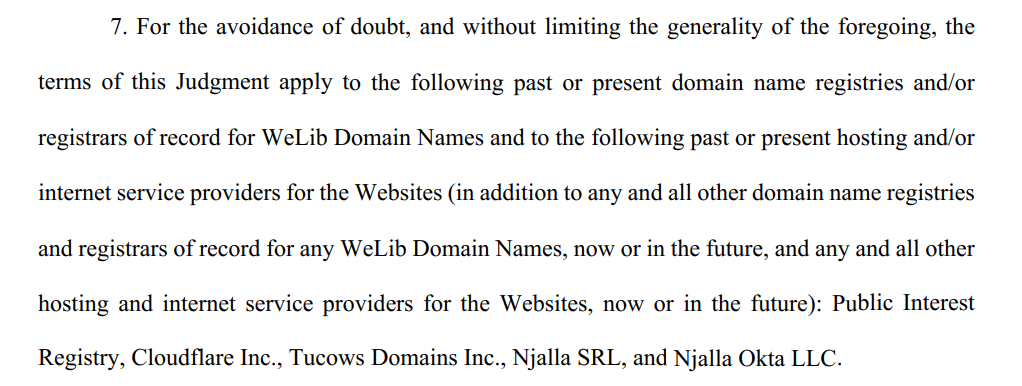
While the injunction would technically bind all applicable intermediaries, the proposed court order explicitly names five specific organizations: the Public Interest Registry, Cloudflare, Tucows, and two separate entities associated with Njalla. This represents a notably streamlined list compared to the injunction secured in the Anna’s Archive litigation, which targeted more than twenty different intermediaries.
The legal filings also highlight an unusual artifact of high-volume copyright litigation: the recycling of legal arguments and text. Large portions of the memorandum submitted against WeLib closely mirror the brief that the intellectual property law firm Oppenheim + Zebrak filed against Anna’s Archive on behalf of the same publishers earlier in the year.
However, this reliance on boilerplate language led to several jarring discrepancies. For instance, the WeLib brief asserts that the site diverts revenue from copyright holders at a scale made worse by its use of the viral BitTorrent protocol. Independent reviews of WeLib’s operations have turned up no evidence that the site utilizes BitTorrent, nor does the WeLib complaint itself contain any allegations regarding peer-to-peer torrent distribution. Instead, the complaint details how WeLib serves files directly from its own centralized servers through a tiered system of slow and paid fast downloads.

The inclusion of the BitTorrent claim stems directly from the fact that the identical paragraph was used in the Anna’s Archive brief, where it was originally backed up by allegations concerning Anna’s Archive’s dedicated torrent pages. The copied text extends further, including a statement claiming that WeLib’s infringement continued despite "this and several other cases against them." While Anna’s Archive has faced a multitude of legal challenges globally, legal observers note that there are no known public lawsuits targeting WeLib’s specific operators prior to this action.
Even minor grammatical errors and clumsy phrasing appear to have migrated over from the previous brief. Both documents contain identical typos regarding what happens if the court "is satified" that default standards have been met, as well as identical arguments concerning whether the defendants can establish that they have presented any meritorious defenses. When reached for comment regarding the mismatched BitTorrent assertions, representatives from Oppenheim + Zebrak did not respond prior to publication.
It now falls to Judge Marrero to evaluate the motion and determine the appropriate judgment. Regardless of the judicial outcome, legal experts point out that the practical recovery of funds remains unlikely. Because WeLib’s operators have maintained strict anonymity throughout the proceedings, collecting millions in damages will present a formidable hurdle.
Precedent from the Anna’s Archive case suggests that while domain-level injunctions and registrar enforcement actions can disrupt operations and force platforms to shift to alternative top-level domains—such as .gl, .pk, and .gd extensions tied to registries outside United States jurisdiction—they rarely result in the permanent cessation of a shadow library. Whether the legal pressure facing WeLib yields a similar outcome will depend on the final scope of the injunction and the willingness of international registries to comply with U.S. court orders.
Copies of the publishers’ memorandum in support of the motion for default judgment, the proposed default judgment, the statement of damages, and the earlier Anna’s Archive brief have been made publicly available through legal documentation archives.



Leave a Reply