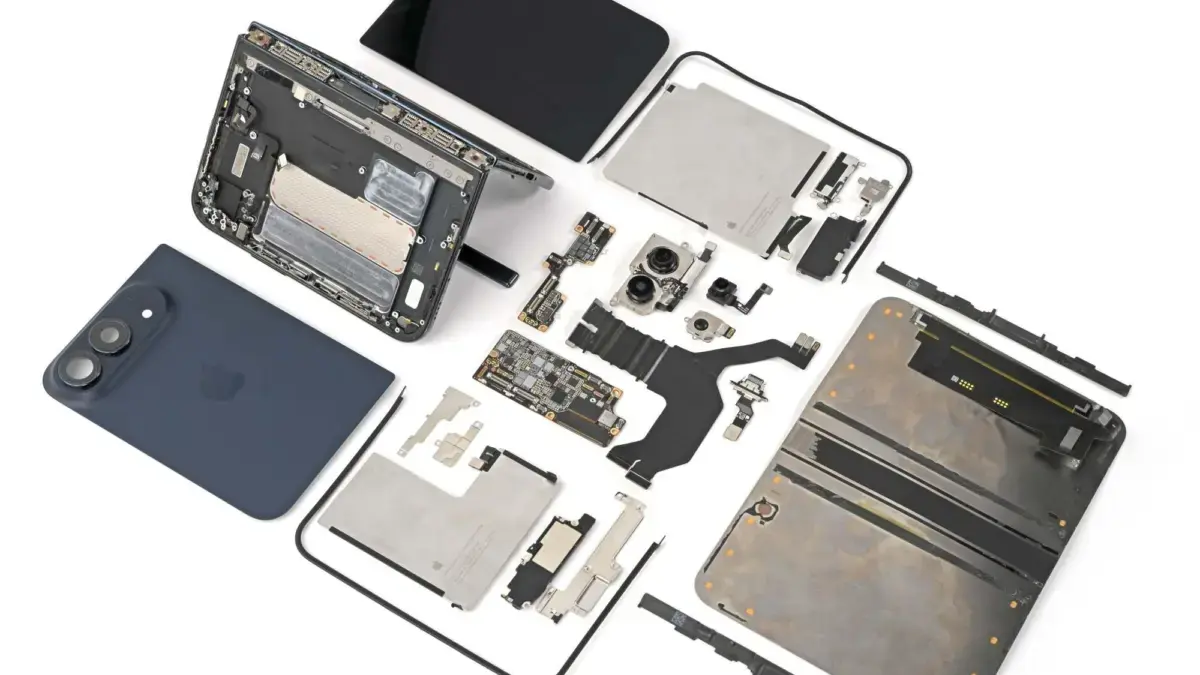
Beyond mere repair metrics, the comprehensive teardown illuminated several fascinating engineering details, particularly regarding how Apple attempted to solve one of the most persistent aesthetic and structural challenges plaguing the foldable category: the dreaded display crease. For years, manufacturers of folding handsets have struggled to eliminate or effectively mask the fold line running down the center of flexible OLED panels. According to iFixit’s analysis, Apple appears to have deployed a multi-pronged approach combining both software and hardware-level innovations to mitigate this visual blemish.
One of the primary tools in Apple’s arsenal for combating the crease is the internal screen’s matte nano-texture cover. While this specialized glass treatment was ostensibly designed to make the display significantly more readable in bright outdoor sunlight by reducing glaring reflections, it also plays a critical secondary role. By diffusing light across the surface, the nano-texture successfully helps mask the central crease, making it considerably less obtrusive to the human eye during everyday use.
However, the optical wizardry does not stop at the outer layer of glass. When examining the inner display under a microscope, the iFixit team discovered a unique arrangement of oval-shaped subpixels positioned at various, calculated angles across the panel. Analysts believe this specialized subpixel geometry is engineered specifically to reduce visual artifacts and further obscure the fold line down the middle of the display. By manipulating how light refracts and escapes from the individual subpixels near the hinge zone, Apple has managed to create a more uniform visual experience across the entire span of the folding screen.
When it comes to the physical maintenance and modularity of these components, the news is a mixed bag for prospective owners. The nano-texture outer layer of the folding display is relatively straightforward to replace on its own, meaning technicians can service this specific scratch-prone component without having to swap out the delicate OLED display panel underneath. Given how easily plastic or soft polymer layers on rival foldables scratch or degrade over time, the ability to service the outer layer independently is a notable win for hardware longevity.
If an unfortunate accident occurs and you need to repair the underlying OLED display itself, however, the situation changes drastically. True to the legacy of virtually all modern foldable devices on the market, replacing the primary folding screen remains an expensive, highly complex nightmare that requires specialized tools, precise calibration, and deep technical expertise. The tight tolerances and adhesives required to keep a folding display functional mean that internal screen swaps are bound to carry prohibitive costs for consumers who opt out of extended warranty coverage.

Durability and environmental sealing are always major concerns for folding phones, given that hinges and moving parts inherently create microscopic gaps where particulate matter can infiltrate. During the teardown, iFixit observed that dust and fine debris did manage to make their way into several vulnerable areas of the iPhone Duo, including the USB-C charging port, the speaker grills, and the heavily engineered mechanical hinge. This infiltration resulted in a somewhat crunchy mechanical feel when opening and closing the device after exposure to debris.
Nevertheless, there is a silver lining when comparing the iPhone Duo’s internal cleanliness to its major competitors. Noticeably less abrasive dust and particulate matter found its way into the critical internal chambers of Apple’s foldable than what technicians previously observed when tearing down the Samsung Galaxy Z Fold8 or the Pixel 11 Pro Fold. This suggests that Apple’s internal gasketing and sealing mechanisms around the hinge cavity offer a slightly higher degree of protection against everyday pocket lint and abrasive grit, even if they cannot completely prevent the hinge from sounding slightly gritty over time.
The teardown also arrives in the wake of mounting consumer reports regarding damaged screens and cracking hinges in the wild, prompting iFixit to investigate the underlying hardware to formulate some plausible theories. The physical hinge mechanism engineered for the iPhone Duo is exceptionally complex, relying on a synchronized network of gears, cams, and tensioners to facilitate a smooth folding action. Based on their microscopic examination of the mechanism, technicians suspect that certain internal components of the hinge occasionally fail to descend or retract properly during the closing motion.
Adding to this mechanical complexity is the presence of a delicate accordion-style flat flex cable that routes directly over that exact high-stress mechanical zone. This cable happens to run perilously close to the edge of the device’s internal battery pack. iFixit’s analysts theorize that when the hinge experiences minor mechanical interference or uneven resistance, this accordion cable might be subjected to abnormal mechanical stress, effectively concentrating localized pressure directly against the back of the display panel or surrounding structural frames.
The investigative team believes this unfortunate convergence of tight spatial tolerances, mechanical shifting, and cable routing could be the root cause behind the alarming issues reported by some early adopters—including instances of broken screens and the distinct, audible cracking sounds reported by users right before their displays failed. As these hardware concerns continue to circulate among tech communities and consumer advocacy groups, Apple has yet to officially respond to inquiries regarding these structural findings, having not immediately returned a request for comment from reporters covering the teardown.