
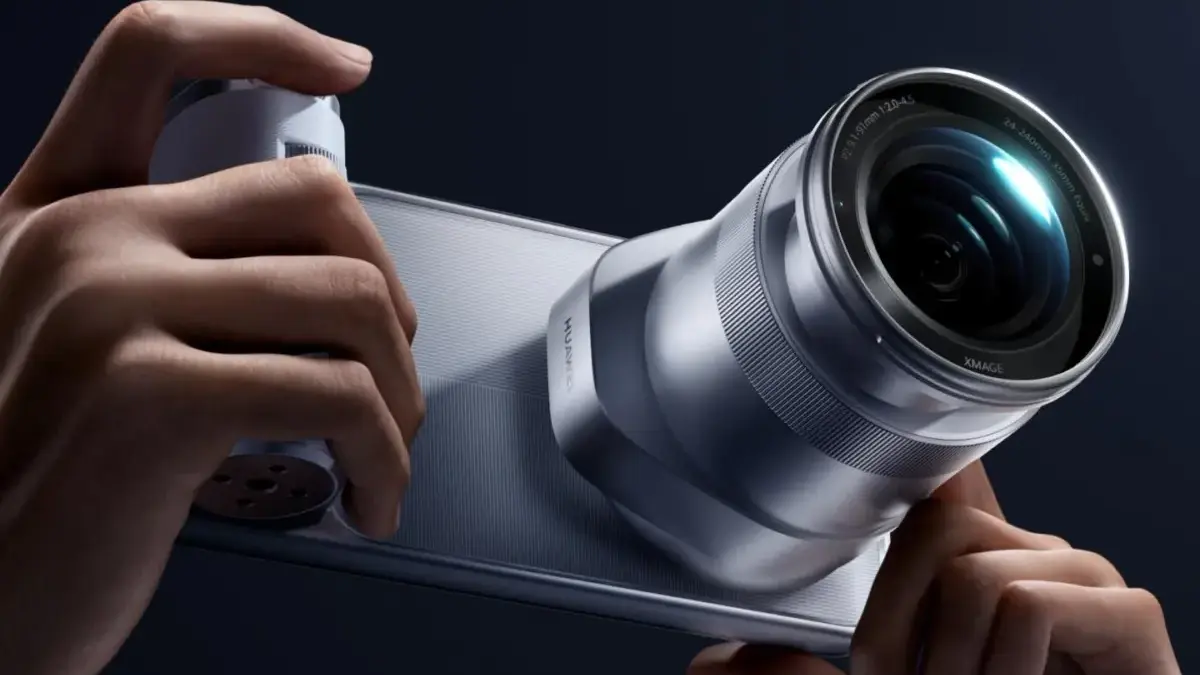
Over the past few years, a compelling trend has steadily taken root across the Chinese Android smartphone market. Following in the pioneering footsteps of Vivo and its acclaimed add-on teleconverter lenses designed for flagship photography kits, rival manufacturers have sought ways to push long-distance mobile photography beyond the physical limitations of standalone smartphone chassis. Today, Huawei has leapfrogged the competition in dramatic fashion, introducing an extraordinarily ambitious modular camera accessory for its newly launched Mate 90 Pro Max flagship. Rather than offering a simple optical multiplier, Huawei’s new creation is a comically massive zoom lens that packs its own dedicated image sensor, blurring the line between pocket-friendly smartphones and professional interchangeable-lens cameras.
At the heart of this new system—officially designated as the Ruiying Z10 modular camera—lies a 1-inch-type, 50-megapixel RYYB image sensor. This sensor is physically larger than any primary or secondary sensor found housed directly within the phone itself. Consequently, snapping this heavy-duty glass onto the rear of the device does not merely offer better magnification; it represents a comprehensive overhaul of the phone’s entire optical and photographic ecosystem. While previous teleconverter lenses introduced by various Android manufacturers have relied on fixed focal lengths, the Ruiying Z10 is a true, mechanical zoom lens. It covers a versatile 24 to 240mm focal range, paired with a flexible variable aperture that spans from f/2.0 to f/4.5. Functionally, it operates almost as a standalone camera in its own right, leaning on the host smartphone exclusively for power, processing muscle, and software handling.

In an impressive engineering feat, Huawei has designed the Z10 to mount directly onto compatible smartphones using a physical screw-mount mechanism built right into the device, bypassing the need for any bulky intermediary protective case or external mounting frame. Yet, the physical realities of such a powerful optical system bring an unavoidable caveat. The Z10 is absolutely enormous—even when measured against traditional teleconverter standards used in mobile photography. Users will certainly not be slipping this massive piece of hardware into a tight pants pocket or a small purse.
Even so, tipping the scales at 346 grams, the modular lens remains significantly smaller, lighter, and more portable than the vast majority of traditional mirrorless or digital single-lens reflex cameras on the market. This portability could grant users a distinct advantage, potentially allowing them to sneak the powerful rig into restricted public venues where professional or detachable-lens cameras are strictly prohibited, such as high-profile live concerts and major sports matches. Of course, this level of specialized engineering commands a steep premium. Priced at 5,999 yuan—approximately $895 USD—the Ruiying Z10 is more expensive than many entire flagship smartphones available today.
Huawei has specified that the Ruiying Z10 is engineered for compatibility with select elite models in the new Mate 90 series, specifically the collector’s edition of the Mate 90 Pro Max and its ultra-luxurious stablemate, the Mate 90 RS Ultimate Design. These two specialized devices are distinct within the broader lineup, featuring the specialized mechanical screw-mount integrated directly around their prominent circular camera islands.

Even without the modular lens attached, these two flagship handsets boast exceptionally powerful camera specifications out of the box. They feature a versatile main camera utilizing an f/1.4-f/4.0 variable aperture, a 50-megapixel resolution, and a sprawling 1.1.28-inch-type sensor. This is complemented by a high-resolution 200-megapixel periscope telephoto lens offering 4x optical zoom built upon the same generous sensor size, alongside a 40-megapixel ultrawide camera for sweeping landscapes and group shots. Up front, the devices showcase a stunning 6.9-inch OLED display capable of reaching a blinding peak brightness of 12,000 nits. Under the hood, the performance is driven by a massive 6,800mAh battery paired with Huawei’s proprietary Kirin 9050 Pro processor, while the standard Mate 90 and Mate 90 Pro models offer slightly more streamlined dimensions and specifications across the board.



Leave a Reply