
The Fedora Design Team has demonstrated that running a virtual conference entirely on open source tools is not only feasible, but remarkably effective. Following the conclusion of the inaugural Creative Freedom Summit in January 2023, organizers shared valuable insights into the background of the event, the philosophy behind choosing a completely open-source infrastructure, and the specific configurations required to bring the ambitious project to life. As communities continually weigh convenience against ideological alignment in software choices, the summit serves as a compelling case study in what can be achieved with passion, volunteer dedication, and decentralized technology.
What is the Creative Freedom Summit?
The genesis of the Creative Freedom Summit can be traced back to Marie Nordin and her review of talk submissions for Flock, the annual conference for Fedora users and contributors, held in August 2022. While evaluating proposals, Nordin noticed an overwhelming number of submissions focused specifically on design and creativity within the open source ecosystem—far more than the main conference program could possibly accommodate. Recognizing the sheer volume of great ideas centered on open-source creative tooling, she began to wonder whether there was an appetite for a dedicated, standalone event celebrating creatives who rely on open source software to produce their work.
Nordin brought the proposal to the Fedora Design Team in the autumn of 2022, prompting an intensive planning phase for an event scheduled for January 17 through 19, 2023. Because it was an entirely new endeavor, the organizing committee chose to launch by directly inviting speakers, drawing from both the surplus Flock submissions and their own personal networks of open-source creative professionals. The response was overwhelmingly positive, with nearly every invited speaker accepting. Consequently, the team did not operate an open Call for Papers or utilize a traditional CFP management tool for this inaugural run, leaving that process as a challenge to tackle for future iterations.
Using Open Source for Open Source Conferences
Ever since the initial disruptions of the COVID-19 pandemic, the broader Fedora community has relied on Hopin to run its virtual Flock conferences. While Hopin is a proprietary online platform, it has maintained a reputation for being friendly to open source communities, offering a polished conference feel complete with integrated sponsor booths, multiple tracks, hallway chat rooms, and robust moderation tools. Because the Creative Freedom Summit was organized under the Fedora umbrella, the team had ready access to the existing Fedora Hopin setup, making it an easy logistical option.
However, for veteran open-source contributors with decades of experience, making the software choice is rarely straightforward. When hosting an event dedicated entirely to open source, relying on a proprietary platform can feel contradictory. Yet, as the scale and complexity of open-source communities grow, building and maintaining an integrated, reliable open-source conference infrastructure presents significant technical hurdles.
Organizers face a complex balancing act with no simple right or wrong answer. For the Creative Freedom Summit, the organizing committee operated with zero financial budget, relying entirely on the dedicated work hours of a passionate volunteer team. They leveraged pre-existing supported infrastructure, including the Fedora Matrix server and a hosted WordPress deployment. Furthermore, core team members possessed the technical capabilities required to manage live video streams through PeerTube, having honed their skills running weekly video calls for the Fedora Design Team. With a shared desire for a low-key, single-track, and informal event—alongside a high tolerance for minor technical glitches and rough edges—the team embraced the challenge of deploying an all-open-source stack.

Building an Open-Source Conference Stack
The technical architecture of the Creative Freedom Summit was divided into live components and post-event workflows. For the live broadcast, the team utilized PeerTube for public livestreaming, Jitsi Meet for the virtual stage and speaker green room, and Element for backstage and attendee communication. For post-event archiving and community engagement, the organizers relied on GitLab to coordinate a massive volunteer video editing effort, alongside LimeSurvey to gather attendee feedback.
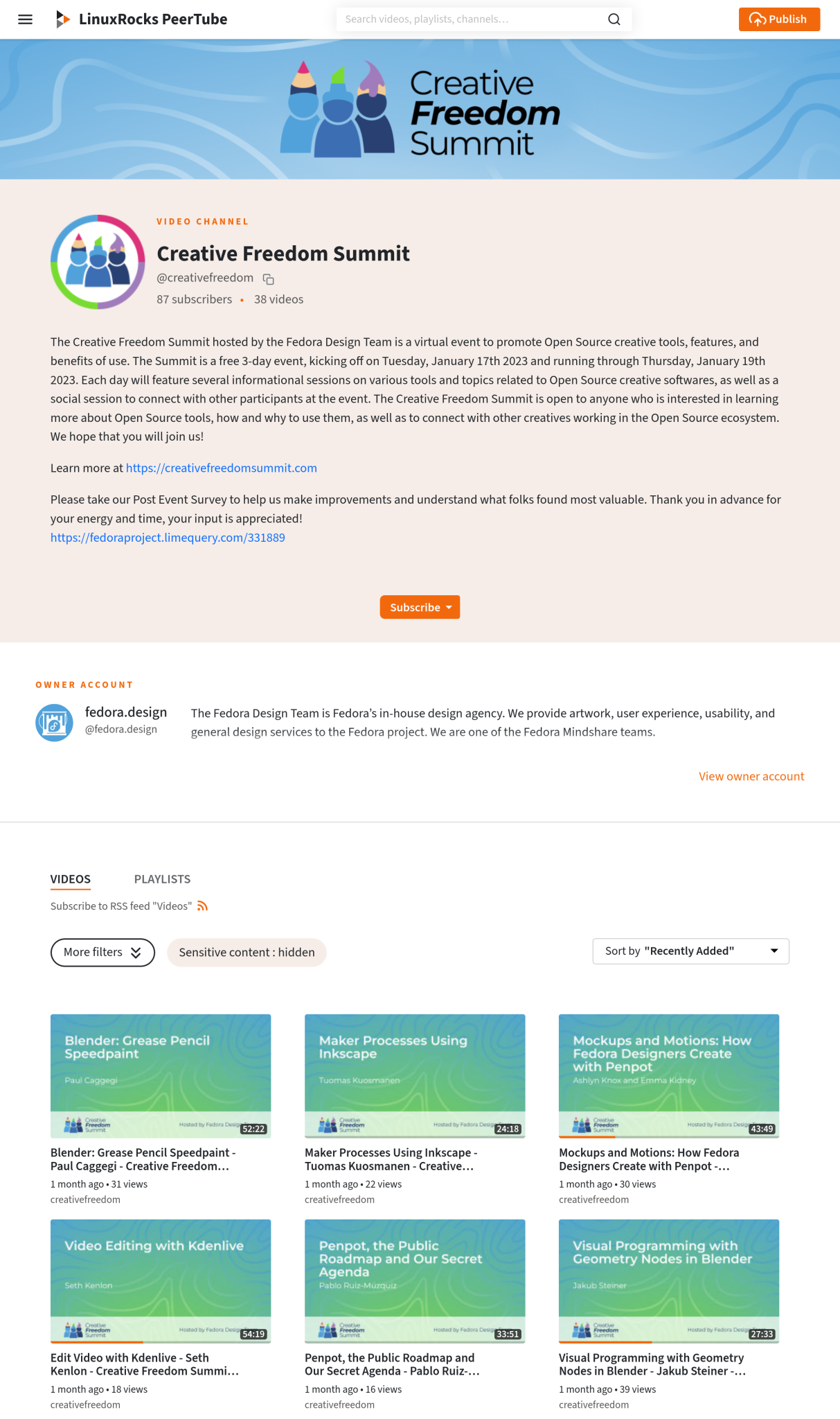
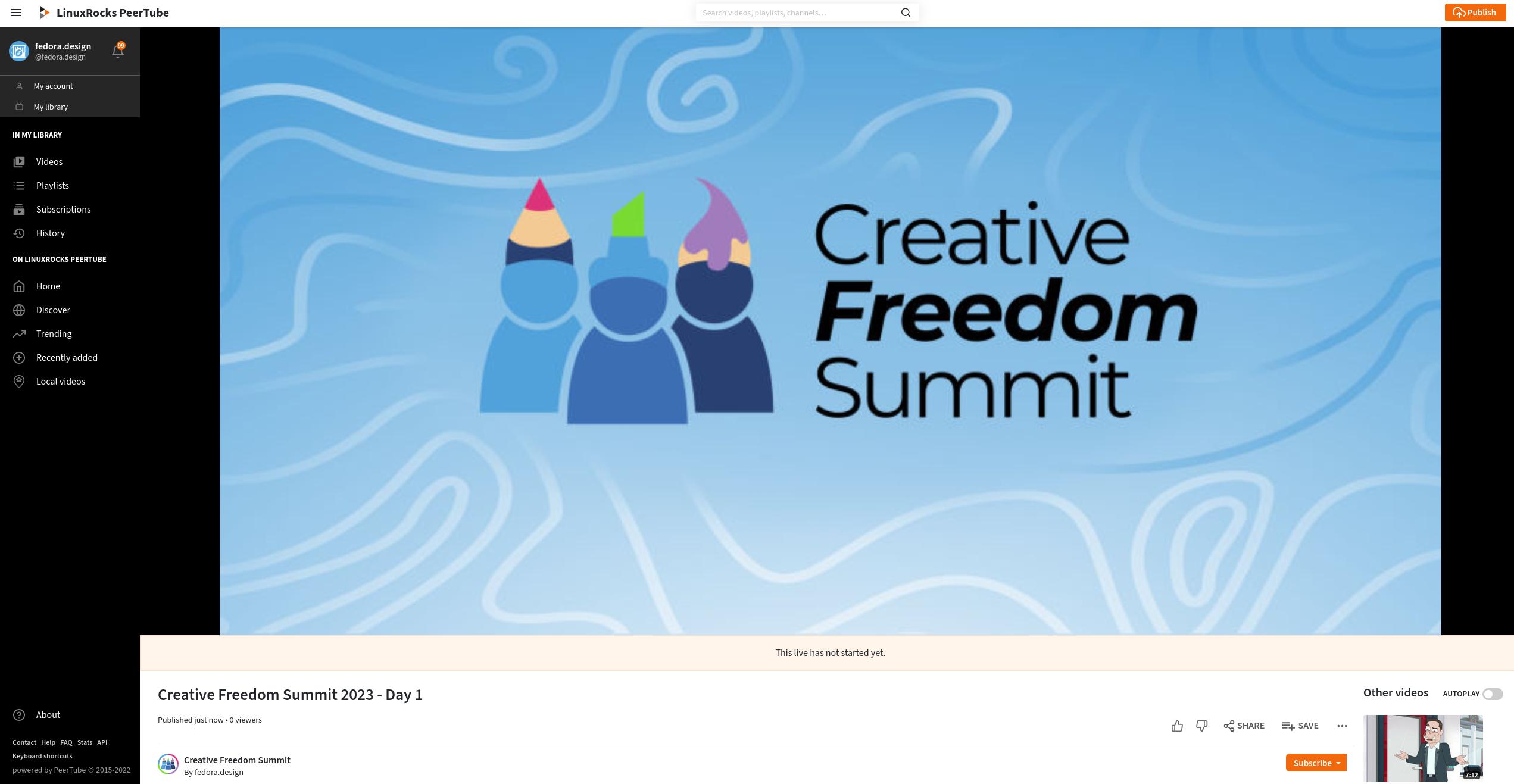
The livestreaming infrastructure relied on the LinuxRocks PeerTube platform, generously hosted by LinuxRocks.online. PeerTube is a decentralized, free and open-source video platform operating within the Fediverse. One of the platform’s standout features is its automated post-stream replay generation. Unlike other platforms that require manual rendering, uploading, and coordination by organizing teams, PeerTube automatically publishes a near-instant recording to the designated channel the moment a livestream concludes. Attendees frequently praised this feature during the event, as it allowed anyone who missed a live session to watch the recording within minutes of the talk ending, requiring zero manual intervention from the volunteers.
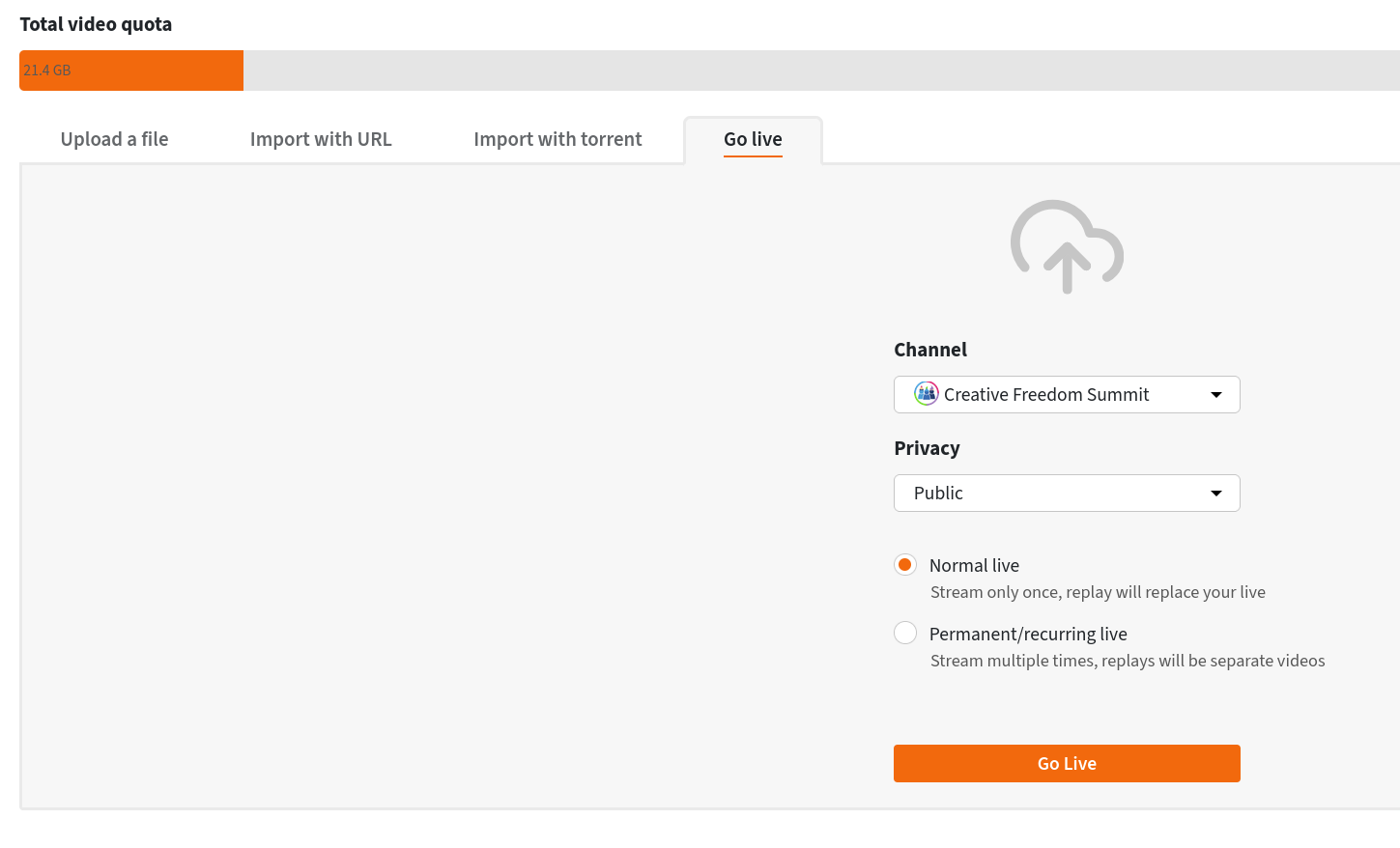
The operational workflow for streaming involved creating a reusable livestream URL and authorization key within PeerTube. By configuring the platform to automatically post replays to the channel upon stream completion, organizers avoided the administrative overhead of generating unique streaming credentials for every individual talk. Instead, a single URL and key combination was shared among hosts in a common document, enabling any authorized team member on duty to initiate the stream for the next speaker seamlessly.
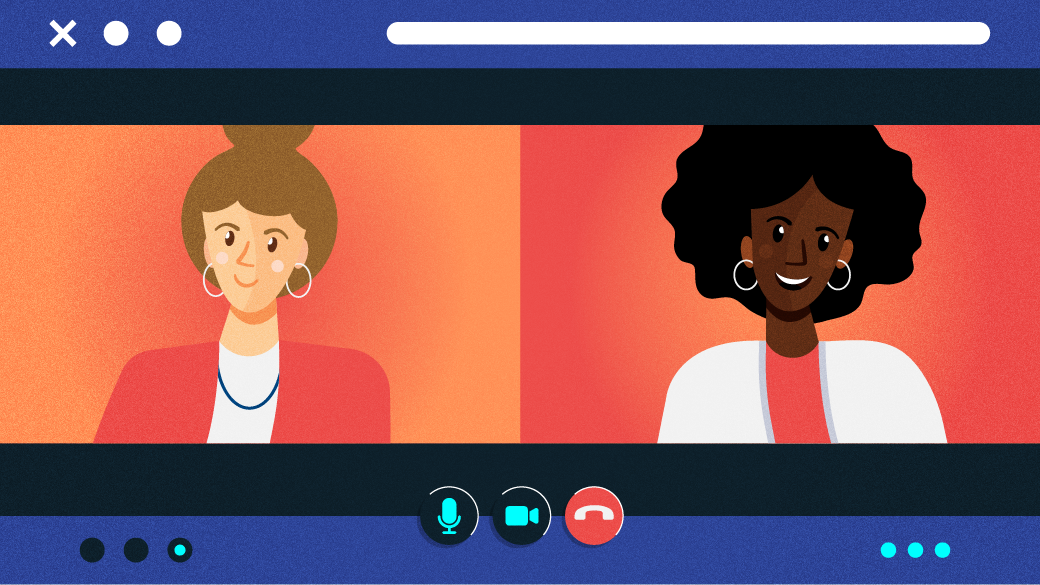
For the virtual stage, the organizers utilized the free and open-source Jitsi Meet platform. A dedicated meeting room was established with a custom URL, distributed strictly to speakers and event moderators. To manage the schedule smoothly, the room was configured with a virtual lobby, allowing speakers to join shortly before their scheduled presentations without disrupting the ongoing talk. Moderators could then easily admit them into the active room once the previous session concluded.
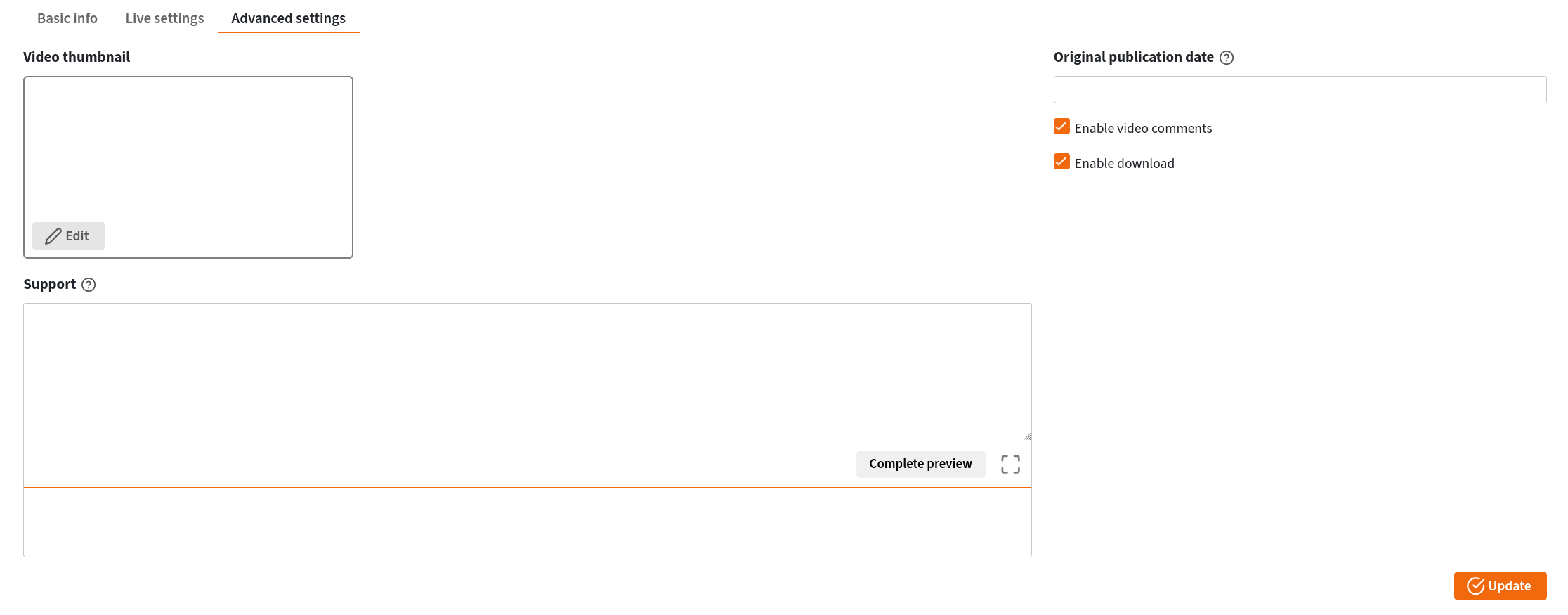
Jitsi’s built-in livestreaming capabilities allowed the virtual stage to broadcast directly to the PeerTube channel via RTMP integration. This setup mirrored the workflow the Fedora Design Team successfully used for its weekly meetings. Speakers were able to share their screens effortlessly to deliver presentations and live software demonstrations.
Managing Backstage Coordination and Attendee Engagement
To maintain smooth communication behind the scenes, organizers established an invite-only "Backstage" chat room using Element roughly a week before the conference. This channel proved invaluable for briefing speakers on technical requirements, verifying audio and visual setups, and coordinating schedule transitions in real time. When unexpected emergencies arose and a speaker had to be rescheduled, the backstage channel allowed the team to adjust on the fly with minimal friction.
For general attendee announcements and public interaction, the team utilized a Matrix channel integrated with embedded widgets. A pinned widget displayed general event information, daily schedules, and codes of conduct, alongside an interactive document for audience questions. Although the team initially used Etherpad widgets, minor loading issues led them to transition to embedded HackMD documents, which offered a smoother experience. This centralized approach allowed attendees to watch the embedded PeerTube livestream, read announcements, and participate in live chat discussions within a single unified interface.
Post-Event Workflows and Community Contributions
Following the conclusion of the summit, the organizing team shifted its focus toward archiving, accessibility, and community feedback. A comprehensive survey deployed via LimeSurvey gathered valuable constructive criticism from participants, helping the committee refine its plans for future iterations.
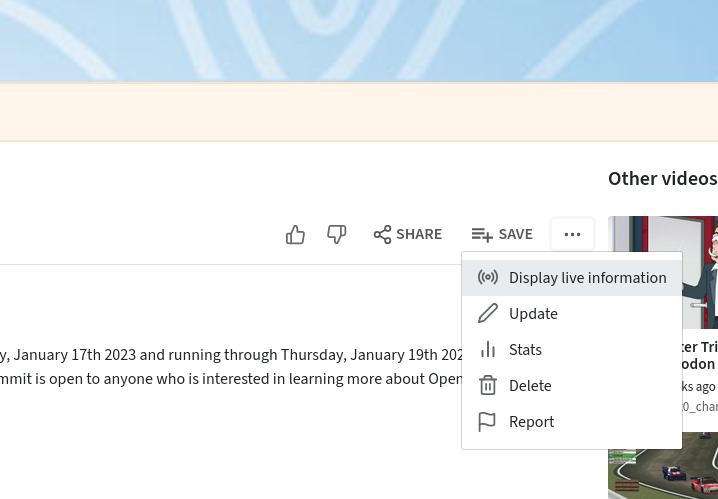
A major focus of the post-event phase was video production and accessibility. While the live event lacked real-time captioning, volunteers utilized Kdenlive, an open-source video editor equipped with built-in speech-to-text capabilities, to automatically generate and embed subtitles into the recorded talks. A dedicated team of community volunteers coordinated through a GitLab epic to clean up raw recordings, add standardized title cards and intro music, and correct auto-generated caption errors.
Volunteers downloaded raw files directly from the unedited PeerTube archives and uploaded their finished edits to a private holding account. Administrators then transferred the polished files to the primary conference channel, successfully overcoming minor platform limitations regarding multi-user channel permissions through practical coordination.
By proving that a complex virtual conference can be executed successfully using entirely open-source software, the Fedora Design Team hopes to inspire other open-source communities to take the plunge. The organizers continue to refine their processes, welcoming feedback and collaboration from anyone interested in participating in future summits through their public Matrix channel.



Leave a Reply