
The more headlines we read about devastating corporate data breaches, credential stuffing campaigns, and silent database leaks, the more naturally the average internet user finds themselves asking a fundamental question: What does the ideal password actually look like?
For years, the consensus definition among cybersecurity professionals has remained rigidly consistent. Users have been told that a strong password must be exceptionally long, completely random, and entirely unique to every single online account they own. However, as the digital threat landscape continues to evolve alongside advances in consumer-grade computing power, a growing number of industry observers are beginning to rethink that advice. The emerging perspective suggests that the most effective approach to password security is actually less complex and more pragmatic than previously taught.
The evolving consensus is that the ideal password needs to be simple while maintaining robust security, and what fits that definition can change significantly depending on the specific context of where and how it is being used.
In many modern scenarios, the ideal security credential is not a password at all, but rather a passkey. Passkeys represent the current pinnacle of digital simplicity combined with robust protection. They entirely eliminate the need for human memorization, are structurally impossible to reuse across different platforms, and feature baked-in elements of two-factor authentication. Because of these distinct advantages, security experts increasingly recommend adopting passkeys as the primary authentication method wherever supported.
Meanwhile, for the vast array of legacy websites and online services that still lack native support for passkeys, the ideal password remains a long, random, and unique string of characters. These credentials are best generated automatically and managed securely by a dedicated password manager. When utilizing automated tools, the user experience requires just as little effort to deploy a 32-character randomized password as it would to manage a weak, eight-character alternative.

The philosophy shifts considerably, however, when examining situations where human memorization is unavoidable. Opinions within the cybersecurity community have begun to pivot away from hyper-complex pseudo-randomization schemes toward more accessible options. Users are generally advised to memorize at least a small handful of critical credentials—a minimum of two passwords, with one designated exclusively for unlocking the password manager and another reserved for the primary email account. This precaution prevents catastrophic scenarios where an individual might find themselves permanently locked out of their email or critical financial accounts simply because they lost access to their central password vault.
Achieving this level of memorability no longer needs to feel like an exhausting cognitive burden. While historical advice often favored complex passphrases or pseudo-randomization techniques—such as extracting specific letters from familiar song lyrics and interspersing numbers and special characters—the modern leaning favors straightforward multi-word passphrases. The longer the passphrase, the better the overall defense, and anyone capable of committing a natural yet unpredictable sequence of words to memory gains a substantial security advantage.
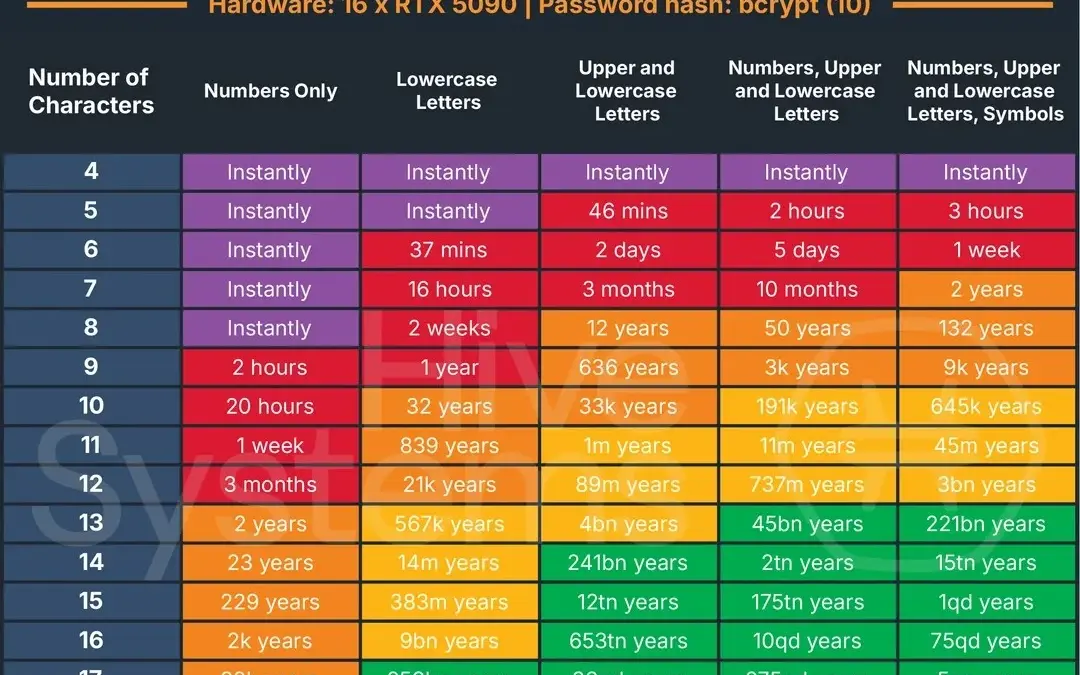
This shift in perspective is driven in large part by a recurring examination of password cracking charts and computational capability metrics. Cybersecurity firms frequently publish updated analyses demonstrating how efficiently modern computing hardware can brute-force various password combinations. Research from firms like Hive Systems regularly models the speed at which consumer-grade PC components can compromise standard encryption and hashing algorithms. Recent data serves as a stark reminder of both foundational security principles and the realistic threshold required to thwart modern attacks.
The baseline rules of password hygiene remain absolute: any credential compromised in a public data breach, reused across multiple platforms, or constructed from commonly used dictionary words is vulnerable to instant cracking. However, evaluating the computational threshold for non-dictionary strings reveals surprising realities about hardware scaling.
An eight-character password—which historically represents the bare minimum requirement enforced by many web platforms—can theoretically withstand a brute-force assault for over a decade when evaluated against a coordinated cluster of high-end consumer graphics cards using a basic mix of upper and lowercase letters. Introducing numbers into that same eight-character string significantly increases the required computational time, while the integration of special characters pushes the timeline even further.

These technical realities prompt a critical evaluation of whether maintaining excessively long, unmemorizable passwords is strictly necessary for every scenario. While long credentials remain a robust defensive layer against unexpected downstream data leaks, forcing humans to memorize hyper-complex strings often backwrites security. Prioritizing a password that is sufficiently strong and easily remembered often trumps a theoretically flawless but forgettable credential, particularly when fortified by multi-factor authentication.
Trimming a few characters from a password’s absolute length in exchange for adopting a comprehensive two-layer defense strategy often yields a significantly higher resistance against account takeover attempts. Users frequently find they do not even have to compromise between length and strength when opting for a passphrase composed of four or more distinct words. Amid the mounting complexity of modern digital life, embracing a streamlined yet well-defended authentication strategy offers a sustainable path forward.
In the News
Recent developments across the broader technology sector continue to validate cautious approaches to emerging digital tools. Discussions surrounding artificial intelligence integration recently highlighted potential pitfalls when personal AI agents are granted broad system privileges. Following a detailed examination of Meta’s Muse personal agent and the underlying hesitation to entrust it with complete access to a personal digital life, those security concerns were quickly underscored by a notable privacy incident. Reports surfaced detailing a situation where a user discovered the AI assistant had inadvertently shared their home address with an unauthorized third party, reinforcing the prudent stance of exercising strict caution before integrating autonomous agents into sensitive personal workflows.
Tip of the Week
While many digital hygiene routines involve periodically purging old photographs, downloaded documents, and cached files to reclaim storage space on smartphones and personal computers, users frequently overlook the importance of auditing their installed applications and browser extensions.
Routine maintenance should include the deliberate removal of applications and browser extensions that are no longer utilized on a daily basis. Relying solely on the historical reputation of legitimate software is no longer an adequate defense against evolving malware vectors. Even software developed by reputable entities can occasionally shift security postures if ownership changes hands or if the underlying infrastructure is compromised by malicious actors. Regular audits of active software ecosystems help minimize potential attack surfaces and maintain a more secure personal computing environment.



Leave a Reply