
When a new Linux distribution enters the technology ecosystem, it typically arrives with grand ambitions of building a permanent community, capturing market share, and establishing itself as a long-term fixture in the open-source landscape. However, a newly launched project called Gravity Linux is charting an entirely different course, operating with the ultimate goal of rendering itself obsolete. Functioning as a specialized Fedora Remix designed explicitly for Apple Silicon Macs, Gravity Linux ships with KDE Plasma on Wayland as its default desktop environment while pursuing a radical strategy of self-extinction.
The driving forces behind this unique undertaking are developers Cody Ho and Niklas Sheth. Originally forking their work from the pioneering Asahi Linux initiative, the duo shares a foundational commitment to bringing robust Linux support to Apple’s proprietary ARM-based silicon. Despite sharing that overarching vision with other efforts in the community, Gravity Linux emerged due to a distinct divergence in contribution policies, particularly concerning the integration and acceptance of Large Language Models and AI-assisted coding tools.
While various open-source communities maintain strict or heavily debated stances on automated coding assistants, Gravity Linux takes an unvarnished and transparent approach. The project’s position is explicitly visible within its open commit history. Specifically, the project’s kernel branch incorporates commits featuring dedicated Assisted-By tags, which openly credit AI coding tools alongside the human authors who guide them. Every component within the distribution is meticulously built through clean-room reverse engineering. This rigorous methodology guarantees that no proprietary Apple source code, official disassemblies, or leaked technical documentation ever contaminate the codebase, keeping the project legally compliant while navigating the complex architecture of Apple’s custom hardware.
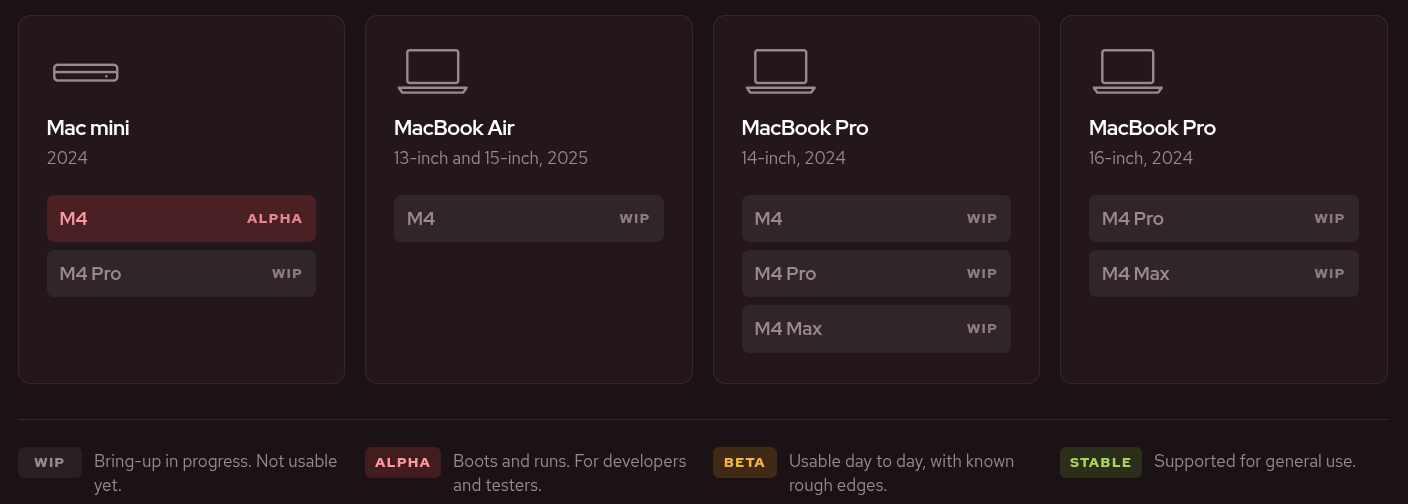
The first alpha release of Gravity Linux has arrived with targeted support for the M4 Mac mini. Out of the box, this initial build delivers functional hardware-accelerated graphics, thanks to a working display controller, known as the DCP, and a fully operational GPU that incorporates compliance for OpenGL ES 3.0 and OpenGL 3.3. For users testing the distribution, this means graphical acceleration is available immediately from the very first boot, providing a smooth visual experience under the KDE Plasma desktop.
Nevertheless, the developers are candid about the current limitations of the software, emphasizing that this initial rollout is strictly a developer-focused alpha release rather than a daily driver. Several core hardware functions remain unsupported or incomplete. Suspend mode is presently non-functional, meaning the system cannot enter low-power sleep states reliably. Furthermore, Thunderbolt and USB4 support are completely missing, and USB-C display output is unavailable, though video output via the device’s HDMI port functions as expected.

System power management also exhibits quirks in this early stage, with shutdowns and reboots described as inconsistent. For a predictable user experience, the physical power button serves as the primary workaround. Additionally, to protect the built-in hardware from potential damage, the speaker volume is intentionally capped in the current configuration. Users experimenting with the alpha should also be aware that an upgrade path to the forthcoming beta release is not guaranteed by the Gravity Linux team, meaning a full re-installation will be necessary when the beta software eventually drops. For those eager to test the build on compatible hardware, the project provides a direct installation method via a standard remote shell script execution.
Beyond the initial M4 Mac mini target, the development roadmap encompasses a broader expansion strategy. Current plans extend coverage to the MacBook Neo alongside the remaining variants of the M4 family, including standard M4, M4 Pro, and M4 Max configurations. New contributors have already begun making measurable progress toward supporting several of these additional devices.
Hardware generations beyond the M4 present distinct challenges, however. The M5 generation tells a different story entirely. On M5 Pro and M5 Max hardware configurations, the macOS 27.0 Beta 5 leaves the machines misconfigured during the boot process, a critical flaw that actively prevents secondary CPU cores from initializing. While Apple is reportedly aware of this underlying firmware issue, no official timeline has been provided regarding when a corrective fix will be issued. Consequently, the Gravity Linux team intends to keep the entire M5 device lineup aligned on a unified firmware version before attempting to ship support, placing M5 enablement on an indefinite hold until Apple addresses the roadblock.
The ultimate ambition of Gravity Linux extends far beyond serving as an alternative operating system installer. The core mission of the project is to upstream every single piece of its driver work directly into the mainline Linux kernel and relevant userspace projects, while exhaustively documenting its clean-room reverse engineering techniques publicly at every stage of development.
A glance at the project’s official GitHub organization clearly illustrates this trajectory. Alongside standard distribution-layer installation scripts and configuration tools, the project maintains active forks of the Linux kernel, Mesa, and U-Boot. These are the exact upstream repositories where low-level driver implementations must eventually reside if they are to benefit the wider open-source ecosystem.
Once this upstream integration is successfully completed and merged into mainstream projects, any standard, mainstream Linux distribution will be able to run natively on supported Apple Silicon hardware without requiring a specialized intermediary remix. At that precise juncture, Gravity Linux as an independent distribution will no longer serve a distinct purpose. True to its foundational ethos, that is the exact moment when the development team plans to sunset the distro permanently, having successfully engineered its own obsolescence by bringing native Apple Silicon support to the broader Linux world.
Leave a Reply