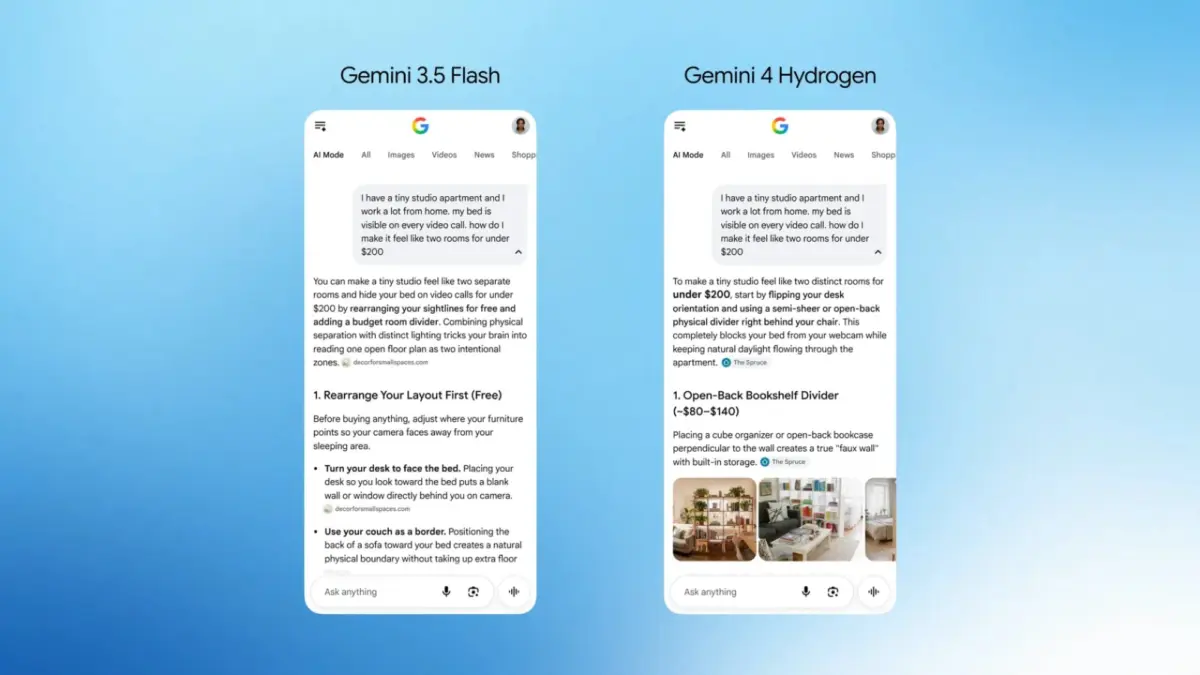
Google has officially announced the launch of Gemini 4 Hydrogen, its latest artificial intelligence model designed to prioritize rapid execution and everyday productivity. Adapted from the architecture of Gemini 4 Carbon and engineered specifically for speed, Google claims that the new model even surpasses its heavyweight frontier counterpart, Gemini 4 Argon, when operating on its default thinking level.
The introduction of Gemini 4 Hydrogen marks a significant step forward in Google’s ongoing strategy to diversify its artificial intelligence ecosystem. By tailoring models to specific operational tiers, the company aims to offer users and developers the right tool for every conceivable digital workload, ranging from resource-intensive logical reasoning to fast-paced, routine assistant tasks.
According to Google DeepMind, the new model is explicitly optimized for efficient execution across various agentic workflows. "While our frontier models, Gemini 4 Carbon and Gemini 4 Argon, excel at deep, long-horizon reasoning on your hardest problems, Hydrogen is built for rapid execution across diverse agentic workflows," wrote Koray Kavukcuoglu, senior vice president at Google DeepMind, in Thursday’s official announcement.
Rather than focusing on complex software architecture design or the painstaking isolation of obscure code bugs, Gemini 4 Hydrogen is intended to quickly execute straightforward daily operational tasks. These include writing functional code snippets, running standard tests, and accelerating common everyday work routines.
To accommodate varying user needs and cost considerations, the model features adjustable reasoning thresholds. Set to a "high" thinking level by default, Hydrogen can be scaled down to low or medium settings depending on the latency and quality required for a specific task. Furthermore, Google has introduced a new "xhigh" tier, allowing users to fine-tune the model’s depth of processing.
Kavukcuoglu emphasized the model’s versatility within broader technological ecosystems, noting that it is built to function independently as a reliable daily assistant or to seamlessly collaborate alongside Carbon and Argon. In more complex multi-model workflows, Hydrogen is positioned to act as the high-efficiency execution engine, handling the heavy lifting of quick output generation while the heavier models tackle deep conceptual problems.

The rollout of Gemini 4 Hydrogen is taking place globally starting today, bringing immediate changes to how millions of people interact with Google Search. The model is now actively powering the AI features embedded directly into Google Search for all users worldwide. Additionally, it is becoming available as an optional selection within the model dropdown menu of the standalone Gemini application.
Prior to this launch, Google Search’s conversational and generative AI capabilities were driven by Gemini 3.8 Flash, which originally debuted in September. The transition to Hydrogen brings several noticeable enhancements to the search experience. Kavukcuoglu stated that the new model responds to user queries with richer, more visual outputs, alongside a significantly wider variety of contextually relevant links to help users find information faster.
Moreover, Gemini 4 Hydrogen has been refined to better interpret conversational prompts and closely follow a user’s train of thought, demonstrating a heightened capability to understand minor typing errors and colloquial phrasing. This improvement translates into a smoother interaction loop that requires less manual correction.
"Gemini 4 Hydrogen makes it easier to get things done, staying on track and following instructions more closely across multi-turn conversations," said Kavukcuoglu. "In the Gemini app, Hydrogen makes your everyday assistant even more helpful — it’s better at following your guidance, calling the right tools, and getting you to a reliable output with less back-and-forth."
Beyond usability improvements, Google has placed considerable emphasis on the safety and reliability architecture of Gemini 4 Hydrogen. Compared to its predecessor, 3.8 Flash, Google reports that the new model is twice as secure against attempts to circumvent established permission boundaries.
The company acknowledges that safety work remains an ongoing commitment, noting that engineering teams are actively continuing to enhance the model’s resilience against jailbreak attempts and adversarial inputs. At the same time, Google candidly notes that, much like all existing generative artificial intelligence agents across the broader tech industry, Gemini 4 Hydrogen is still inherently susceptible to occasional hallucinations when generating text and processing ambiguous inputs.