
As the global Internet community approaches a critical operational milestone, administrators and network operators are turning their attention to the upcoming transition of the Domain Name System (DNS) root key. Scheduled for October 11, 2026, this scheduled key roll represents a fundamental administrative event for the underlying security architecture that keeps web navigation, email routing, and digital communications functioning securely across the globe.
Unlike routine cryptographic updates within standard subdomains, rolling the DNS root key is a uniquely complex procedure. Within the framework of the DNS Security Extensions (DNSSEC), nearly every cryptographic key relies on a designated parent key to validate its authenticity. For a Zone-Signing Key, validation is handled by the zone’s Key-Signing Key, while subordinate keys are verified through signed Delegation Signer resource records published in parent zones.
The root key, however, stands entirely alone. Because the root zone has no parent, traditional top-down validation paths do not apply. Instead, a new root key must be authenticated through a process where the old key signs the new key, followed by an extended observation period to allow DNSSEC-validating resolvers worldwide to safely discover and trust the incoming credential.

According to RFC 5011, which governs trust anchor updates, resolvers must observe an add hold-down time of at least 30 days or match the original Time-to-Live expiration of the first resource record set containing the new key. This requirement ensures that resolvers encounter multiple validated records featuring the incoming key before accepting it into local trusted caches. When proper hold-down periods are respected throughout each phase, the entire rollover sequence is designed to proceed automatically.
The 2026 event does not introduce a new cryptographic algorithm; rather, it is a straightforward update of the public and private key pair governing the root zone. The incoming Key-Signing Key, designated as KSK-2024, was published by the Internet Assigned Numbers Authority (IANA) in July 2024 and integrated into the root zone’s DNSKEY resource record in January 2025. Following a multi-year preparation window, IANA is scheduled to perform the rollover, applying KSK-2024 to generate digital signatures for the root zone’s DNSKEY record set.
As the implementation date draws near, critical questions remain regarding global preparedness. Specifically, network engineers and researchers must determine whether recursive resolvers operated by internet service providers and enterprises have successfully incorporated KSK-2024 into their local trust anchor sets. Measuring this adoption requires specialized techniques capable of peering into the broader Internet infrastructure.
Trust Signal and Measurement Methodologies

Network researchers rely on two primary mechanisms to evaluate whether recursive resolvers have integrated KSK-2024 into their trusted configurations. The first technique is outlined in RFC 8145, which details methods for signaling trust anchor knowledge in DNSSEC. Under this approach, a validating resolver embeds the key tags of its trusted verification keys directly into queries sent toward authoritative root servers. These tag values can be encoded within the query name itself or transmitted through the edns-key-tag option.
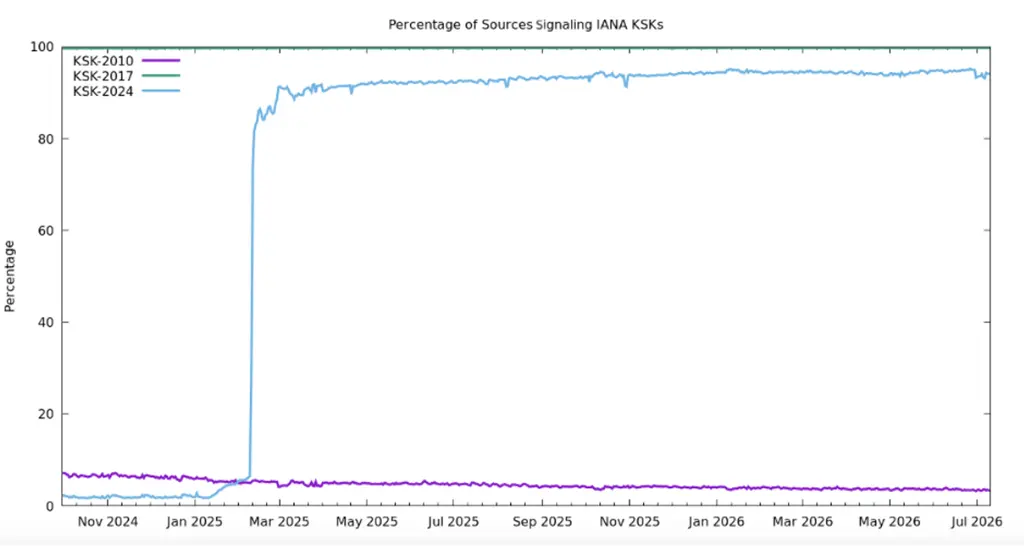
Data collected from these queries is visible within the operational logs managed by root server administrators. Analyses conducted by major root infrastructure operators, such as Verisign, provide broad sampling data regarding resolver trust anchor configurations. While these logs indicate that a significant majority of reporting resolvers have successfully added KSK-2024 to their local collections, raw server query counts do not automatically translate into accurate estimates of the underlying end-user populations relying on those resolvers. Some validating resolvers serve millions of active users, while others support only a single device.
To address the need for user-centric visibility, RFC 8509 introduced an alternative measurement approach known as the Root Key Trust Anchor Sentinel. This mechanism folds the measurement signal back toward the querier rather than forwarding it onward to the root zone infrastructure. By encoding specific query labels that prompt designated responses based on whether a resolver trusts a particular key tag, administrators can test resolver behaviors directly.
Researchers at APNIC utilize an ad-based measurement system to issue these queries to collections of active end users daily. Rather than isolating individual recursive resolvers, this methodology quantifies the proportion of users situated behind validating resolvers that have failed to adopt KSK-2024. The diagnostic process involves multiple queries designed to verify whether a resolver supports the sentinel mechanism and whether it recognizes specific key tags, such as the legacy 2017 key and the incoming KSK-2024 credential.
Observing Global Adoption Trends
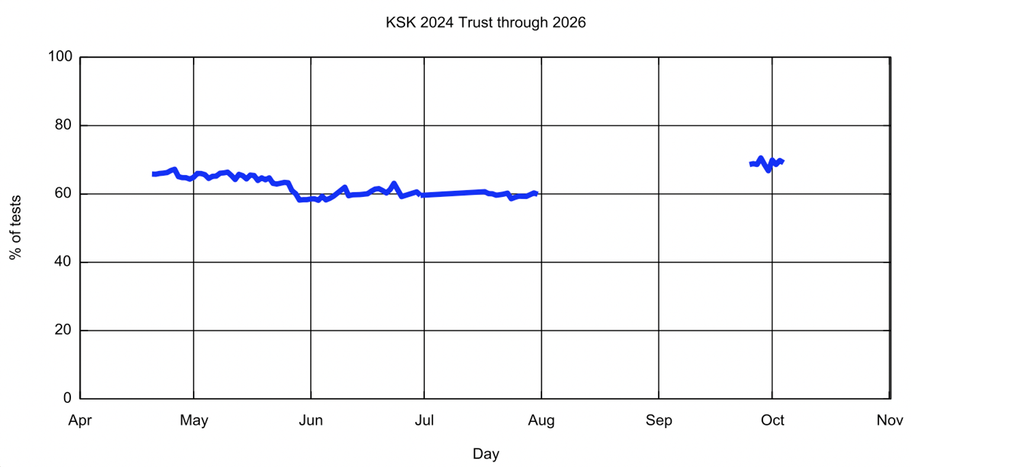
Preliminary small-scale testing utilizing RIPE Atlas probes across thousands of distinct autonomous systems demonstrated that a large portion of tested infrastructure exhibited behavior consistent with successful trust anchor updates, though a minority of probes revealed lagging configurations. Broader measurement campaigns conducted throughout 2026, averaging roughly 16 million tests per day, provide a more comprehensive view of global progress.
Out of millions of daily evaluations, a distinct subset of tests identifies end systems operating behind DNSSEC-validating recursive resolvers that actively support the RFC 8509 sentinel mechanism. Aggregate data from these larger samples indicates that approximately 70% of reporting resolvers have successfully loaded KSK-2024 into their trusted key stores.
While aggregate figures offer a high-level overview, global averages obscure significant regional and network-specific disparities. A closer examination of measurement logs reveals specific autonomous systems and internet service providers where adoption rates remain notably lower than the global average.
Network-level data highlights numerous telecommunications providers across various regions—spanning parts of Latin America, Africa, South Asia, Southeast Asia, the Middle East, and parts of Europe and North America—where substantial portions of observed tests indicate that local DNS resolvers have not yet incorporated KSK-2024. For instance, large operators in countries such as Costa Rica, Eswatini, South Africa, Sri Lanka, Thailand, Bangladesh, Mauritania, Djibouti, Libya, India, the Philippines, Myanmar, Armenia, Ukraine, the United States, the Netherlands, Iceland, Algeria, Pakistan, Czechia, Australia, Iraq, Canada, Switzerland, Saudi Arabia, Malaysia, Luxembourg, Angola, Botswana, Oman, Madagascar, Bulgaria, and Azerbaijan register varying degrees of lag in their adoption metrics.
If recursive resolvers managed by these network operators fail to complete their trust anchor updates prior to the operational transition, end users relying on those networks may encounter resolution failures or security validation errors when attempting to access domains protected by DNSSEC. Network administrators and subscribers who identify low adoption metrics within their local providers are encouraged to utilize available public testing tools and coordinate with their network service providers to review and update their DNS infrastructure settings accordingly.
Leave a Reply