
The global Domain Name System (DNS) has successfully navigated another major cryptographic transition. Following the October 11, 2026, DNS root Key Signing Key (KSK) rollover, newly released measurement data reveals that the global infrastructure largely absorbed the shift without major disruptions. Utilizing advertisement-based measurement networks and the KSK Sentinel signal, network analysts have been able to track precisely which autonomous systems and regional economies successfully adapted to the rolling of the root key, providing a comprehensive look at the health of modern internet security infrastructure.
This latest update follows previous operational briefings published in May and early October ahead of the scheduled root KSK rollover. The core mechanism used to monitor these developments is the KSK Sentinel signal, which allows researchers to observe whether validating resolvers have successfully tracked and adopted the rolling of the root cryptographic keys. By analyzing data collected across the first sixteen days of October, engineers gained a clear picture of how recursive resolvers behaved before, during, and immediately after the transition occurred at 14:00 UTC on October 11.

In the critical 48-hour window following the start of the roll—a timeframe designed to account for the standard cached lifetime of root zone DNSKEY records in validating resolvers—daily measurement ad presentation rates remained entirely within normal operational parameters. Prior to the event, validating resolvers relied on trust in the outgoing KSK. Once local caches refreshed before the afternoon of October 13, those same resolvers were required to trust the incoming KSK to perform successful validation operations.
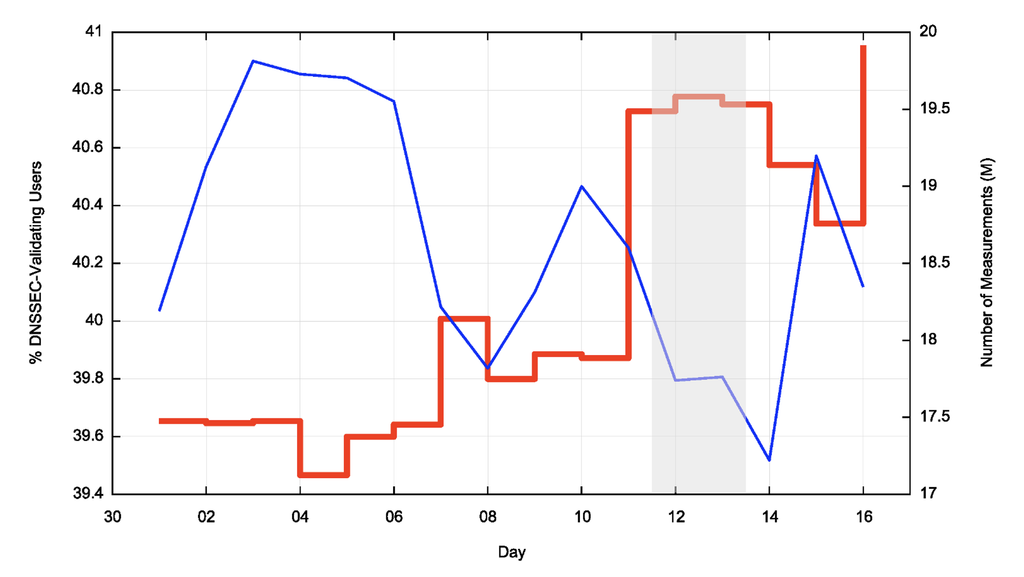
Global metrics indicate that the overall DNSSEC validation rate experienced a slight upward tick, moving from a pre-roll average of 39.7 percent to a post-roll average of 40.6 percent. Globally, this net positive outcome confirms that the KSK was rolled successfully, averting any catastrophic DNS outages. This smooth transition stands as a testament to the years of collaborative development, standardization, software implementation, and proactive deployment carried out by operators and developers worldwide.
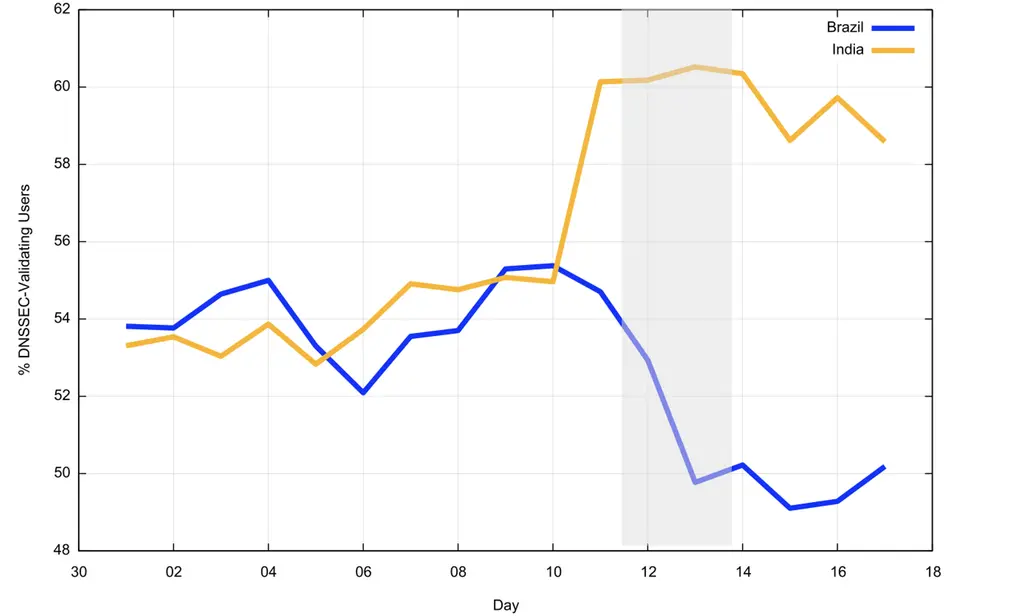
However, global averages can frequently mask distinct regional variations and individual network behaviors. A closer examination of specific economies with high concentrations of DNSSEC-validating users reveals diverging trends. India and Brazil, for instance, both feature substantial populations of internet users served by ISP-provisioned recursive resolvers that actively perform DNSSEC validation, making them vital case studies for the rollover’s operational impact.

Proactive outreach played a decisive role in shaping outcomes in certain regions. On October 9, network researchers successfully contacted a major Indian internet service provider after KSK Sentinel telemetry indicated their resolvers had not yet established local trust in the incoming KSK, putting them at risk of validation failure. Prompt action by the operator allowed them to correct their configurations in time, helping drive the DNSSEC validation rate among measured users in India from 55 percent to 59 percent across the rollover period.
Unfortunately, similar proactive outreach attempts directed at select Brazilian ISPs encountering comparable telemetry signals did not yield the same preventive adjustments. As a result, the measured DNSSEC validation rate in Brazil experienced a decline, dropping from 54 percent prior to the roll to 50 percent in the days following the key transition.
Attention was also directed toward a subset of networks that had previously raised red flags. An earlier analysis published at the start of October identified fifty distinct networks exhibiting the lowest rates of acceptance for the incoming key, despite showing support for the Key Sentinel mechanism. Tracking these specific networks through October 18 revealed an unexpected turn of events: none of them were stranded or knocked offline when the KSK rolled. Every single one of these fifty networks successfully integrated the new KSK into their trusted key sets during the narrow window between October 7 and October 13. While such uniform, corrective behavior is highly unusual within the typically fragmented environment of the global DNS, it ultimately averted widespread connectivity failures for those user bases.
Broader analysis of DNSSEC validation outcomes across more than 13,500 networks—each capturing an average of twenty samples per day before and after the roll—highlighted localized shifts in operational security configurations. A small subset of thirty-five networks recorded a dramatic positive shift in validation rates exceeding 50 percent, likely reflecting configurations that had pre-configured trust in the incoming KSK while dropping the incumbent key. Expanding the criteria to a ten percent threshold identified 594 networks with notable increases in validation. Conversely, fifty-eight networks saw validation rates drop by 50 percent or more, while 660 networks experienced declines of ten percent or greater.
By mapping these network-level changes against established estimates of regional user populations, analysts were able to gauge the human impact of the rollover. Out of a total estimated global user base exceeding 4.3 billion, the population utilizing DNSSEC-validating resolvers stood at roughly 1.65 billion prior to the transition. Following the roll, that figure climbed by approximately 45.8 million, bringing the total population behind validating resolvers to over 1.7 billion users.
Regionally, the largest net gains in validating user populations were led by India, which saw an increase of over 45.4 million validating users, followed by Viet Nam with an increase of roughly 9.1 million. Other economies registering notable net growth included Algeria, Morocco, Kazakhstan, Slovakia, Iran, Thailand, Sri Lanka, and Lithuania.
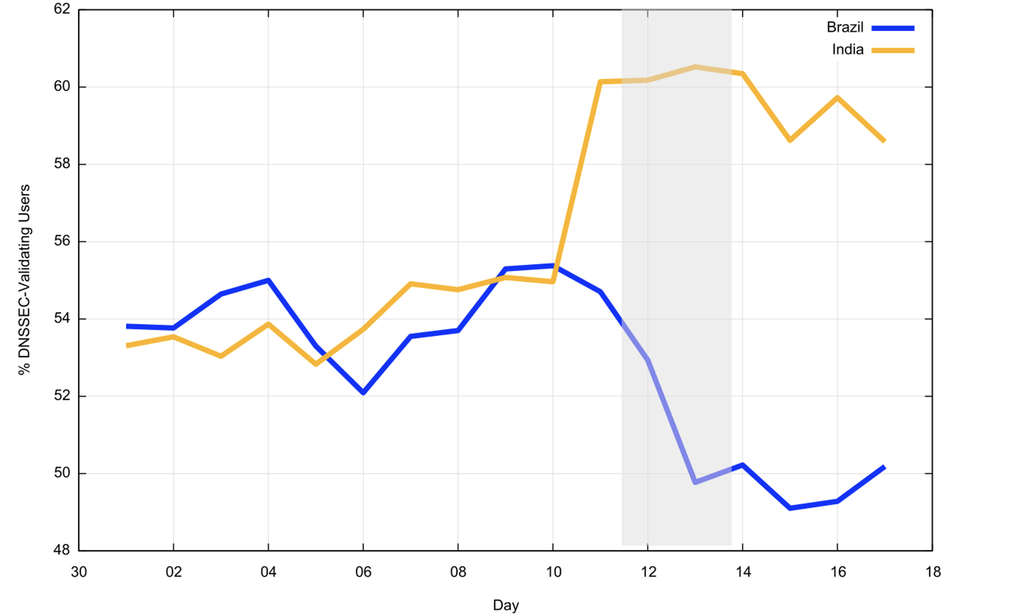
Conversely, certain regions experienced notable contractions in their validating user counts following the key roll. Brazil recorded the largest net drop, with a decrease of nearly 7.8 million validating users, followed by the Russian Federation with a reduction of roughly 3.1 million. Additional economies observing declines included China, the United States, Bulgaria, Bangladesh, Japan, Uganda, Pakistan, and Egypt.
Evaluating the overarching success of an infrastructure event as vast as a root KSK rollover requires a realistic framework. The DNS operates as a massively distributed yet loosely coupled system where precise, synchronized coordination is practically impossible. Because minor variations and friction are inevitable, assessments of success must account for this inherent decentralization. Measured against these realities, the data gathered from the October 2026 root key rollover confirms that the operation was a resounding success, demonstrating the resilience and maturity of the global domain name system.


Leave a Reply