
As the internet infrastructure community prepares for a major scheduled transition, network operators and researchers are closely monitoring the global adoption of the incoming Domain Name System Security Extensions (DNSSEC) root key. With the root key rollover scheduled for October 11, 2026, technical teams worldwide are evaluating how successfully recursive resolvers have integrated the new cryptographic key into their local trust anchor sets. Unlike subordinate keys within the Domain Name System, the root key lacks a parent key, making its annual or periodic rollover a unique administrative challenge that requires careful measurement and automated trust updates.
To understand the mechanics of this transition, it helps to examine how DNSSEC validation typically functions. In a standard hierarchical DNS structure, every key relies on a parent key to validate its authenticity. A Zone-Signing Key is authenticated by the zone’s Key-Signing Key, while a Key-Signing Key is verified by entries signed within the parent domain. For these subordinate keys, validation simply requires the parent key to sign across the new key value, typically published as a signed Delegation Signer resource record in the parent zone.
The root zone presents a distinct scenario because it sits at the absolute apex of the hierarchical tree and possesses no parent zone. Consequently, authenticating a new root key requires the old Key-Signing Key to sign across the incoming Key-Signing Key. This process, often described simply as the old key signing the new key, initiates an extended waiting period designed to give DNSSEC-validating clients sufficient time to discover, retrieve, and implicitly trust the incoming cryptographic material.
Guidance for managing this delicate operational phase is outlined in RFC 5011, titled "Trust Anchor Update." The specification mandates a specific hold-down interval before a new trust anchor can be officially adopted by a validating resolver. According to the standard, the add hold-down time is set to thirty days or the expiration time of the original Time-To-Live of the first trust point resource record set that contained the new key, whichever period is greater. This requirement guarantees that resolvers observe at least two validated resource record sets containing the new key before accepting it into local secure storage.

When the new Key-Signing Key is added to the root zone’s resource record set, validating resolvers automatically encounter the updated data during routine zone retrievals. Once the new key has been observed continuously throughout the mandatory thirty-day hold-down interval, compliant resolvers append the key value to their local cache of trusted keys. When these minimum observation periods are strictly respected across every stage of the rollout, the entire cryptographic key rollover is designed to proceed automatically without manual intervention.
The 2026 rollover does not introduce a new cryptographic algorithm; rather, it represents a straightforward update of the private and public key pair. The incoming Key-Signing Key, designated as KSK-2024, was published on the official Internet Assigned Numbers Authority website in July 2024 and subsequently integrated into the root zone’s resource record set in January 2025. With the operational timeline pointing toward October 11, 2026, the Internet Assigned Numbers Authority prepared to deploy KSK-2024 to generate the authoritative digital signature for the root zone’s resource record set.
As the industry approached this milestone, network architects naturally raised questions regarding ecosystem preparedness. Specifically, researchers wanted to know whether recursive DNSSEC-validating resolvers had successfully learned of KSK-2024 and incorporated the asset into their local trust anchor sets. Answering this question required sophisticated measurement techniques capable of peering deeply into the global DNS infrastructure to track resolver behavior without disrupting live traffic.
Trust Signal and RFC 8145 Measurement
Network measurement specialists rely on two primary techniques to evaluate which recursive resolvers have successfully incorporated KSK-2024 into their trust anchor collections. The first approach is detailed in RFC 8145, known as "Signaling Trust Anchor Knowledge in DNS Security Extensions." Under this methodology, a validating resolver embeds the key tags of its currently trusted keys directly into routine queries dispatched toward the authoritative servers responsible for the root zone.

One implementation of this signaling mechanism appends the tag values of all trusted keys directly into the query name itself. For example, a query formatted as a specific string containing unique identifier tags indicates to root operators that the originating resolver recognizes and trusts particular key identifiers. An alternative approach embeds these trusted key tag values directly within an EDNS key tag option contained inside the query packet.
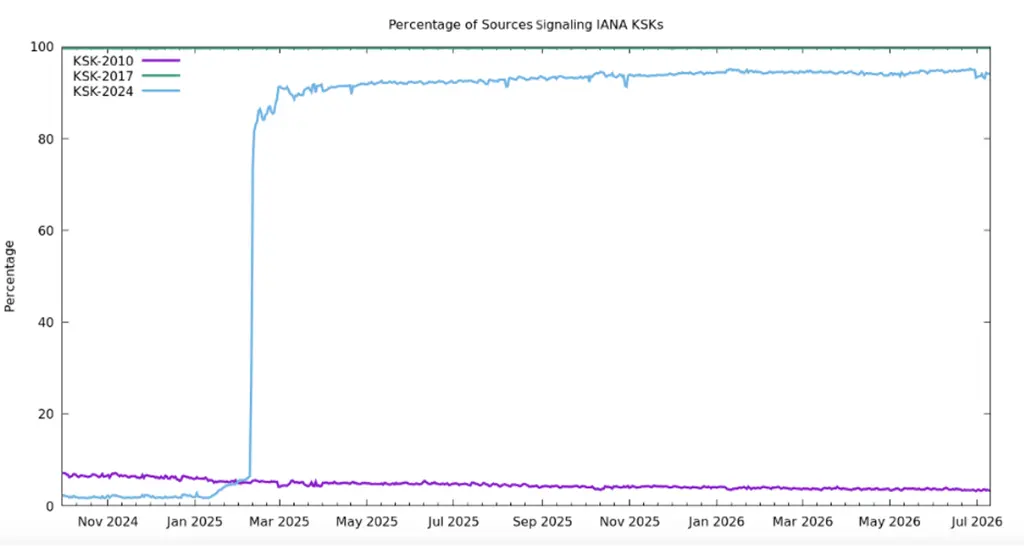
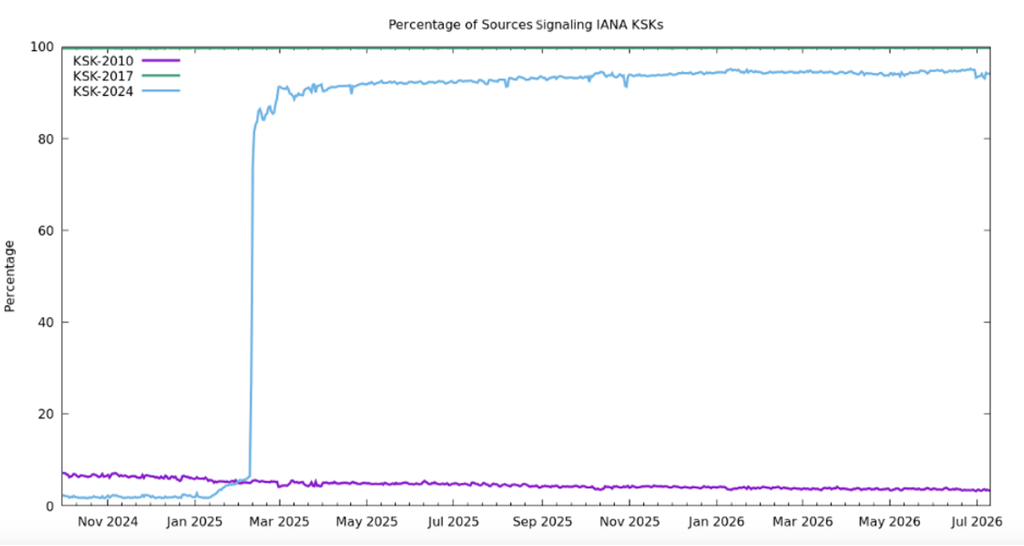
This diagnostic information is readily observable within the query logs managed by root server operators, such as Verisign, which continuously analyze incoming telemetry to gauge global trust anchor deployment. While these server-side log analytics provide valuable macroscopic visibility into resolver behavior, they present certain analytical limitations. Specifically, raw query counts do not reflect the actual human population sitting behind each recursive resolver. While some validating resolvers handle traffic for millions of end users across massive enterprise or public networks, others serve only a single machine. Even with these limitations, server telemetry gathered ahead of the rollover indicated that approximately ninety percent of reporting resolvers had successfully added KSK-2024 to their trust anchor sets. However, this metric did not translate directly into a precise count of end users potentially vulnerable to validation failures.
To address the need for user-centric visibility, RFC 8509 introduced an alternative methodology titled "A Root Key Trust Anchor Sentinel for DNSSEC." This specification proposes a mechanism where the signal reflecting a recursive resolver’s trusted keys is folded back and returned directly to the querier rather than passing onward to a root server. The technique utilizes the leftmost label of a DNS query name, requiring the local resolver to recognize the specialized label structure and formulate a response dictated by its internal set of trusted keys.
If a resolver trusts a specific key tag queried via the sentinel mechanism, it returns a normal, successful DNS response. Conversely, if the resolver does not trust the specified key, it responds with a server failure status. Operators and network administrators can run these targeted diagnostics on their own infrastructure using specialized web pages provided by industry entities such as Cloudflare.
Researchers at APNIC utilized an advertisement-based measurement system to pose these specialized diagnostic queries to collections of end users on a daily basis. Rather than attempting to isolate individual recursive validating resolvers, this technique quantifies the exact proportion of end users situated behind validating resolvers that have failed to adopt KSK-2024. The underlying test framework relies on a series of distinct queries designed to evaluate both resolver support for the sentinel mechanism and the presence of specific key tags within local trust stores.
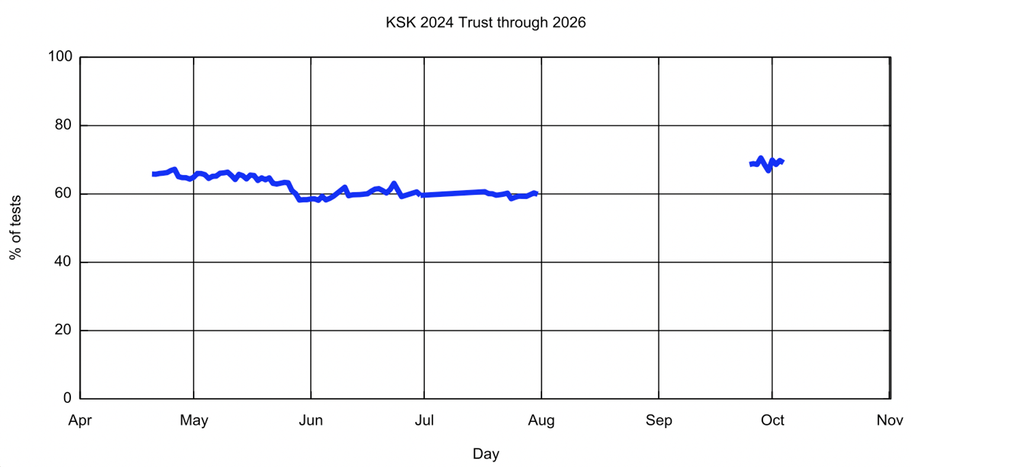
Initial testing utilizing RIPE Atlas probes across thousands of distinct autonomous systems revealed that a substantial majority of tested probes exhibited resolver behaviors consistent with a root key sentinel that had successfully loaded the new key. Conversely, a small subset of probes displayed operational characteristics indicating that the incoming key value had not yet been integrated into local trusted key collections. Expanded ad-based measurement campaigns conducted throughout mid-2026, averaging roughly sixteen million tests per day, provided a comprehensive view of global adoption trends.
Results and Regional Adoption Patterns
The broader measurement datasets revealed that approximately seventy percent of tests supporting the RFC 8509 sentinel mechanism confirmed that KSK-2024 had been successfully loaded as a trusted key. However, analyzing these massive daily sample sizes revealed significant operational nuances. Out of millions of daily tests, only a fraction originated from end systems operating strictly behind DNSSEC-validating recursive resolvers, and a further subset provided clean telemetry confirming active support for the root key sentinel mechanism.
Because global averages obscure critical regional variations, network researchers compiled detailed breakdowns highlighting specific Internet Service Provider networks where sentinel tests indicated low rates of KSK-2024 adoption. Analysis of networks meeting specific testing thresholds revealed notable disparities across different geographies, involving prominent telecommunications operators and regional carriers spanning multiple continents.
For instance, networks operated by major telecommunications providers in countries such as Costa Rica, Eswatini, South Africa, Sri Lanka, Thailand, Bangladesh, Mauritania, Djibouti, Libya, India, the Philippines, Myanmar, Armenia, Ukraine, the United States, the Netherlands, Iceland, Algeria, Pakistan, Czechia, Australia, Iraq, Canada, Switzerland, Saudi Arabia, Malaysia, Luxembourg, Angola, Botswana, Oman, Madagascar, Bulgaria, Azerbaijan, and Reunion exhibited varying degrees of lag in adopting the new trust anchor.
In several of these autonomous systems, a significant percentage of validating resolver tests returned signals showing that KSK-2024 had not been incorporated into local key stores. Such findings suggested that localized administrative oversights, outdated resolver software versions, or delayed firmware updates by equipment vendors could leave portions of the subscriber base vulnerable to resolution failures once the root key rollover took effect.
Network operators whose autonomous systems appeared on telemetry watchlists were encouraged to utilize diagnostic testing scripts and work alongside their upstream providers to review local DNS configurations. Ensuring that recursive resolvers are fully synchronized with modern cryptographic standards remains a critical responsibility for network administrators seeking to prevent widespread connectivity disruptions for end users relying on secure, validated domain name resolution.
Leave a Reply