
In recent years, French courts have increasingly ordered internet intermediaries to block access to unauthorized sports streams. While these mandates traditionally targeted standard Internet Service Providers, judicial enforcement has rapidly expanded to encompass public domain name system (DNS) resolvers, virtual private network services, search engines, and content delivery network providers—all of which possess the technical capacity to help users bypass initial blockades.
Internet infrastructure and security giant Cloudflare has found itself frequently targeted by these legal actions. In April, the Paris Judicial Court ordered the company to block a combined 37 domains linked to unauthorized broadcasts of Formula 1 and MotoGP events. The mandate covered both Cloudflare’s popular public DNS resolver and its CDN services. However, the court’s initial directive did not prescribe a mandatory technical method for achieving the blockade, instructing Cloudflare instead to prevent access from France "by any effective means."
French pay-TV heavyweight Canal+, which originally requested the blockades, quickly concluded that Cloudflare’s compliance efforts fell short of expectations. Displeased with the scope of the implementation, the broadcaster returned to court seeking substantial financial penalties.

Canal+ Requests Stiff Daily Penalties
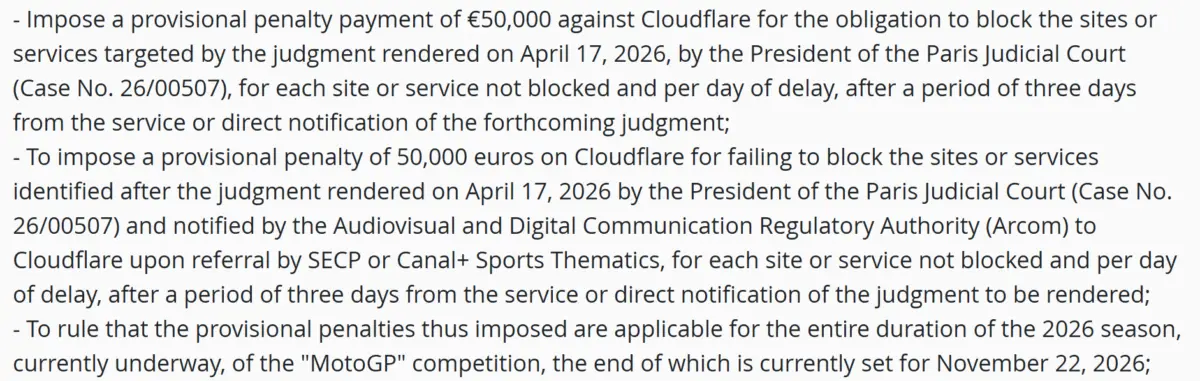
Seeking to enforce stricter compliance, Canal+ asked the Paris Judicial Court in May to impose retroactive daily penalties tied to the April orders. The broadcaster demanded a penalty of €50,000 per day for every targeted domain that remained accessible, alongside the same daily fee for any newly discovered pirate site reported to Cloudflare by France’s media regulator, Arcom.
According to legal arguments presented by Canal+, Cloudflare had deliberately failed to comply fully with the spirit and letter of the site-blocking injunctions. Canal+ asserted that Cloudflare circumvented the core measures by exclusively implementing the blocks through its CDN service. As a result, the broadcaster claimed that only three of the 21 domain names listed in the Formula 1 injunction were successfully blocked.
A similar outcome was reported in the MotoGP case, where Canal+ counted only three blocked domains out of 16. Furthermore, the broadcaster argued that even those limited blocks proved ineffective over time, noting that two of the three initially blocked sites managed to reappear online within a week—one by switching to a competing CDN provider and another by migrating to an alternative mirror site.

The Court Rules in Favor of Cloudflare
On September 17, a panel of three judges delivered a definitive ruling on both penalty requests, ultimately siding with Cloudflare. Throughout the proceedings, Cloudflare pointed to substantial technical constraints that prevented it from implementing blocks via its public DNS resolver, emphasizing that the court’s original order had explicitly left the choice of service up to the company as long as it meaningfully contributed to anti-piracy efforts.
The court acknowledged that it was undisputed that Cloudflare exclusively implemented the mandated measures by blocking content through its CDN service whenever targeted websites utilized that specific infrastructure.
Cloudflare defended this architectural limitation by arguing that CDN-level blocking is vastly more effective than attempting to manipulate its public DNS resolver. Furthermore, the company maintained that the underlying architecture of its global public DNS resolver simply does not support targeted content blocking, rendering such demands technically unreasonable and disproportionate.
While Canal+ argued that Cloudflare had failed to block a significant portion of the ordered domains, the court interpreted the company’s actions as evidence of a genuine, good-faith willingness to help curb copyright infringement. The judicial panel also dismissed Canal+’s assertions regarding site migration, ruling that Cloudflare could not be held legally responsible when clever site operators elected to switch to alternative CDN providers or deploy redirect mechanisms to mirror domains.
According to the court, the burden rests squarely on rightsholders like Canal+ to pursue newly appointed intermediaries and report emergent mirror sites to regulatory authorities like Arcom.
Addressing arguments concerning European Union case law, Canal+ pointed to the landmark UPC Telekabel Wien ruling by the EU Court of Justice, arguing that it obligates intermediaries to enforce absolute blocking efficacy. The Paris court rejected this narrow interpretation, concluding instead that EU jurisprudence only requires intermediaries to implement reasonable measures—a threshold the judges determined Cloudflare had successfully met through its CDN interventions.
Consequently, the court dismissed the requested daily penalties, deeming them neither necessary nor proportionate. Canal+’s separate request for €20,000 in legal costs was similarly denied.

The 1.1.1.1 Resolver Remains Block-Free
As a direct result of the ruling, Cloudflare avoids financial penalties despite its public DNS resolver, known as 1.1.1.1, continuing to provide unhindered access to the disputed domains. This outcome aligns with Cloudflare’s long-standing corporate policy of maintaining neutrality within its public DNS network.
In recent transparency reports, Cloudflare has repeatedly confirmed that it has not instituted content blocking via the 1.1.1.1 public DNS resolver, despite receiving distinct judicial orders from courts in both France and Italy. Company disclosures note that while the public resolver remains untouched, its CDN infrastructure has been extensively utilized for geoblocking operations. During the second half of the previous year, Cloudflare geoblocked 1,238 domains in France under a single court order, following another 662 domains restricted across seven distinct orders earlier in the year.
Cloudflare recently articulated this operational philosophy to the European Commission during consultations for the EU Counterfeit and Piracy Watch List. In its submission, the company argued that global public DNS resolvers are fundamentally unsuited for content blocking or access restriction mandates.

Instead, Cloudflare champions its proprietary real-time pirate stream mitigation program. This system enables vetted rightsholders to flag unauthorized live streams running across Cloudflare’s network, allowing the company to disrupt the broadcasts within seconds without relying on blunt DNS or IP address blocking mechanisms.
For live transmissions where operational speed is paramount, Cloudflare maintains that targeted network mitigation offers a far superior remedy compared to traditional judicial blocking orders directed at foundational internet infrastructure.
While this latest ruling provides legal breathing room for Cloudflare, the broader legal battle over internet infrastructure liability remains active. Canal+ retains the right to appeal the Paris court’s decision, signaling that the ongoing friction between broadcasters and technical intermediaries is far from over.
Meanwhile, other infrastructure providers face similar high-stakes legal pressures in France. Non-profit public DNS resolver Quad9 is currently navigating a parallel, potentially severe penalty dispute initiated by sports broadcaster beIN Sports over its refusal to implement pirate content blocks on its DNS service. A judicial decision regarding Quad9’s case is anticipated later this month, promising further clarity on the legal boundaries governing neutral internet utilities in Europe.


Leave a Reply