
A Paris court has dealt a significant blow to French pay-TV giant Canal+, dismissing its attempts to impose steep daily financial penalties against internet infrastructure firm Cloudflare over anti-piracy website blocks.
Over the past two years, French courts have increasingly ordered a diverse array of internet intermediaries to block access to unauthorized sports streams. In addition to traditional Internet Service Providers (ISPs), these judicial orders now frequently target public DNS resolvers, virtual private network (VPN) services, search engines, and Content Delivery Networks (CDNs)—all of which can potentially assist users in bypassing preexisting network blockades.
Cloudflare, a major global internet infrastructure and security company, has been repeatedly subjected to these legal directives. In April, the Paris Judicial Court ordered the firm to block dozens of domains associated with unauthorized broadcasts, specifically targeting 21 domains linked to Formula 1 streams and 16 linked to MotoGP.

The scope of those court orders encompassed both Cloudflare’s public DNS resolver service and its CDN network. However, the directives intentionally avoided prescribing exact technical methods for how the sites must be blocked, specifying only that access from within France had to be prevented "by any effective means."
Canal+, the broadcaster that originally requested the broad blockades, quickly concluded that Cloudflare’s technical compliance efforts fell short of expectations. Unhappy with the results, the broadcaster returned to court seeking stricter enforcement mechanisms and heavy financial repercussions, a development first uncovered by legal and technology publication L’Informé.
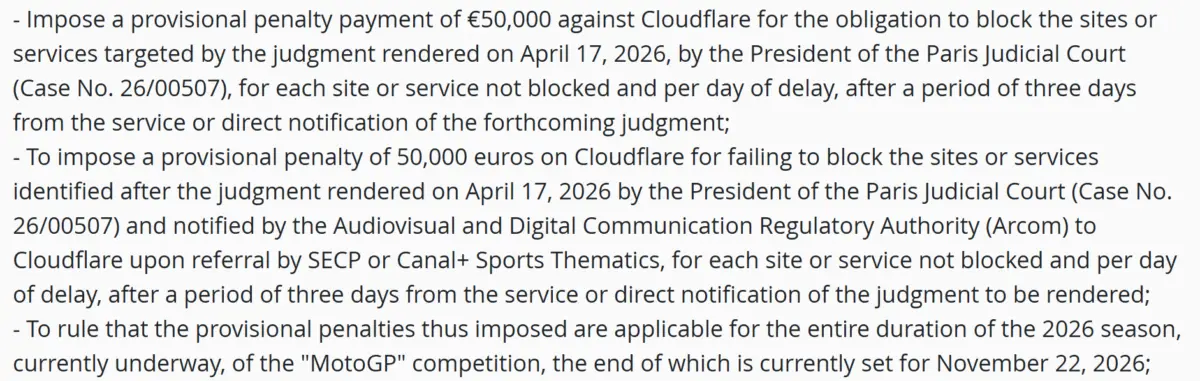
Canal+ Requested €50,000 a Day
In May, Canal+ petitioned the Paris judicial authorities to attach daily financial penalties to the original April injunctions. The broadcaster demanded a penalty of €50,000 per day for every targeted domain that remained accessible to internet users in France, alongside the exact same daily fine for any new pirate site that the French media regulator Arcom subsequently reported to Cloudflare.

According to legal arguments presented by Canal+, Cloudflare had deliberately failed to comply fully with the spirit and letter of the site-blocking mandates. Canal+ argued that Cloudflare allegedly circumvented the measures by exclusively implementing the decisions through its CDN service. As a result, the broadcaster claimed that only three of the 21 domain names listed in the Formula 1 court order were actually blocked.
A similarly low compliance rate was cited in the MotoGP case, where Canal+ counted just three blocked domains out of the 16 ordered by the court. Furthermore, the broadcaster noted that the enforcement proved fleeting, asserting that two of the three initially blocked sites managed to return online within a single week. According to Canal+, one of those recidivist sites simply switched to a different CDN provider, while the other quickly established operations via a mirror site.
Court Sides With Cloudflare
A panel of three judges reviewed the opposing arguments and formally issued their ruling on both penalty requests. During the proceedings, Cloudflare highlighted significant technical constraints inherent to its network architecture, explaining that these limitations only permitted practical compliance through its CDN layer. The company also heavily emphasized that the original court orders had explicitly left it free to choose which specific services to deploy, provided its actions contributed meaningfully to ongoing efforts to combat sports piracy.
The court acknowledged at the outset that the underlying method employed by Cloudflare to implement the blocking orders was not a matter of dispute between the litigants. The judicial panel noted that it was undisputed that Cloudflare exclusively implemented the ordered measures through its CDN service whenever targeted websites actually utilized that specific network infrastructure.
Cloudflare defended this approach by arguing that CDN-level blocking is incomparably more effective than attempting to filter traffic via public DNS. The company further maintained that the foundational architecture of its public DNS resolver—widely known as 1.1.1.1—fundamentally does not support localized content blocking, rendering such demands completely unreasonable and technically unfeasible.
While Canal+ argued that Cloudflare had failed to block nearly 28 percent of the ordered domain names, the court interpreted the remaining accessibility figures differently. Rather than evidence of deliberate evasion, the judges viewed the high percentage of blocked domains as proof of a genuine and good-faith willingness on Cloudflare’s part to help suppress copyright infringement. The court’s written decision did not elaborate on how this favorable interpretation reconciled with the specific numeric discrepancy regarding the three out of 21 domains initially cited by the broadcaster.
Furthermore, the judicial panel ruled that Cloudflare could not reasonably be held legally responsible when site operators actively evaded the blocks by migrating to competing CDN providers or establishing redirects to mirror domains. The court noted that once a site shifts its infrastructure, it becomes the legal responsibility of Canal+ to petition the new intermediary for a block and to formally report any newly discovered mirror sites to Arcom, the French media regulator.

Canal+ had also attempted to rely on established European Union jurisprudence, specifically pointing to the Court of Justice of the European Union’s landmark UPC Telekabel Wien ruling to argue that internet intermediaries are legally mandated to achieve absolute effectiveness in blocking operations. The Paris court firmly rejected this interpretation. In the judges’ view of the same EU ruling, intermediaries are only required to implement reasonable measures—a threshold that the court determined Cloudflare had successfully met through its targeted CDN blocks.
Consequently, the court dismissed the financial penalty requests submitted by Canal+, declaring them to be neither necessary nor proportionate under the circumstances. The judges also denied a separate request from Canal+ demanding €20,000 to cover legal costs associated with the failed penalty motions.
1.1.1.1 Stays Block-Free
As a direct consequence of the ruling, Cloudflare will not face punitive financial penalties under the current orders, allowing its public DNS resolver to remain entirely free of targeted website blocks. This outcome aligns closely with the company’s long-standing corporate policy and public assertions that it does not intentionally interfere with name resolution data on its public resolver network.

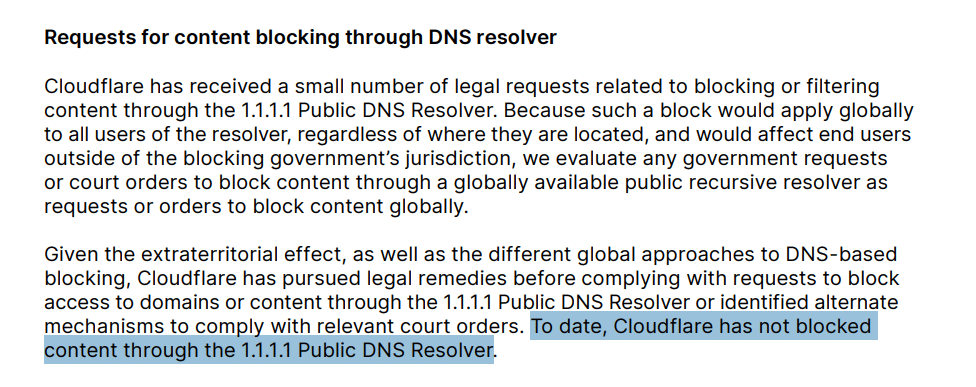
In recent transparency reports published by the company, Cloudflare has repeatedly confirmed that it has not implemented content blocking through the 1.1.1.1 Public DNS Resolver, despite receiving formal judicial orders to do so from courts in both France and Italy. Company reporting notes that while no content has ever been blocked via the public resolver, CDN-level geoblocking remains a regular operational activity necessitated by foreign court mandates. For instance, transparency data indicates that Cloudflare geoblocked 1,238 domains in France during the second half of the previous year under a single comprehensive court order, following 662 domain blocks executed across seven separate orders in the year’s opening months.
Cloudflare recently articulated this policy distinction directly to the European Commission during a formal consultation regarding the EU Counterfeit and Piracy Watch List. In its written submission, the infrastructure provider stressed that global public DNS resolvers should never be repurposed as tools for blocking or restricting internet access.
Instead, Cloudflare continues to advocate for its proprietary real-time pirate stream mitigation program. This system enables vetted rightsholder partners to directly flag unauthorized live streams running across Cloudflare’s network infrastructure. According to the company, these specific streams can be disrupted within seconds of a report, completely bypassing the need for cumbersome DNS or IP address blockades.
Cloudflare noted in its communication with the European Commission that for live content where speed is paramount, it has constructed real-time mitigation mechanisms that allow rightsholder partners to flag infringing broadcasts. When those streams transit through the company network, rapid action is taken within seconds.
For the time being, Cloudflare is legally permitted to continue restricting pirate domains strictly through its CDN infrastructure, leaving its 1.1.1.1 DNS resolver untouched. Because Canal+ retains the right to appeal the Paris court’s latest rulings, this legal battle may not have reached its final conclusion.
Meanwhile, other infrastructure providers face similar high-stakes legal pressures in France. The non-profit public DNS resolver Quad9 is currently confronting a potentially bankrupting penalty request from pay-TV broadcaster beIN Sports over its refusal to implement pirate content blocks on its own DNS infrastructure. A Paris court is expected to rule on that separate dispute in the near future.

Leave a Reply