The chief technology officer and co-founder of ransomwarehelp.com, a Florida-based business that spent six years marketing itself as a premier data recovery service utilizing "advanced cryptographic tools" to unlock systems held hostage by ransomware, has been formally charged with wire fraud. According to federal court documents, an FBI sting operation blew the lid off the enterprise, revealing that the company was doing nothing more than secretly paying the cybercriminals behind the attacks for decryption keys and then billing desperate victims astronomical markups for technical wizardry that was never actually performed.
The website for RansomwareHelp aggressively courted panicked victims with a bold public relations stance: "Do not pay the ransom!" The portal assured prospective clients that its proprietary cryptographic tools could restore 100 percent of locked data, servers, and systems back to their original format, rendering extortion demands completely obsolete.
"Our cryptography experts use proprietary tools and algorithms to achieve 100% data recovery, all backed by a success rate of over 99%," the website boasted to visitors, adding that the firm possessed more than 28 years of combined experience backed by a team of 80 specialists specializing in cryptography, cybersecurity, forensic analysis, and reverse engineering. To solidify its ethical facade, the site explicitly stated, "We never promote, intermediate or pay ransom to threat actors on behalf of our clients."
However, an indictment returned in federal court in Rhode Island shatters that illusion. The documents name the company’s co-founder as 52-year-old Juan Ricardo Palacio Escobar, who divides his time between Miami, Florida, and Medellin, Colombia. Investigators allege that Palacio routinely paid ransomware syndicates out of his own pocket to obtain decryption keys, and subsequently billed victim companies sums far exceeding his underlying acquisition costs. While Palacio’s indictment first surfaced via reporting by 404 Media, initial coverage omitted the name of the specific company involved in the alleged scheme.
The federal case against Palacio was cemented largely through a meticulously planned FBI sting operation. Law enforcement agents established a simulated victim company and concurrently operated a fictitious ransomware group. Posing as corporate victims of a severe cyberattack, the undercover investigators contacted RansomwareHelp and provided a copy of a fabricated ransom note, making it clear they preferred not to engage with or pay extortionists. RansomwareHelp responded by swiftly echoing its official corporate policy, assuring the "victims" that they strictly opposed negotiating with threat actors.
According to government filings, Palacio wasted little time reaching out to the fake ransomware group controlled by the FBI to negotiate the cheapest possible rate for a decryption key. The undercover agents operating the fake syndicate responded with an initial price tag of 0.2 bitcoin, which valued out to approximately $13,000 at the time. In less than 48 hours, Palacio allegedly contacted the agents posing as the victim company, claiming that a diagnostic assessment had been successfully completed and quoting a total decryption cost of $13,260.

The sting detailed how the scheme operated behind closed doors. The very next day, government documents allege, Palacio messaged the fictitious ransomware group run by the feds and attempted to drive the extortion demand down even further, asking to reduce the price of the decryption tool to $4,000. An agreed-upon price of roughly $6,000 in bitcoin was eventually struck with the undercover agents, yet Palacio turned around and invoiced the FBI’s fake victim enterprise a total of $16,010. That grand total included an initial $2,750 diagnostic fee stacked on top of the $13,260 decryption service fee.
The tactics deployed by RansomwareHelp left a trail of suspicious interactions with legitimate cybersecurity professionals who crossed paths with the firm’s clients. Paul Ihme, co-founder of the security firm Soteria, recalled being contacted in 2024 by a small accounting firm that had already paid RansomwareHelp a diagnostic fee in a desperate bid to recover from a Lockbit ransomware infection that had crippled its internal systems and locked away vital client records.
Ihme noted that RansomwareHelp subsequently delivered a formal recovery proposal to the victimized accounting firm with a jaw-dropping price tag of $438,880. The proposal claimed the massive fee covered the "professional configuration of forensic servers," "expert engineering hours of programming to configure decryption algorithms," and "eight (6-hour processing cycles) related to the decryption process."
The proposal document further claimed that the convoluted recovery methodology involved reverse engineering the ransomware encryption using "510 preconfigured forensic servers of the maximum quantitative capacity located in different parts of the world."
"Our programmers will inject randomly the encryption codes extracted during the forensic and cryptographic analysis using brute force processes," the proposal asserted to the unsuspecting business owners.
According to Ihme, RansomwareHelp heavily insisted on obtaining unrestricted remote access into the victim’s corporate network to perform their supposed diagnostic checks and analyses, utilizing the AnyDesk remote desktop software installer. Ihme and other security investigators believe this mandatory remote access served a darker secondary purpose: allowing the firm to systematically delete all copies of the plaintext ransomware notes left by the attackers across the infected network.
A standard ransomware note is typically a plain text file left by malicious actors on compromised machines. It introduces the hacking collective, outlines their financial demands, and provides communication channels such as an email address or a darknet live chat portal. Attackers routinely scatter copies of this note across every locked system on a victim’s network.

However, Ihme explained that a forensic review of the accounting firm’s network infrastructure revealed just a single copy of the original ransom note, which investigators eventually managed to unearth from a backup snapshot on one of the compromised computers. When the victimized firm connected directly to the Lockbit chat server using the extracted user ID and communication links, they were stunned to discover that someone had already been actively negotiating with the Lockbit extortionists behind their backs for several days.
"The charitable view would be to say that they were using AnyDesk so they could grab the stuff they needed without having to walk the client through downloading and uploading a bunch of stuff," Ihme remarked. "A legitimate firm would say, ‘Hey, send us a copy of the ransom note,’ which will have a link or URL to go to and chat with the threat actors. What they were doing is using that access to delete ransomware notes off the systems. The only reason they would do that is to prevent the victim from jumping into that chat itself."
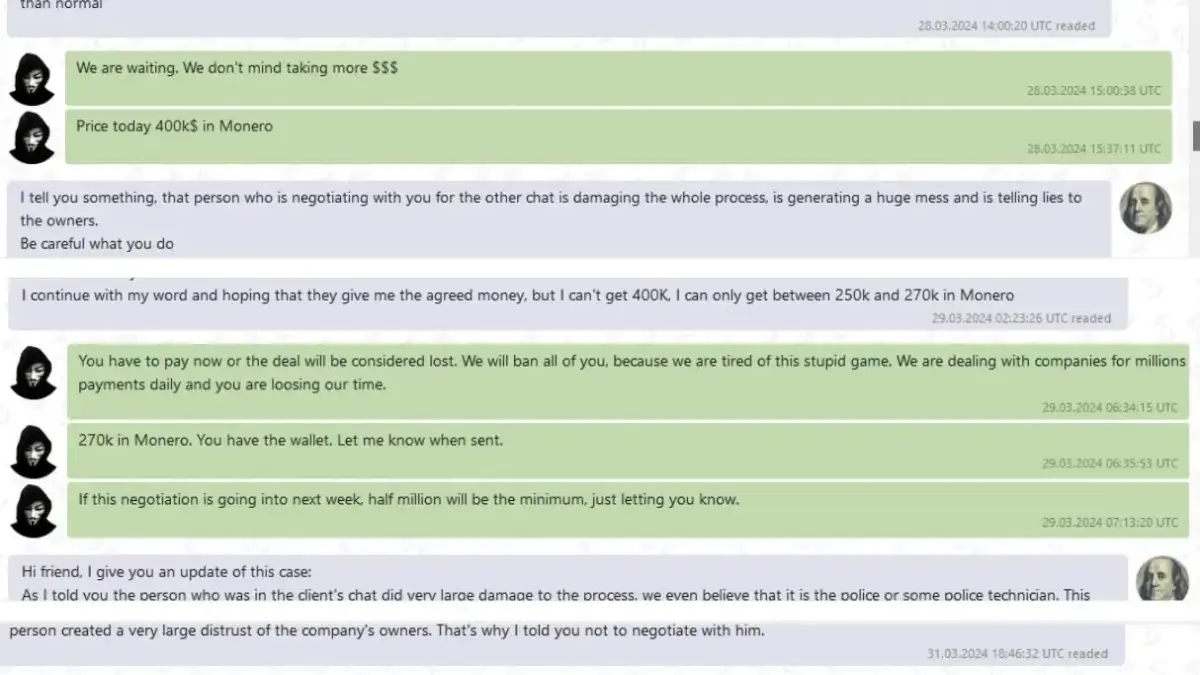
Chat transcripts retrieved from the investigation show that RansomwareHelp repeatedly implored the Lockbit gang not to reveal to the actual victim that negotiations were already underway. Nevertheless, the Lockbit representatives quickly grew frustrated by the protracted pace of the talks, warning that the victims had waited too long and that the ransom demand would automatically increase by $100,000 for each additional day that passed without a payout.
Ultimately, the accounting firm heeded Ihme’s counsel and bypassed RansomwareHelp, partnering instead with an established security firm that successfully negotiated a direct payment to Lockbit to salvage their operations.
"The victim told us, ‘If we don’t get this data back, our business is over,’" Ihme recalled. "They ended up paying half of what RansomwareHelp was going to charge them."
Archived chat logs demonstrate that RansomwareHelp kept pestering the Lockbit group to strike a deal even after it became glaringly obvious that a separate, legitimate negotiator had stepped in to represent the victim’s interests.
"I tell you something, that person who is negotiating with you for the other chat is damaging the whole process," RansomwareHelp wrote in a message to Lockbit. "Please do not change the price. I am doing my best to achieve it."

Ihme observed that RansomwareHelp intentionally cast its net across small-to-medium-sized businesses that lacked internal technical sophistication, pointing out that many of the high-sounding technical claims plastered across the company’s website and commercial proposals were patently absurd. For instance, the proposal delivered to the accounting firm boasted an ability to break six distinct types of encryption, yet proceeded to list irrelevant password hashing algorithms such as SHA-256 that have nothing to do with modern ransomware file encryption.
"If it were really true these guys could decrypt any ransomware out there, this guy would be a billionaire," Ihme said. "They were going after people who don’t have any technical knowledge, are desperate, and don’t have anyone advising them about how any of this stuff works."
The criminal case against Palacio represents just the latest salvo in an ongoing series of aggressive federal prosecutions by the U.S. Department of Justice targeting remediation and negotiation firms accused of conspiring with fraudsters to fleece corporate clients. In early October, federal authorities arrested 54-year-old Edward Dubrovsky, an executive at Canadian cybersecurity firm Cybersteward. While specific court documents detailing Dubrovsky’s case remain sealed, he currently faces serious cyber extortion and conspiracy charges.
Concurrently, the DOJ announced criminal charges against MonsterCloud CEO Zohar Pinhasi, 50, alleging wire fraud and conspiracy. Prosecutors state that Pinhasi billed corporate clients handsomely to remediate ransomware infections while secretly paying hackers behind their backs, funneled roughly $8 million to ransomware syndicates while extracting a staggering $19 million from victims.
Earlier in the year, 41-year-old ransomware negotiator Angelo Martino of Land O’Lakes, Florida, was sentenced to 70 months in prison. Martino was convicted of conspiring with the Blackcat/ALPHV ransomware group to extort multiple victims. According to the DOJ, Martino accepted payments from the BlackCat hackers in exchange for leaking confidential internal details regarding the negotiating positions and strategic decisions of his own employer’s clients, enabling the threat actors to maximize the financial extraction from distressed companies.